Two Soldiers, Two Lost Fronts: German War Diaries of the Stalingrad and North Africa Campaigns by Donald A. Gregory & William R. Gehlen
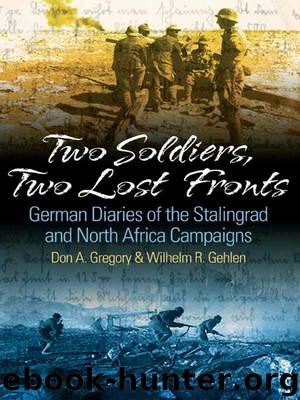
Author:Donald A. Gregory & William R. Gehlen [Gregory, Donald A.]
Language: eng
Format: mobi
Tags: Bisac Code 1: HIS027100
Publisher: Casemate
Published: 2009-07-02T04:00:00+00:00
First kill: a British Matilda tank.
A Kubelwagen (German jeep).
The Eighth Army slipped by the German and Italian defenses along the Egyptian frontier south of Halfaya Pass and circled behind them to set up positions within range of the German positions around Tobruk along the coastal road to Bardia. General Cunningham planned to strike the DAK with an armored division while XXX Corps attacked the Italian positions at Bardia. Rommel had a plan of his own, however, and confused the British by attacking the southern spear of the British thrust at Sidi Rezegh. The British drives were repelled by well manned antitank positions around Tobruk and the mobile German and Italian panzer units. At Bir el Gobi, the Italian Ariete Armored Division engaged in a fierce fighting retreat that caused far more British losses than Italian. The 21st Panzer Division repulsed the attack aimed at them and counterattacked at Gabr Saleh. The British strategy of matching their forces in individual battles against those of the Axis instead of overpowering them in numbers, was not working against the fast moving forces of the Germans. Rommel, meanwhile, launched a concentrated attack with all of his armor on November 23. The 21st Panzer held Sidi Rezegh as the Italian Ariete Division attacked the British flanks, encircling and tying up most of the British armor. Overall, the Axis forces destroyed two-thirds of the British armor and the rest retreated south to Gabr Saleh.
Rommel saw an opportunity to take advantage of British losses and inferior tactics, and on November 24 he counterattacked deep into British supply lines, called the “dash to the wire,” the wire being the frontier between Libya and Egypt. Rommel was also trying to cut off Eighth Army and relieve his garrison at Halfaya Pass. Rommel ignored the British forces in Tobruk and Bardia because he believed they would abandon those positions and pursue him, allowing him to capture Tobruk once the British forces had evacuated it. On November 26, General Cunningham ordered a withdrawal of British forces in Tobruk, but that order was immediately countermanded by General Auchinleck, who then relieved Cunningham and replaced him with General Neil Ritchie. Rommel’s plan had almost worked. The German attack, however, began to slow down because of a lack of supplies. As usual, Rommel had outrun his supply lines, and again he was roundly criticized by the German High Command for wasteful use of his resources and for disobeying orders. The strategy had nearly succeeded and would have dealt a serious blow to British forces, not to mention British pride.
During Rommel’s counterattack on the British, Allied forces in Tobruk threatened to breach the weak Axis lines there. Rommel ordered the 21st Panzer Division withdrawn from Sidi Rezegh and sent back to Tobruk as reinforcements; however, British forces sent to relieve Tobruk and the defenders inside finally were able to join forces on November 27. Rommel could do little about this because his 90th Light Division was in danger of being overrun after their dash to the wire, and he had to rescue them.
Download
This site does not store any files on its server. We only index and link to content provided by other sites. Please contact the content providers to delete copyright contents if any and email us, we'll remove relevant links or contents immediately.
Waking Up in Heaven: A True Story of Brokenness, Heaven, and Life Again by McVea Crystal & Tresniowski Alex(37899)
Still Foolin’ ’Em by Billy Crystal(36432)
Cecilia; Or, Memoirs of an Heiress — Volume 1 by Fanny Burney(32682)
Cecilia; Or, Memoirs of an Heiress — Volume 2 by Fanny Burney(32040)
Cecilia; Or, Memoirs of an Heiress — Volume 3 by Fanny Burney(32025)
Fanny Burney by Claire Harman(26682)
Empire of the Sikhs by Patwant Singh(23164)
We're Going to Need More Wine by Gabrielle Union(19133)
Hans Sturm: A Soldier's Odyssey on the Eastern Front by Gordon Williamson(18685)
Plagued by Fire by Paul Hendrickson(17494)
Out of India by Michael Foss(17000)
All the Missing Girls by Megan Miranda(16469)
Cat's cradle by Kurt Vonnegut(15487)
Pimp by Iceberg Slim(14733)
For the Love of Europe by Rick Steves(14721)
Molly's Game by Molly Bloom(14223)
Bombshells: Glamour Girls of a Lifetime by Sullivan Steve(14172)
Leonardo da Vinci by Walter Isaacson(13438)
4 3 2 1: A Novel by Paul Auster(12557)
