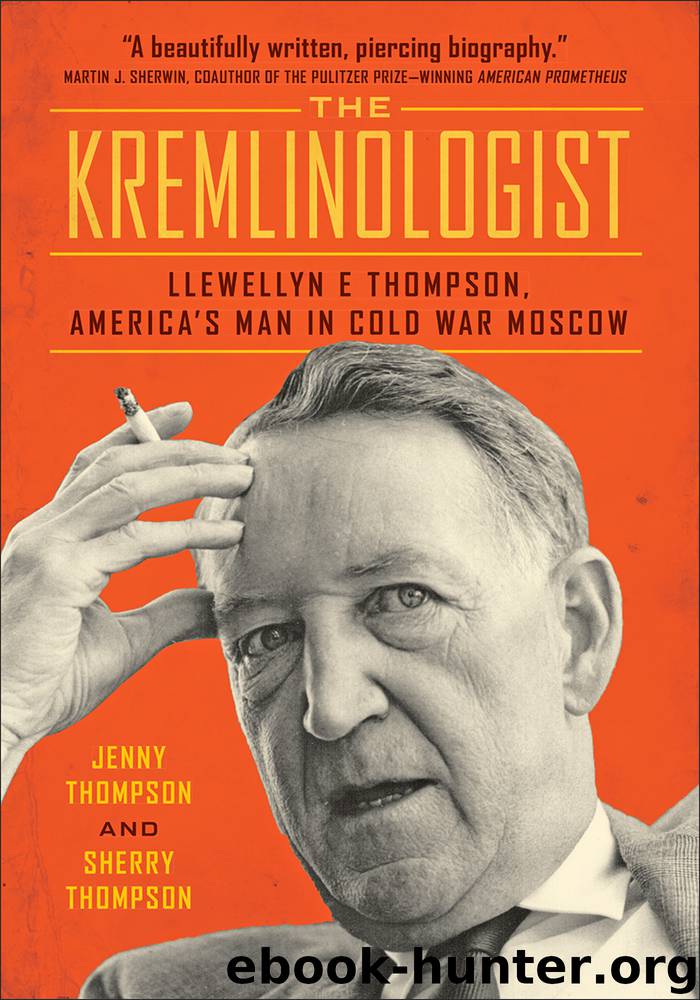
The Kremlinologist by Jenny Thompson
Author:Jenny Thompson
Language: eng
Format: epub
Publisher: Johns Hopkins University Press
Published: 2018-12-09T16:00:00+00:00
The Personal Letter
These dire indications prompted Khrushchev not to wait for the Soviet Foreign Ministry to finish drafting his letter to JFK, but to prepare one of his own. Perhaps a fear that the American military, especially hard-liners in the Pentagon, might use this opportunity to unleash war against the USSR—a possibility he had always considered plausible—prompted him to act now. Khrushchev consulted Gromyko and, most likely, Mikoyan, but he did not convene the Presidium to review his letter. It would not mention the NATO missiles. Khrushchev’s advisors weren’t too happy, but they did not openly disagree with the premier.106
At the American embassy in Moscow, at 4:43 p.m. Moscow time, political officer Richard Davies received Khrushchev’s personal letter for transmission to Washington, DC. It wasn’t unusual for the embassy to receive a letter from Khrushchev. Davies had received such letters before and would translate them, but this one was different. Two men had come over from the Soviets’ Foreign Office with a letter in Khrushchev’s own handwriting, containing margin notes in green ink. The men came off the rickety old elevator in the US embassy, panting and apologizing for delivering the letter without the usual Foreign Office seals, saying they simply did not have time for this formality. They’d come directly from the Kremlin. They were under “tremendous pressure” and were unusually polite and very nervous.107 The letter from Khrushchev arrived in Washington, DC, in four parts, via teletype, at the State Department ten hours later, between 6 and 9 p.m.
It was a remarkable letter: rambling, personal, and passionate. In it, Khrushchev spoke of the need for peace, the calamity of war, and the requirement for statesmanlike wisdom. The Soviet leader proposed that he promise none of their ships bound for Cuba would carry any armaments, and that the United States should, in turn, declare that it would “not invade Cuba with its forces and [would] not support any sort of forces which might intend to carry out an invasion of Cuba. Then the necessity for the presence of our military specialists in Cuba would disappear.”108 It was peppered with accusations of “piratical actions” and of the Americans starting the whole business. Nonetheless, Khrushchev was making the hints of the day concrete: the crisis could end with the removal of the Soviet missiles in Cuba in exchange for a US pledge not to invade that country. A group composed of some ExCom members, including Thompson, reconvened at 10:00 p.m. to read Khrushchev’s letter. They all would sleep better that night, planning to meet the next day to craft their reply.
Download
This site does not store any files on its server. We only index and link to content provided by other sites. Please contact the content providers to delete copyright contents if any and email us, we'll remove relevant links or contents immediately.
Waking Up in Heaven: A True Story of Brokenness, Heaven, and Life Again by McVea Crystal & Tresniowski Alex(37925)
Still Foolin’ ’Em by Billy Crystal(36468)
Cecilia; Or, Memoirs of an Heiress — Volume 1 by Fanny Burney(32721)
Cecilia; Or, Memoirs of an Heiress — Volume 2 by Fanny Burney(32089)
Cecilia; Or, Memoirs of an Heiress — Volume 3 by Fanny Burney(32066)
Fanny Burney by Claire Harman(26726)
Empire of the Sikhs by Patwant Singh(23205)
We're Going to Need More Wine by Gabrielle Union(19170)
Hans Sturm: A Soldier's Odyssey on the Eastern Front by Gordon Williamson(18724)
Plagued by Fire by Paul Hendrickson(17540)
Out of India by Michael Foss(17022)
All the Missing Girls by Megan Miranda(16705)
Cat's cradle by Kurt Vonnegut(15556)
For the Love of Europe by Rick Steves(14915)
Pimp by Iceberg Slim(14796)
Molly's Game by Molly Bloom(14260)
Bombshells: Glamour Girls of a Lifetime by Sullivan Steve(14219)
Leonardo da Vinci by Walter Isaacson(13514)
4 3 2 1: A Novel by Paul Auster(12614)
