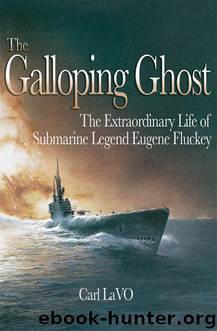
The Galloping Ghost by Carl P. LaVO
Author:Carl P. LaVO [LaVO Carl]
Language: eng
Format: epub
ISBN: 9781612510750
Publisher: Naval Institute Press
On the midafternoon of 19 December 1944 the Barb began its eleventh war patrol, bearing west toward China. Nearing Guam, the boat’s seventy-seven enlisted men and nine officers celebrated what they hoped would be their last wartime Christmas. The skipper whipped up a sampler of eggnog from an improvised recipe of powdered milk, eggs, medicinal rye whiskey, and nutmeg. The cook prepared seven gallons for the holiday. “In our own small way we’re trying to make Christmas seem like something, even way out here in nowhere,” Fluckey wrote in a letter home to be mailed from Guam. “At times we all look awfully sad and moody and everyone seems to take turns snapping the others out of it. Really, Christmas Eve is the hardest to take. One of the men’s mothers had sent me a phonograph record of his little sister singing a few songs for him and the rest of us. What a pleasant surprise it was for him when I put the record on. She had such a sweet voice. It was quite touching.”
The boat arrived at Guam on 27 December to top off fuel and make minor voyage repairs. There, the Barb rejoined Loughlin’s Loopers and continued west, the Queenfish and Picuda leading. Engine repairs while under way forced the Barb to lag behind.
Four days out from Guam the two forward submarines shelled a Japanese naval weather picket, leaving it holed and on fire. Commander Loughlin radioed the Barb to sink the vessel at Fluckey’s discretion. Closing, the skipper noticed that two fires had been extinguished forward and aft and that no flooding was apparent. He assumed the ship’s crew was hiding. With grapnels, the sub pulled alongside the hundred-ton ship and a well-armed boarding gang jumped aboard. For fifteen minutes they scoured the vessel, scooping up a sextant, charts, rifles, books, a compass, a barometer, and a radio transmitter. The submariners avoided searching the crew’s quarters, where a gunfight might break out. The sub cast off and commenced shelling the ship. Nine sailors who scrambled on deck were killed by gunfire. Assuring the ship sank, the Barb resumed its run to the west.
Arriving at the northern reach of the Formosa Strait in the predawn of 7 January, the Picuda and Barb made contact with a convoy of seven ships sprinting east from Shanghai to the port city of Keelong on the northern tip of Formosa. Though rough seas, rain squalls, and haze foiled the Barb’s attempt to attack, the Picuda heavily damaged a 10,500-ton tanker and sank a cargo ship. Afterward the wolf pack headed for the Chinese coast.
For several days all three subs patrolled the coast without success. It soon was clear the enemy had adopted new tactics. Enemy convoys—“mud-crawlers” to the submariners—now traveled only during daylight hours, when planes could protect them as they hugged the Chinese coast in shallow seas where they believed submarines wouldn’t operate. At night they holed up in shallow bays or river mouths behind mine fields and roving patrol boats.
Download
This site does not store any files on its server. We only index and link to content provided by other sites. Please contact the content providers to delete copyright contents if any and email us, we'll remove relevant links or contents immediately.
Waking Up in Heaven: A True Story of Brokenness, Heaven, and Life Again by McVea Crystal & Tresniowski Alex(37935)
Still Foolin’ ’Em by Billy Crystal(36479)
Cecilia; Or, Memoirs of an Heiress — Volume 1 by Fanny Burney(32726)
Cecilia; Or, Memoirs of an Heiress — Volume 2 by Fanny Burney(32090)
Cecilia; Or, Memoirs of an Heiress — Volume 3 by Fanny Burney(32068)
Fanny Burney by Claire Harman(26736)
Empire of the Sikhs by Patwant Singh(23209)
We're Going to Need More Wine by Gabrielle Union(19178)
Hans Sturm: A Soldier's Odyssey on the Eastern Front by Gordon Williamson(18728)
Plagued by Fire by Paul Hendrickson(17542)
Out of India by Michael Foss(17027)
All the Missing Girls by Megan Miranda(16742)
Cat's cradle by Kurt Vonnegut(15566)
For the Love of Europe by Rick Steves(14941)
Pimp by Iceberg Slim(14805)
Molly's Game by Molly Bloom(14265)
Bombshells: Glamour Girls of a Lifetime by Sullivan Steve(14223)
Leonardo da Vinci by Walter Isaacson(13532)
4 3 2 1: A Novel by Paul Auster(12628)
