Sweet Taste of Liberty by McDaniel W. Caleb;
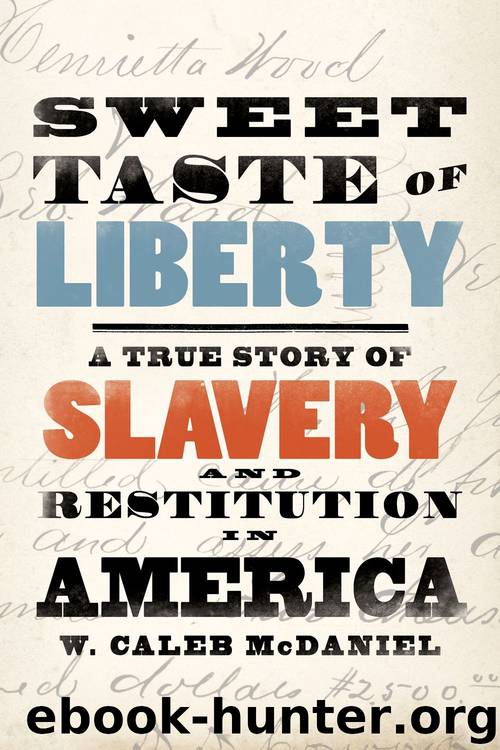
Author:McDaniel, W. Caleb;
Language: eng
Format: epub
Publisher: Oxford University Press, Incorporated
Published: 2019-07-02T16:00:00+00:00
Chapter Twenty
A Rather Interesting Case
On June 8, 1870, five days after Zebulon Ward received notice of being sued, the Cincinnati Enquirer published an item titled “A Case of Alleged Kidnapping.” “A rather interesting case has been commenced in the Superior Court of this city,” the Enquirer reported, noting that it arose “out of the custom of slavery, now supposed to be extinct.” The plaintiff was “a mulatto woman, formerly a resident of this city, who brings suit against Zeb. Ward” on charges that she had been abducted, reenslaved, and then sold to a plantation owner in Mississippi before being taken to Texas, “remaining there in the bonds of slavery until her shackles were knocked off by the lamented Mr. Lincoln.” Now the woman had returned to Cincinnati and sued Ward for $20,000 in damages, including the years of wages she had lost because of her reenslavement.1
The Enquirer story contained a number of errors about details—a flaw that would also plague subsequent accounts of the case. It named the plaintiff as “Henrietta Ward,” and Brandon became “Gerard Bronson.” Rebecca Boyd was wrongly identified as a defendant. Nonetheless, the Enquirer captured accurately enough the basic, startling truth: Henrietta Wood had filed a lawsuit against Ward in Cincinnati. “The case,” concluded the paper, was bound “to attract some attention.”2
The reasons why were not hard to see in 1870. Before abolition, freedom suits in the slave states had sometimes included claims for monetary damages, but the amounts paid or even requested in such suits had never been as high as five figures. And although some abolitionists and radical Republicans had advocated reparations of some form to the enslaved, previous efforts had fallen short.3
In 1853, for instance, not long after Wood’s abduction, a man named Solomon Northup published a memoir of his own “twelve years a slave” after being kidnapped as a free man in New York and sold to a planter in Louisiana. Abolitionists signed petitions calling for reparations for Northup, to no avail. Some abolitionists also knew the case of John Lytle, a free American kidnapped and eventually enslaved in Cuba. He was later freed and paid $2,211.33 by the Cuban government, but such an outcome had never been matched in the United States. After the Civil War, some white Republicans joined freedpeople in calling for abandoned Confederate lands or homesteads on public lands to be allotted to former slaves. Those proposals, too, had withered on the vine, along with the promises of “forty acres and a mule” that had been made by government officials during and immediately after the war.4
Everyone who heard of it knew, therefore, that Wood’s legal claim was extraordinary. Even apart from that fact, her story piqued curiosity. It stretched from Ohio and Kentucky to Mississippi and Texas. It included a colorful turfman and prison lessee. And last but not least, it featured a woman who had somehow managed to make it back from some of the darkest corners of the cotton kingdom to the city where she had been abducted seventeen years before.
Download
This site does not store any files on its server. We only index and link to content provided by other sites. Please contact the content providers to delete copyright contents if any and email us, we'll remove relevant links or contents immediately.
Waking Up in Heaven: A True Story of Brokenness, Heaven, and Life Again by McVea Crystal & Tresniowski Alex(37815)
Still Foolin’ ’Em by Billy Crystal(36363)
Cecilia; Or, Memoirs of an Heiress — Volume 1 by Fanny Burney(32563)
Cecilia; Or, Memoirs of an Heiress — Volume 2 by Fanny Burney(31962)
Cecilia; Or, Memoirs of an Heiress — Volume 3 by Fanny Burney(31945)
Fanny Burney by Claire Harman(26608)
Empire of the Sikhs by Patwant Singh(23090)
We're Going to Need More Wine by Gabrielle Union(19055)
Hans Sturm: A Soldier's Odyssey on the Eastern Front by Gordon Williamson(18596)
Plagued by Fire by Paul Hendrickson(17417)
Out of India by Michael Foss(16861)
All the Missing Girls by Megan Miranda(16053)
Cat's cradle by Kurt Vonnegut(15365)
Pimp by Iceberg Slim(14523)
For the Love of Europe by Rick Steves(14179)
Molly's Game by Molly Bloom(14149)
Bombshells: Glamour Girls of a Lifetime by Sullivan Steve(14082)
Leonardo da Vinci by Walter Isaacson(13342)
4 3 2 1: A Novel by Paul Auster(12405)
