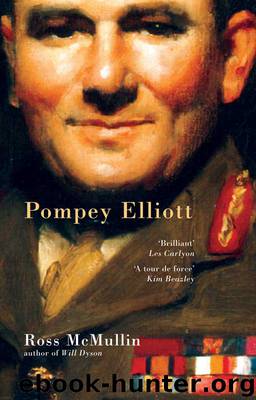
Pompey Elliott by Ross McMullin
Author:Ross McMullin
Language: eng
Format: epub
Tags: HIS000000, HIS004000, HIS027000, BIO000000
Publisher: Scribe Publications
Published: 2008-04-07T04:00:00+00:00
CHAPTER FIFTEEN
‘Never So Proud of Being an Australian’:
Resisting the German onslaught
MARCH–APRIL 1918
IN MID-MARCH 1918 German shellfire intensified in the Australian sector. In particular, a big long-range gun repeatedly harassed the 15th Brigade, then in reserve. On 18 March, after days of this unwelcome attention, Elliott asked the Fifth Division to organise subduing counter-battery fire. The same gun kept persevering on the 19th, and the following day, Elliott noted, it was ‘active all day and night’. On 21 March it was ‘very persistent and annoying all day’, inflicting casualties in the 57th and 59th Battalions, and landing several shells near his headquarters. Nearby a ‘huge one landed in the road, blew a hole some 12 feet across … and shook the whole place’. To many Australians, this increased enemy activity signified the commencement of the long-anticipated German drive for victory, and later that day came confirmation. The Germans had launched their offensive south of the Australians, in a region familiar to them — among the villages initially attacked was Bullecourt.
This development was widely welcomed in the AIF. It certainly was in the 15th Brigade, Elliott felt:
There is a feeling in the air that we are all glad he is coming, and that we will hit him up to some tune before he wins through.
Other Australians were delighted, including the official AIF correspondent Charles Bean:
My heart and spirits jumped up 100 degrees. So the German was attacking after all — he was really going to do it. The bombardment was on a front of over 50 miles! … I cannot say how relieved I felt … One hoped almost beyond hope that they would … [try to] end the war by an offensive this year. And they are doing it. One does not for a moment believe that they will succeed. The attack always loses more men than the defence; they will get 5, 10, perhaps 15 miles. They may very likely take Bapaume. But at the end of it their army will be brought up against an unbroken wall … It is not an easy time for the actual battalions in the line … But one cannot help rejoicing.
Delight soon turned to concern, then alarm. The Germans succeeded in driving the British well back. Day after day came news of ominous advances, particularly in the Somme region. On 21 March the attackers captured no fewer than 21,000 prisoners, and penetrated in one day as far as the entire 1916 British Somme offensive had managed in over four months. Bapaume fell, then Flers, Guedecourt, Montauban, and Albert. Much of the British Fifth Army under General Gough was retiring in disarray. Even Amiens, more than 40 miles west of the pre-assault front line, seemed threatened, and there was still no sign of the unbroken wall that Bean had confidently expected. A special order from Haig, the Commander-in-Chief, described the situation as ‘a crisis’. Elliott’s relatives were among countless civilians gripped by the ‘crushing tension’ expressed by Vera Brittain: ‘into our minds had crept for the first time the secret, incredible fear that we might lose the War’.
Download
This site does not store any files on its server. We only index and link to content provided by other sites. Please contact the content providers to delete copyright contents if any and email us, we'll remove relevant links or contents immediately.
Waking Up in Heaven: A True Story of Brokenness, Heaven, and Life Again by McVea Crystal & Tresniowski Alex(37939)
Still Foolin’ ’Em by Billy Crystal(36483)
Cecilia; Or, Memoirs of an Heiress — Volume 1 by Fanny Burney(32734)
Cecilia; Or, Memoirs of an Heiress — Volume 2 by Fanny Burney(32100)
Cecilia; Or, Memoirs of an Heiress — Volume 3 by Fanny Burney(32079)
Fanny Burney by Claire Harman(26739)
Empire of the Sikhs by Patwant Singh(23212)
We're Going to Need More Wine by Gabrielle Union(19194)
Hans Sturm: A Soldier's Odyssey on the Eastern Front by Gordon Williamson(18730)
Plagued by Fire by Paul Hendrickson(17547)
Out of India by Michael Foss(17030)
All the Missing Girls by Megan Miranda(16765)
Cat's cradle by Kurt Vonnegut(15574)
For the Love of Europe by Rick Steves(14965)
Pimp by Iceberg Slim(14807)
Molly's Game by Molly Bloom(14268)
Bombshells: Glamour Girls of a Lifetime by Sullivan Steve(14229)
Leonardo da Vinci by Walter Isaacson(13536)
4 3 2 1: A Novel by Paul Auster(12632)
