Karunanidhi by Sandhya Ravishankar
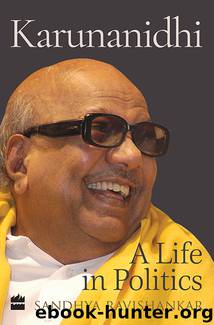
Author:Sandhya Ravishankar
Language: eng
Format: epub
Tags: null
Publisher: HarperCollins Publishers India
Published: 2018-05-27T04:00:00+00:00
6
CASES AND CONTROVERSIES
The first blot on Karunanidhi’s sparkling political career came in the form of MGR’s allegations of mismanagement of party funds in 1972. In November that year, MGR went a step further after being unceremoniously expelled from the DMK. He, along with his loyalists, sent memorandums to the President of India, asking for a Commission of Inquiry to be set up to probe corruption charges against then Chief Minister M. Karunanidhi.
Shri M. Kalyanasundaram, M.P., and five others viz S/Shri K. Baladhandayudham, M.P., K.T.K. Thangamani, M.L.A., K.T. Raju, P. Manickam, M.V. Sundaram and S. Narayanan, all of the Communist Party of India, submitted a Memorandum, dated November 6, 1972, to the President of India, making similar allegations chiefly against Shri M. Karunanidhi and his companion Ministers of the D.M.K. Government.1
The R.S. Sarkaria Commission looked into a large number of allegations of corruption made by MGR, his loyalists and the CPI. Below is a gist of the allegations made and the details of the various scams.
1)The Nathan Press Scandal: A key minister in Karunanidhi’s cabinet, Anbil Dharmalingam, was one of the many ministers named in the corruption allegations probed by the Sarkaria Commission. The commission’s first report details how Nathan Press, which was owned by Pandurangam and Kasturi Chettiar in Trichy, was in fact a benami for Dharmalingam. In 1968, shortly after the DMK first came to power, a new enterprise, Nathan Publications, was begun, with Dharmalingam’s sister Dhanamanickam as a partner along with Pandurangam and others. Two years later, the Tamil Nadu Textbook Society was formed and Nathan Publications got a plum contract for printing and distribution of textbooks despite quoting a higher rate in the bids. The report details how Nathan Publications got more and more business from the government in the ensuing years, despite having no prior experience in printing textbooks, a basic prerequisite to even participate in the bids. In enabling Dharmalingam to obtain these contracts for Nathan Publications, Minister V.R. Nedunchezhiyan was a keen facilitator.
Year2 Percentage of Commission Total Commission Allowed (Rs)
1970-71 6
7 18,496.55
16,106.12
1971-72 6
7 24,781.89
20,364.58
1972-73 10 1,80,821.32
1973-74 10 1,18,084.90
1974-75 10 1,39,817.11
1975-76 (up to 31-1-76) 12 1,82,716.08
Total Rs 7,01,188.55
The table here shows that (a) the percentage of commission paid by the government to Nathan Press for printing textbooks was higher than that for other vendors and (b) the number of contracts given to Nathan Press increased over the years.
Let us look at some more examples of corruption in the Karunanidhi government, as detailed in the Sarkaria Commission’s first report.
2)Aerial Spraying of Crops: When the Centre, under Prime Minister Indira Gandhi introduced a subsidized scheme for state governments to aerially spray pesticides on crops, Agriculture Minister Anbil Dharmalingam once again made a killing, through another benami firm called Ponni Enterprises. This was also one of the more serious charges against Karunanidhi directly as the aviation companies that won the tenders for aerial spraying deposed in detail before the Commission about how the chief minister’s private secretary, IAS officer Vaithialingam, entered the scene and demanded large sums in return for getting the contracts.
Download
This site does not store any files on its server. We only index and link to content provided by other sites. Please contact the content providers to delete copyright contents if any and email us, we'll remove relevant links or contents immediately.
Waking Up in Heaven: A True Story of Brokenness, Heaven, and Life Again by McVea Crystal & Tresniowski Alex(37935)
Still Foolin’ ’Em by Billy Crystal(36480)
Cecilia; Or, Memoirs of an Heiress — Volume 1 by Fanny Burney(32726)
Cecilia; Or, Memoirs of an Heiress — Volume 2 by Fanny Burney(32090)
Cecilia; Or, Memoirs of an Heiress — Volume 3 by Fanny Burney(32068)
Fanny Burney by Claire Harman(26736)
Empire of the Sikhs by Patwant Singh(23209)
We're Going to Need More Wine by Gabrielle Union(19178)
Hans Sturm: A Soldier's Odyssey on the Eastern Front by Gordon Williamson(18728)
Plagued by Fire by Paul Hendrickson(17542)
Out of India by Michael Foss(17027)
All the Missing Girls by Megan Miranda(16742)
Cat's cradle by Kurt Vonnegut(15566)
For the Love of Europe by Rick Steves(14942)
Pimp by Iceberg Slim(14805)
Molly's Game by Molly Bloom(14265)
Bombshells: Glamour Girls of a Lifetime by Sullivan Steve(14224)
Leonardo da Vinci by Walter Isaacson(13532)
4 3 2 1: A Novel by Paul Auster(12628)
