Kannur by Ullekh N P
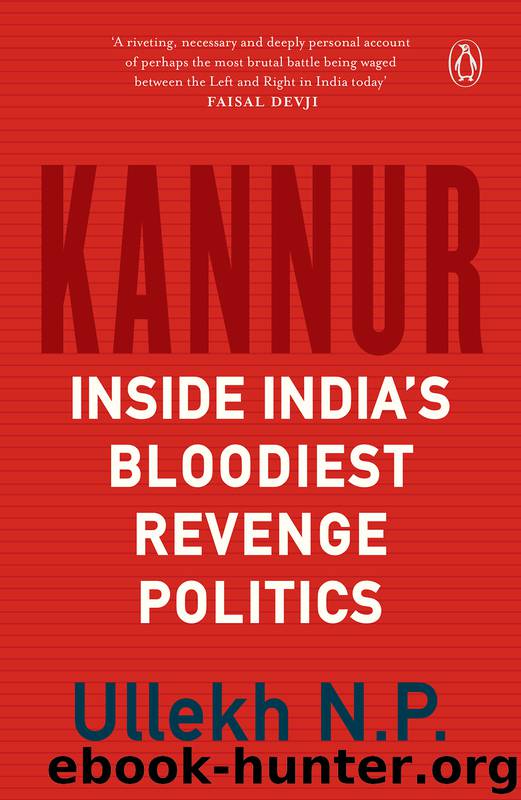
Author:Ullekh N P
Language: eng
Format: epub
ISBN: 9789353051051
Publisher: Penguin Random House India Private Limited
Published: 2018-05-29T04:00:00+00:00
6
Congress versus the Communists
In the late 1960s and ’70s, M.V. Raghavan wielded enormous power within his party after he had managed to sideline—some say with A.K. Gopalan’s covert help—senior leaders from trade unions (like in the case of C. Kannan) and farmer organizations (like in the case of A.V. Kunhambu), who were pivotal to the growth of the party in Kannur for more than three decades. In the run-up to the 1980s, many of his seniors and contemporaries who could have posed a threat to him either left the party, died or were killed, leaving him to deal mostly with yes-men and a small band of young rebels and old-timers who had to grin and bear the humiliation of his ruthless dominance, until an opportunity struck many years later.1
For the CPI(M), the slide in interest in peasant struggles and hard-line trade unionism was in line with the thinking among a section of the national party leaders, who largely believed that such activities tended to put the movement more on the revolutionary path while they were yearning to sail along the parliamentary route to power and formulate policy decisions for the disadvantaged and the marginalized. Alternatively, throughout India, communists were determined to place more emphasis on promoting student and youth feeder wings. With Indira Gandhi unofficially giving the nod for a large section of leftists to dominate the intellectual realm in exchange for leaving the political space to the Congress, such a shift in strategy, deliberate or otherwise, was irresistible.
Interestingly, MVR’s brand of domination accompanied the decline of one brawny politician and the rise of another. And that gave no gap to experiment with peaceful political means, which would have meant ceding power to far more sober colleagues.
P.R. Kurup was a socialist leader who had made his entry into politics at the age of twenty in 1935. He claims in his autobiography, Ente Naadinte Katha, Enteyum (The Story of My Birthplace, and Mine), that he had fought feudal lords and their influence in his village. It is evident that he got attracted by socialism early in his life and had a band of supporters who would do anything for him. As a young man, he was charismatic and started off as a member and later as a leader of the PSP, a party formed by Jayaprakash Narayan after he disbanded the CSP. As decades went by, in a series of political shifts and realignments, he also worked with the Samyukta Socialist Party, Janata Party and the Janata Dal. Until the mid-1960s, he had been an anti-communist despite the fact that he had worked with some of them in the CSP (and maintained good relations with them, especially with P. Ramamurti, a founder politburo member of the CPI(M). Horror tales of people being thrashed by Kurup2 or his supporters were endless in Panoor, Pathayakkunnu, Pathippalam, Pattiam, Kathiroor and other places. One of my paternal uncles once narrated to me how the men would arrive from nowhere and begin to beat up people, tearing off their shirts and mundus, and leaving before anyone could figure out what was going on.
Download
This site does not store any files on its server. We only index and link to content provided by other sites. Please contact the content providers to delete copyright contents if any and email us, we'll remove relevant links or contents immediately.
Waking Up in Heaven: A True Story of Brokenness, Heaven, and Life Again by McVea Crystal & Tresniowski Alex(37935)
Still Foolin’ ’Em by Billy Crystal(36479)
Cecilia; Or, Memoirs of an Heiress — Volume 1 by Fanny Burney(32726)
Cecilia; Or, Memoirs of an Heiress — Volume 2 by Fanny Burney(32090)
Cecilia; Or, Memoirs of an Heiress — Volume 3 by Fanny Burney(32068)
Fanny Burney by Claire Harman(26736)
Empire of the Sikhs by Patwant Singh(23209)
We're Going to Need More Wine by Gabrielle Union(19178)
Hans Sturm: A Soldier's Odyssey on the Eastern Front by Gordon Williamson(18728)
Plagued by Fire by Paul Hendrickson(17542)
Out of India by Michael Foss(17026)
All the Missing Girls by Megan Miranda(16742)
Cat's cradle by Kurt Vonnegut(15566)
For the Love of Europe by Rick Steves(14941)
Pimp by Iceberg Slim(14805)
Molly's Game by Molly Bloom(14264)
Bombshells: Glamour Girls of a Lifetime by Sullivan Steve(14223)
Leonardo da Vinci by Walter Isaacson(13532)
4 3 2 1: A Novel by Paul Auster(12628)
