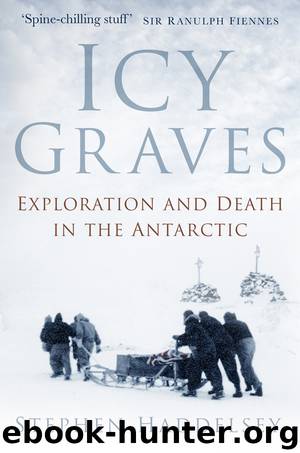
Icy Graves by Stephen Haddelsey
Author:Stephen Haddelsey
Language: eng
Format: epub
Publisher: The History Press
When Discovery sailed from Dartmouth on 24 September 1925, it seemed to many of those on board that they had embarked on a great adventure: an opportunity to study nature at her harshest, among towering seas and on the edges of a mysterious and beautiful land of ice. Stenhouse, whose character was essentially romantic in nature, shared their enthusiasm and he admitted to one journalist that he found ‘a peculiar and poetic interest in the Discovery going into the very latitude where her first commander perished’.40 Kemp thought differently. As far as he was concerned, the expedition would be undertaken on rigidly scientific lines, with little or no place for the kind of muscular exploration which Stenhouse loved and which his old leader, Shackleton, had come to epitomise. Moreover, the science was driven by hard-nosed economic reality. The accumulation of knowledge for the broader benefit of mankind would be countenanced only where such activities complemented the purpose of the expedition, and of exploration for exploration’s sake there would be none. ‘Our work will be in connection with whaling,’ he told polar historian Hugh Mill, ‘in all probability we shall not cross the Antarctic Circle and I fear we may have little opportunity for coastal surveys.’41
Despite this marked difference in outlook, the initial cause of tension between the two men was Discovery herself. Like many ships designed for work in the ice, she rolled abominably in open water; so abominably, indeed, that Henry Herdman, the expedition’s hydrologist, thought ‘she’d roll in the lake at Wembley!’42 Such a tendency made the ship fundamentally unsuited to the work of the expedition, which required the frequent completion of ‘stations’, each station consisting of a detailed observation on a vertical line into the ocean’s depths. With Discovery constantly rolling and pitching even in moderate seas, the lines were continually dragged from the vertical, making the critical assessment of the depth from which the samples were taken quite impossible. As a result, a significant proportion of the results were compromised.
Stenhouse quickly recognised that the old ship was unsuited to the work, but to him, whatever her faults, Discovery remained a thing of legend and the feelings of nostalgia when he trod her decks, particularly in an ice-strewn seascape, were strong. Kemp, on the other hand, had little time for such emotions and he felt no compunction in sharing his disappointment and frustration with the expedition committee. ‘It is … to the unsuitability of the ship,’ he told them, ‘that our lack of success is mainly to be attributed.’43 In his professional judgement, Discovery had failed and should be replaced as quickly as possible with a vessel better suited to the task in hand. Relations between the two men remained cordial, but the seeds for future discord had been sown.
The pressure mounted. In June 1926, when Discovery reached Simonstown Naval Dockyard for an essential refit, Stenhouse admitted to his wife, ‘I have had quite a lot of worry and trouble through breaches of discipline and I get rather tired of it.
Download
This site does not store any files on its server. We only index and link to content provided by other sites. Please contact the content providers to delete copyright contents if any and email us, we'll remove relevant links or contents immediately.
Waking Up in Heaven: A True Story of Brokenness, Heaven, and Life Again by McVea Crystal & Tresniowski Alex(37887)
Still Foolin’ ’Em by Billy Crystal(36424)
Cecilia; Or, Memoirs of an Heiress — Volume 1 by Fanny Burney(32654)
Cecilia; Or, Memoirs of an Heiress — Volume 2 by Fanny Burney(32025)
Cecilia; Or, Memoirs of an Heiress — Volume 3 by Fanny Burney(32005)
Fanny Burney by Claire Harman(26676)
Empire of the Sikhs by Patwant Singh(23150)
We're Going to Need More Wine by Gabrielle Union(19121)
Hans Sturm: A Soldier's Odyssey on the Eastern Front by Gordon Williamson(18665)
Plagued by Fire by Paul Hendrickson(17483)
Out of India by Michael Foss(16992)
All the Missing Girls by Megan Miranda(16411)
Cat's cradle by Kurt Vonnegut(15468)
Pimp by Iceberg Slim(14711)
For the Love of Europe by Rick Steves(14659)
Molly's Game by Molly Bloom(14216)
Bombshells: Glamour Girls of a Lifetime by Sullivan Steve(14152)
Leonardo da Vinci by Walter Isaacson(13427)
4 3 2 1: A Novel by Paul Auster(12544)
