Fingers by Richard Curran
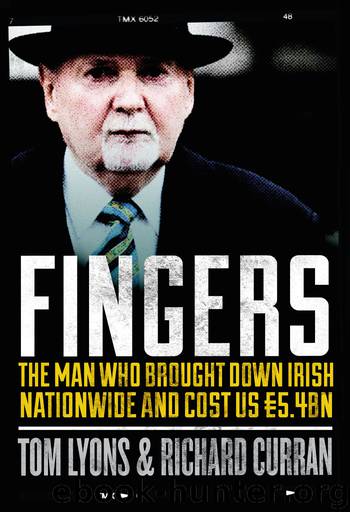
Author:Richard Curran [Lyons, Tom and Curran, Richard]
Language: eng
Format: epub
ISBN: 9780717155811
Publisher: Gill & Macmillan
As these talks went back and forth, the credit market continued its vice-like tightening. Drumm told FitzPatrick to meet Lenihan to discuss the possibility of Irish Nationwide merging with Anglo Irish. They met in Lenihan’s private office in Merrion Street. It was the first time the two men had met. Kevin Cardiff, the civil servant in charge of banking, was also in attendance.
‘Basically what they were talking about was Anglo,’ FitzPatrick said. ‘It was a lead on the whole issue of Irish Nationwide. I spoke to him about that but I didn’t really speak to him.’
Lenihan was preoccupied and kept getting up to take phone calls. FitzPatrick thought he would have encouraged a merger, as it was Neary’s idea, but no dice. ‘He wasn’t really interested,’ FitzPatrick said.
Lenihan seemed to know that bolting two wrecks together wouldn’t solve anything. He had more to think about than the views of Seán FitzPatrick. Irish banking was falling apart, and he knew that it was almost inevitable that Irish Nationwide would continue to be downgraded. He became anxious to get his own eyes and ears at the society’s boardroom table, someone he could trust to tell him what was going on.
On 10 September the society announced that it had beefed up its flimsy board with the appointment of Seán Carey, a former assistant city manager of Dublin, as a non-executive director. Carey was hardly a banking heavy-hitter but he knew something about finance from his days with Dublin City Council, and was uncompromised, unlike others who had been on the board for too long. This happened the same day that Fitch, another rating agency, followed Moody’s and downgraded Irish Nationwide, moving it from A– to BBB+ or seven levels below its former AAA rating, the highest level. Fitch welcomed the appointment of Carey as a step towards strengthening the society’s corporate governance but also fretted about its huge exposure to commercial and residential property.
Irish Nationwide knew better, of course, than either Fitch or Moody’s. Responding to its downgrading, it said it ‘fundamentally disagrees’ with both and that their views did ‘not reflect the underlying financial strength of the society. It is important to emphasise that the society is and continues to be a strong, profitable financial institution and that profit budgeting projections are on target for the first half of 2008.’
The society said it had made a profit of €391 million in 2007 and expected to have earnings in 2008 that would again be greater than the EBS, First Active, ACC and National Irish Bank combined.
Fitch wasn’t as convinced of the society’s brilliance. It noted that it had billions to refinance over the coming fifteen months. ‘The increasing cost of funding, together with reduced revenue from lower volumes of business, has begun to impact profitability,’ it said, ‘although, currently, performance ratios remain strong.’
Within days, Irish Nationwide’s views of its own prospects would be shown to be woefully out of touch with the emerging harsh reality for banks around the world.
On 15 September the crisis reached a new apex: Lehman Brothers fell.
Download
This site does not store any files on its server. We only index and link to content provided by other sites. Please contact the content providers to delete copyright contents if any and email us, we'll remove relevant links or contents immediately.
Waking Up in Heaven: A True Story of Brokenness, Heaven, and Life Again by McVea Crystal & Tresniowski Alex(37925)
Still Foolin’ ’Em by Billy Crystal(36468)
Cecilia; Or, Memoirs of an Heiress — Volume 1 by Fanny Burney(32721)
Cecilia; Or, Memoirs of an Heiress — Volume 2 by Fanny Burney(32089)
Cecilia; Or, Memoirs of an Heiress — Volume 3 by Fanny Burney(32066)
Fanny Burney by Claire Harman(26726)
Empire of the Sikhs by Patwant Singh(23205)
We're Going to Need More Wine by Gabrielle Union(19170)
Hans Sturm: A Soldier's Odyssey on the Eastern Front by Gordon Williamson(18724)
Plagued by Fire by Paul Hendrickson(17540)
Out of India by Michael Foss(17022)
All the Missing Girls by Megan Miranda(16704)
Cat's cradle by Kurt Vonnegut(15556)
For the Love of Europe by Rick Steves(14914)
Pimp by Iceberg Slim(14796)
Molly's Game by Molly Bloom(14260)
Bombshells: Glamour Girls of a Lifetime by Sullivan Steve(14219)
Leonardo da Vinci by Walter Isaacson(13514)
4 3 2 1: A Novel by Paul Auster(12614)
