Half - Lion: How P.V. Narasimha Rao Transformed India by Vinay Sitapati
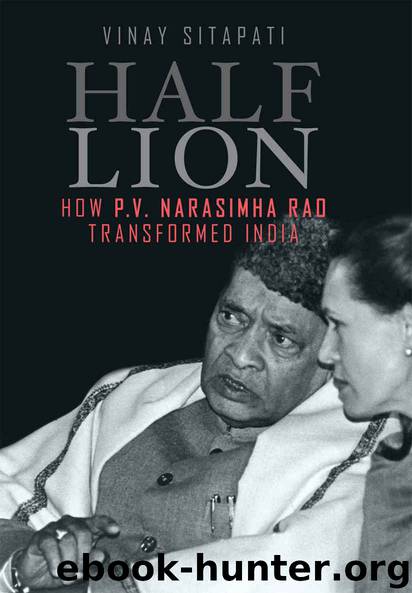
Author:Vinay Sitapati [Sitapati, Vinay]
Language: eng
Format: epub
ISBN: 9789386057723
Publisher: Penguin Books Ltd
Published: 2016-06-26T22:00:00+00:00
The secret to Narasimha Rao’s steady climb up the Congress ladder was simple and bears repeating. He lacked a power base, a coterie that threatened others. As he told a confidant, ‘You have known me for so long. The party and party leader are supreme to me. Never have I attempted to build a base of my own . . . I have never drawn anybody closer or kept anybody at a distance.’18
Now that he was finally at the top of the ladder, Narasimha Rao realized that he needed a team of his own.
His economic line-up had been assembled in the first months of his premiership, as we saw in the chapter on how Rao rescued the economy. By March 1992, his political team was taking shape. Principal Secretary Amar Nath Varma and Cabinet Secretary Naresh Chandra were as central to Rao’s politics as they were to his economics. He also brought back two advisors from the past. P.V.R.K. Prasad had served chief minister Rao in the 1970s. Twenty years later, he was appointed the prime minister’s voice to mediamen, businessmen and godmen. Prasad would go on to administer the Tirupati temple, become the monk that Rao never could, and remain on good terms with Rao’s children in Hyderabad.
If Prasad represented the older, Hindu world that was central to Rao’s disposition, Ramu Damodaran embodied Rao’s more modern side. Damodaran had previously served under foreign minister Rao in the 1980s. He was scrupulous, urbane, and had spent years working in New York. He came back to work as the prime minister’s private secretary. ‘Ramu was like family,’ Prabhakara Rao remembers. While Rao treated Damodaran as his son, he was careful to insulate his earnest protégé from his more Machiavellian schemes.
In the durbar culture of Delhi, blessed are the gatekeepers. Jawaharlal Nehru’s secretary, M.O. Mathai, controlled access to India’s first prime minister. Indira Gandhi’s stenographer, R.K. Dhawan, rose to power because he was in charge of her appointments. So it was with Vincent George, secretary first to Rajiv, then Sonia Gandhi. Narasimha Rao’s gatekeeper was R.K. Khandekar. Given to wearing safari suits and thick, black-rimmed glasses, Khandekar was entirely loyal and utterly discreet. He was an officer from the Maharashtra civil service, and knew leaders from across the political spectrum, including the RSS.
Bhuvanesh Chaturvedi, from Rajasthan, was another of Rao’s conduits to the right wing, especially to BJP leader Atal Bihari Vajpayee. When it came to managing Parliament, Rao deployed V.C. Shukla and Subramanian Swamy. And he cultivated M.S. Bitta, Matang Sinh, Kumaramangalam, Rajesh Pilot and Jitendra Prasada as his eyes and ears within the Congress.19
These relationships were as unsentimental as they were instrumental. Jairam Ramesh, whom Rao used only to later discard, says that Rao ‘had contempt for Congressmen. He never had a kind word for anyone.’ As K. Natwar Singh—a friend whom Rao eventually sidelined—put it, ‘[Rao was] capable of radioactive sarcasm. He smiled without a smile.’20
Rao tolerated, perhaps even encouraged, rivalry within his inner circle. A.N. Varma and Naresh Chandra were larger than life, filling any room they occupied.
Download
This site does not store any files on its server. We only index and link to content provided by other sites. Please contact the content providers to delete copyright contents if any and email us, we'll remove relevant links or contents immediately.
Waking Up in Heaven: A True Story of Brokenness, Heaven, and Life Again by McVea Crystal & Tresniowski Alex(37815)
Still Foolin’ ’Em by Billy Crystal(36363)
Cecilia; Or, Memoirs of an Heiress — Volume 1 by Fanny Burney(32562)
Cecilia; Or, Memoirs of an Heiress — Volume 2 by Fanny Burney(31959)
Cecilia; Or, Memoirs of an Heiress — Volume 3 by Fanny Burney(31945)
Fanny Burney by Claire Harman(26607)
Empire of the Sikhs by Patwant Singh(23090)
We're Going to Need More Wine by Gabrielle Union(19053)
Hans Sturm: A Soldier's Odyssey on the Eastern Front by Gordon Williamson(18596)
Plagued by Fire by Paul Hendrickson(17417)
Out of India by Michael Foss(16861)
All the Missing Girls by Megan Miranda(16052)
Cat's cradle by Kurt Vonnegut(15365)
Pimp by Iceberg Slim(14522)
For the Love of Europe by Rick Steves(14174)
Molly's Game by Molly Bloom(14149)
Bombshells: Glamour Girls of a Lifetime by Sullivan Steve(14081)
Leonardo da Vinci by Walter Isaacson(13341)
4 3 2 1: A Novel by Paul Auster(12405)
