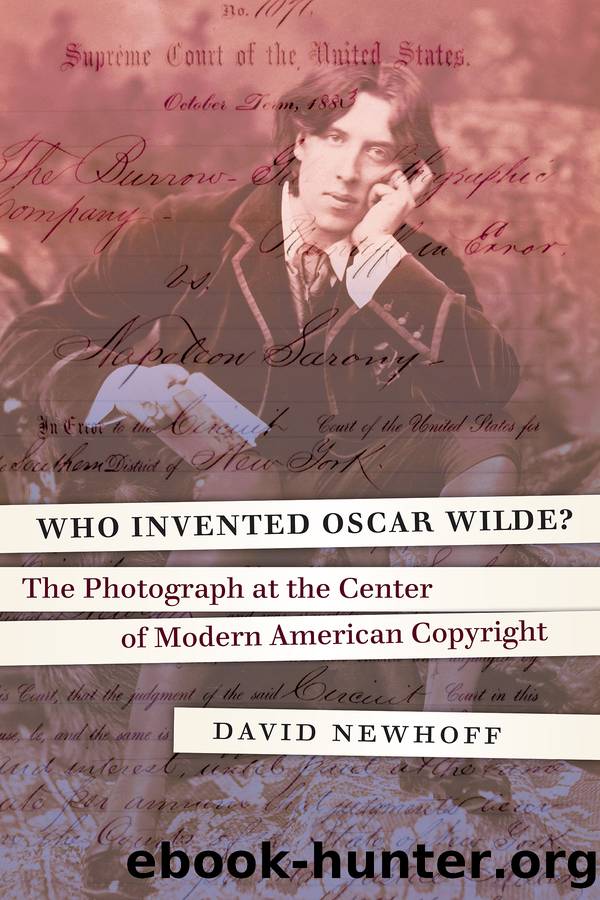
Who Invented Oscar Wilde? by David Newhoff
Author:David Newhoff [Newhoff, David]
Language: eng
Format: epub
Tags: PHO010000 Photography / History, LAW050010 Law / Intellectual Property / Copyright, LAW060000 Law / Legal History
Publisher: University of Nebraska Press
Thereâs that word âusefulâ again, linking the constitutional language for patent law to a landmark copyright decision, but the relevance of this part of the opinion was its holding that at least some photographs revealed âauthorshipâ where the court could readily identify creative decisions made by the photographerâeven if that recognition was rudimentary by modern standards. For instance, Sarony did not âselect the costumeâ per seâit was the costume of the Apollo Lodge at Oxford that Wilde would wear often during his lecture tourâand it is possible that neither Gurlitz nor the court was necessarily aware of any of the more subtle forms of control Sarony had exerted to produce the final image. Instead, the emphasis on the more obvious selected elementsâthe pose, the draperies, etc.âwas aided by a familiarity with painting, which provided the justices a language in which to explain authorship in this particular photograph.14 Consequently, the court had little difficulty in recognizing that of course Sarony did not invent Oscar Wilde, but that he had most certainly invented âOscar Wilde No. 18.â
This naturally raises the question as to how this case might have gone had the photograph under scrutiny been one of the more typical portraits of the ageâsome figure photographed against a plain backgroundâwhich might have been much more conducive to Calmanâs arguments. It seems possible that a photographer in that hypothetical case might have lost his claim of copyright in the individual work but that the court still would not have held that the addition of photographs to copyright law was unconstitutional, least of all based on Calmanâs reliance on the âliteraryâ essence of the IP clause. Millerâs opinion specifically notes that many of the same men who were present at the nationâs founding also ratified the 1790 law protecting maps and charts (even ahead of books) and then amended copyright in 1802 to embrace prints, which produced no argument against the addition during the intervening eighty years. He states, âUnless, therefore, photographs can be distinguished in the classification of this point from the maps, charts, designs, engravings, etchings, cuts, and other prints, it is difficult to see why congress cannot make them the subject of copyright as well as the others. These statutes certainly answer the objection that books only, or writing, in the limited sense of a book and its author, are within the constitutional provision.â15
Although the decision in Saronyâs case against Burrow-Giles was not especially challenging for the court, it was a significant threshold bridging the premodern, literary, manual, inky world in which copyrightâs raw elements first appeared and the purely metaphysical universe of the mind and a more egalitarian notion of what it means to create and own intellectual property. âSarony was the first great copyright-meets-technology decision of the United States copyright law and sets a tone of technological neutrality that is still with us,â writes Hughes.16 Calman was correct when he argued that anyone willing to acquire a little skill could make a photograph. Even the daguerreotype, as cumbersome a
Download
This site does not store any files on its server. We only index and link to content provided by other sites. Please contact the content providers to delete copyright contents if any and email us, we'll remove relevant links or contents immediately.
The Great Music City by Andrea Baker(33722)
Aircraft Design of WWII: A Sketchbook by Lockheed Aircraft Corporation(32385)
Call Me by Your Name by André Aciman(20736)
The Secret History by Donna Tartt(19476)
The Art of Boudoir Photography: How to Create Stunning Photographs of Women by Christa Meola(18763)
Shoot Sexy by Ryan Armbrust(17854)
Plagued by Fire by Paul Hendrickson(17541)
Portrait Mastery in Black & White: Learn the Signature Style of a Legendary Photographer by Tim Kelly(17107)
Adobe Camera Raw For Digital Photographers Only by Rob Sheppard(17097)
Photographically Speaking: A Deeper Look at Creating Stronger Images (Eva Spring's Library) by David duChemin(16800)
Ready Player One by Cline Ernest(15149)
Pimp by Iceberg Slim(14804)
Bombshells: Glamour Girls of a Lifetime by Sullivan Steve(14221)
The Goal (Off-Campus #4) by Elle Kennedy(13968)
Art Nude Photography Explained: How to Photograph and Understand Great Art Nude Images by Simon Walden(13147)
Kathy Andrews Collection by Kathy Andrews(12098)
The Priory of the Orange Tree by Samantha Shannon(9365)
The remains of the day by Kazuo Ishiguro(9226)
Thirteen Reasons Why by Jay Asher(9127)
