Where the Other Half Lives by Glynn Sarah;
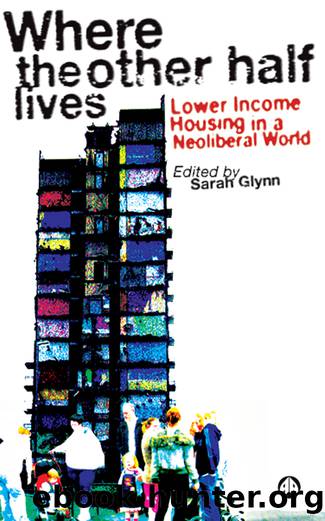
Author:Glynn, Sarah;
Language: eng
Format: epub
Publisher: Pluto Press
7
CIRCUMVENTING CIRCUMSCRIBED NEOLIBERALISM: THE âSYSTEM SWITCHâ IN SWEDISH HOUSING
Eric Clark and Karin Johnson
Sweden is an example of what might be called âcircumscribed neoliberalizationâ, and its generally superior social condition reflects that fact.
David Harvey, 20051
During the middle decades of the twentieth century, the social democratic welfare state in Sweden succeeded in institutionalising the redistribution of prosperity, while maintaining a market economy, to a greater extent than perhaps any other country. Often considered the most generous social welfare system in the world, the âSwedish modelâ ensures general access to basic human needs such as health care, education and housing. Or rather, it used to. Since the early 1990s, the housing sector has been radically reformed in accordance with neoliberal ideology, with far-reaching consequences for the increasingly polarised poor and rich. This chapter provides a brief historical background to Swedish housing before outlining how the neoliberalisation of the housing sector in Sweden has radically changed housing conditions, circumventing hindrances to the otherwise relatively circumscribed neoliberalism of the Swedish welfare state.
Housing in Sweden: A Brief Historical Overview
Historically, Sweden has been at one extreme of the housing policy spectrum, emphasising interest-rate subsidies to investment, neutrality between tenures, generous overall benefits to housing both in the form of general subsidy and income-related benefits, and low risks to financiers, investors and households alike.
Bengt Turner and Christine Whitehead, 20022
The complex social system of housing provision in Sweden, sometimes referred to as a socialist market system, was politically constructed in the 1930s and 1940s and came to be a pillar of the Swedish social democratic welfare state. Continuously modified to overcome challenges and problems â some of which were generated by its own successes and failures â and with considerable variation between municipalities across Sweden, the system was part and parcel of Social Democratic popularity and dominance in Swedish politics since the 1930s, catering as it did to the basic needs of the broad working and middle classes. In many international comparative analyses, Swedenâs post-war housing policies and programmes have been deemed âphenomenally successful both qualitatively and quantitativelyâ.3 The historical and political contexts and the genesis of the system have been described and analysed in considerable detail in the voluminous literature on housing in Sweden. Here, only the very broad strokes can be outlined.
Housing conditions among the working population in Sweden during the first decades of the twentieth century were miserable â indeed, among the worst in Europe. An early effort at regulation focused on land policy to curtail speculation, with legislation in 1907 providing for municipal right of site leasehold, encouraging municipal ownership of housing land and control over land development.4 The First World War brought housing construction to a standstill. Following the war, the most severe housing problems were addressed with rapidly built, poor-quality and short-lived housing for the most deprived, constructed under municipal or state programmes; rent control was instated to combat post-war inflation, and a temporary system of subsidies and credits was established that ran from 1917 to 1922.
The labour movement, consolidating in strong unions, took an active interest in housing issues.
Download
This site does not store any files on its server. We only index and link to content provided by other sites. Please contact the content providers to delete copyright contents if any and email us, we'll remove relevant links or contents immediately.
Spell It Out by David Crystal(36108)
Life for Me Ain't Been No Crystal Stair by Susan Sheehan(35794)
Cecilia; Or, Memoirs of an Heiress — Volume 1 by Fanny Burney(32536)
Cecilia; Or, Memoirs of an Heiress — Volume 2 by Fanny Burney(31934)
Cecilia; Or, Memoirs of an Heiress — Volume 3 by Fanny Burney(31925)
The Great Music City by Andrea Baker(31911)
Professional Troublemaker by Luvvie Ajayi Jones(29644)
We're Going to Need More Wine by Gabrielle Union(19030)
The Secret History by Donna Tartt(19025)
Twilight of the Idols With the Antichrist and Ecce Homo by Friedrich Nietzsche(18617)
All the Missing Girls by Megan Miranda(15922)
Cat's cradle by Kurt Vonnegut(15324)
Pimp by Iceberg Slim(14476)
Bombshells: Glamour Girls of a Lifetime by Sullivan Steve(14046)
For the Love of Europe by Rick Steves(13854)
Talking to Strangers by Malcolm Gladwell(13340)
Norse Mythology by Gaiman Neil(13332)
Fifty Shades Freed by E L James(13228)
The Social Justice Warrior Handbook by Lisa De Pasquale(12182)
