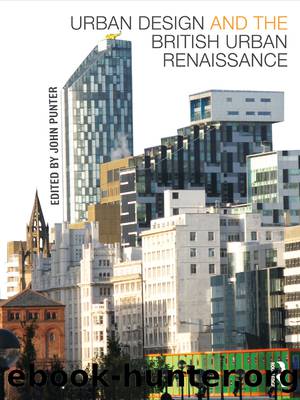
Urban Design and the British Urban Renaissance by Punter John;
Author:Punter, John; [JOHN PUNTER]
Language: eng
Format: epub
Publisher: Taylor & Francis Group
Published: 2011-10-22T00:00:00+00:00
11 Kingâs Cross
Renaissance for whom?
Michael Edwards
Introduction
This chapter examines the planning and development history of the area around Kingâs Cross station on the northern edge of central London, picking up the story in the late 1980s and concentrating on the last decade. In the late 1980s London was in the grip of a major property boom, an outcome of the deregulation of the Thatcher period, in which a speculative surge in office property development was replacing and expanding the building stock of central London, pushing upwards but also outwards and lapping at areas such as Kingâs Cross.
At its core, London is polycentric, with its main concentrations of activity around the Bank of England in the Roman and medieval âCityâ; the Westminster focus of government, royalty and diplomacy; and with shopping and entertainment just to the west and north of Westminster. Between these eastern and western poles lie areas in Fleet Street, Holborn and Covent Garden which have transformed dramatically in the twentieth century with the exodus of wholesale vegetable trading from Covent Garden and of newspapers and printing from Fleet Street, and the assimilation of the urban fabric into retail, entertainment and cultural uses in Covent Garden, and with offices in Holborn and Fleet Street strongly linked to the legal profession. The whole of this âcentreâ is ringed by the Circle Line of the underground.
Kingâs Cross lies on the northern edge of this centre, extremely well connected by underground and surface railways. However, it had long been a Cinderella district, shunned by big business. It lies in the valley of the River Fleet, which, running from Hampstead to the Thames at Blackfriars, had long been associated with insanitary living conditions, poverty and mess. In the second half of the twentieth century the district suffered severe blight caused by the disinvestment in the railways, and by planning uncertainty about how the awkward traffic intersections should be handled. It was thus, by the 1980s, the lowest-rent area for central London offices and with a commercial building stock mostly unchanged since the nineteenth century. Buildings of the twentieth century were all either social housing â the product of massive building by the London County Council (LCC) and two socialist boroughs â or public buildings, of which the outstanding example was the new British Library. The area was thus densely populated with working-class and other council tenants, and with a distinctive set of local enterprisesâ virtually none of them corporate â taking advantage of cheap yet accessible premises.
The experience of the Kingâs Cross area merits analysis because it is in many respects a microcosm (Edwards 1992), representative of wider processes going on in the city and in society. The analysis thus has to touch on what has been happening in society at large and its spatial development, on the changing dynamics of the economy and of property development, on the weakening planning and local government system and its continuing reconstitution, since the 1970s, as subordinate to business interests. Within this turbulent history, design and planning
Download
This site does not store any files on its server. We only index and link to content provided by other sites. Please contact the content providers to delete copyright contents if any and email us, we'll remove relevant links or contents immediately.
Spell It Out by David Crystal(36109)
Life for Me Ain't Been No Crystal Stair by Susan Sheehan(35800)
Cecilia; Or, Memoirs of an Heiress — Volume 1 by Fanny Burney(32544)
Cecilia; Or, Memoirs of an Heiress — Volume 2 by Fanny Burney(31940)
Cecilia; Or, Memoirs of an Heiress — Volume 3 by Fanny Burney(31928)
The Great Music City by Andrea Baker(31915)
Professional Troublemaker by Luvvie Ajayi Jones(29648)
The Secret History by Donna Tartt(19045)
We're Going to Need More Wine by Gabrielle Union(19033)
Twilight of the Idols With the Antichrist and Ecce Homo by Friedrich Nietzsche(18620)
All the Missing Girls by Megan Miranda(15942)
Cat's cradle by Kurt Vonnegut(15331)
Pimp by Iceberg Slim(14481)
Bombshells: Glamour Girls of a Lifetime by Sullivan Steve(14050)
For the Love of Europe by Rick Steves(13891)
Talking to Strangers by Malcolm Gladwell(13344)
Norse Mythology by Gaiman Neil(13343)
Fifty Shades Freed by E L James(13231)
The Social Justice Warrior Handbook by Lisa De Pasquale(12185)
