The Sistine Secrets by Benjamin Blech & Roy Doliner
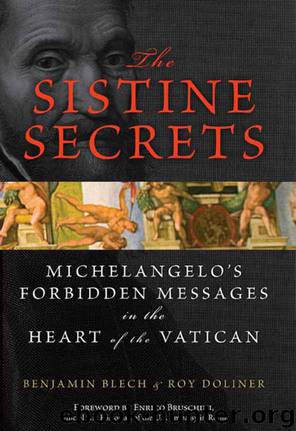
Author:Benjamin Blech & Roy Doliner [Blech, Benjamin & Doliner, Roy]
Language: eng
Format: epub, mobi, azw3
Tags: Non-Fiction, History, Art, Religion
ISBN: 9780061469053
Publisher: HarperOne
Published: 2008-04-29T07:00:00+00:00
Chapter Eleven
A COMPANY OF PROPHETS
With all forms of wisdom has she built her house,
she carved out its seven pillars.
—PROVERBS 9:1
THEY LOOM OVER US, sixty-five feet in the air, these giant figures from the ancient world. They are not looking down at us, though. They have something much more important on their minds: the future. They are a strangely assorted group: pagan female fortune-tellers and Jewish male prophets. In a sense, they are polar opposites. The empires represented by the sibyls—Egyptian, Babylonian, Persian, Greek, Roman—tried, one after another, to wipe out the Jews and Judaism. Conversely, the seven selected Hebrew prophets preached fervently for the eradication of pagan worship within the borders of the Holy Land of Israel in order to ensure the preservation of the Jewish people.
What could they possibly have in common? Combining the images of pagan seeresses and Hebrew prophets, although not unheard of, was not a common practice in Christian art. It wasn’t, that is, until Michelangelo. Here he is, in his work on the Sistine ceiling, showing us his roots in Neoplatonism and in Talmud by creating a whole new genre of art that is both inclusionary and multilayered in meaning. After he painted the ceiling, this combination became a trend in Renaissance painting, copied by many artists of the day, including Raphael. However, no one—including Buonarroti’s beloved Tommaso dei Cavalieri and his closest surviving assistant, Daniele da Volterra—chose to portray the same five sibyls that we find on the Sistine ceiling. Obviously, Michelangelo had a secret reason for these choices. What was it?
Our first clue, included in each of the Sistine portraits of the sibyls and prophets—save one—is a scroll or a book, symbolizing literacy. Through his use of books and writing, Michelangelo is showing us that he believes these seers were the intellectuals of their respective times and places. In fact, the Latin root of the word literacy is the same as for the word intellect: leggere, “to read.” The source for the word intellectual also gives us its true meaning: inter-leggere, “to read between.” An intellectual is defined by an ability to read between the lines, to analyze and to think critically, to understand things on many levels at the same time. This is exactly what we must do to appreciate fully the works of Michelangelo and his fellow Renaissance artists.
Let’s read between the lines here, since there is probably yet another reason that Michelangelo put books and scrolls in the hands of these seers. Only months earlier he had completed a hated task, the casting of the large bronze statue of Julius II for the Cathedral of Bologna, the Warrior Pope’s symbolic seal on his dominion over the rebellious citizenry. Buonarroti loathed everything about the job: working in bronze, doing a banal portrait, having to cope with Bologna’s rainy climate and even its wine, which did not get along with his Florentine stomach. The lowest point occurred when he had to obtain papal approval to begin the project.
Showing Julius a clay model
Download
The Sistine Secrets by Benjamin Blech & Roy Doliner.mobi
The Sistine Secrets by Benjamin Blech & Roy Doliner.azw3
This site does not store any files on its server. We only index and link to content provided by other sites. Please contact the content providers to delete copyright contents if any and email us, we'll remove relevant links or contents immediately.
The Great Music City by Andrea Baker(34019)
Aircraft Design of WWII: A Sketchbook by Lockheed Aircraft Corporation(32392)
Call Me by Your Name by André Aciman(20753)
The Secret History by Donna Tartt(19507)
The Art of Boudoir Photography: How to Create Stunning Photographs of Women by Christa Meola(18789)
Shoot Sexy by Ryan Armbrust(17873)
Plagued by Fire by Paul Hendrickson(17557)
Portrait Mastery in Black & White: Learn the Signature Style of a Legendary Photographer by Tim Kelly(17116)
Adobe Camera Raw For Digital Photographers Only by Rob Sheppard(17107)
Photographically Speaking: A Deeper Look at Creating Stronger Images (Eva Spring's Library) by David duChemin(16811)
Ready Player One by Cline Ernest(15174)
Pimp by Iceberg Slim(14821)
Bombshells: Glamour Girls of a Lifetime by Sullivan Steve(14241)
The Goal (Off-Campus #4) by Elle Kennedy(13994)
Art Nude Photography Explained: How to Photograph and Understand Great Art Nude Images by Simon Walden(13160)
Kathy Andrews Collection by Kathy Andrews(12124)
The Priory of the Orange Tree by Samantha Shannon(9393)
The remains of the day by Kazuo Ishiguro(9248)
Thirteen Reasons Why by Jay Asher(9155)
