The Political Theory of Salvage by Jason Kosnoski;
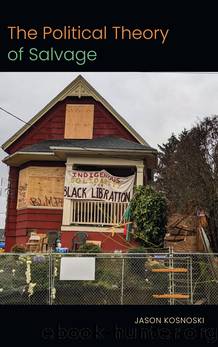
Author:Jason Kosnoski;
Language: eng
Format: epub
Publisher: State University of New York Press
Published: 2022-08-15T00:00:00+00:00
The City as the Landscape of Salvage?
Lefebvre, through both his explanation of the microfoundations of inhabiting urban spaces and his observations concerning the macro political economic tendencies that produce peripheral salvage spaces, gives us the âwhereâ of a political theory of salvage. Yet, in many ways, his identification of spatial tendencies within capitalist cities that produce radical contestation relies too much upon space itself as an activating agent for politics. He helps us to understand how salvage becomes political salvage, but these spatial dynamics that can lead to salvage inhabitation cannot be regarded as the only cause or even prime agent of such political salvage. I will now raise questions concerning Lefebvreâs work that will not only highlight his overreliance upon space itself to prompt anticapitalist attitudes and actions, but will open the door to further argument regarding how political salvage can play a powerful role in contemporary anticapitalist resistance.
As increasing segregation and abstraction within urban spaces lead more and more stakeholders to demand a âright to the city,â it is important to understand how Lefebvreâs work demonstrates that salvage activities can act as an important expression of that right. Whereas Lefebvre often talks about the origins of such demands in the repression people experience in their daily efforts to inhabit public spacesâthe signs prohibiting sitting on steps and the harassment members of marginalized communities feel in certain areas of cities, a political theory of salvage suggests that a similar everyday prompting to spatial appropriation might be trying to find usable parts within a pile of rubbish and then, perhaps, to use those parts to repair a wall, faucet, or bicycle. Furthermore, as Lefebvre sees these small acts of appropriation facing increasing official resistance, greater defiance to repression and defense of appropriated spaces by groups develops, so too with the communities that protect the squats, informal communities, and public squares they have salvaged. Finally, as Lefebvre sees appropriation generating affiliation and solidarity with place that replaces sole identification with factory or possession, thus rendering the city as potent a cause around which to organize as class, salvaged spaces act as a potent manifestation of the connection to a space that might unify a people in both challenging efforts to undermine their collective appropriation and also challenging the underlying capitalist social dynamics that caused governments in the first place to organize cities based on the model of abstract urban design.
But despite the fact that Lefebvreâs work can be generally linked to my discussion of salvage by examining his concept of appropriation, and his discussion of the capitalist city can be used to deconstruct the spatial dialectics that constitute the macro geography that creates the spaces with potential for salvage, his vision relies too heavily on the concept of self-organization. He sees the spatial dynamics of cities themselves as nearly independent causal factors that will inspire the excluded to engage in acts of spatial appropriation exhibiting autogestion and other horizontal forms of organization. Such rosy assumptions about the power of the city to generate radical political activity act on both the micro and macro levels.
Download
This site does not store any files on its server. We only index and link to content provided by other sites. Please contact the content providers to delete copyright contents if any and email us, we'll remove relevant links or contents immediately.
Spell It Out by David Crystal(36110)
Life for Me Ain't Been No Crystal Stair by Susan Sheehan(35804)
Cecilia; Or, Memoirs of an Heiress — Volume 1 by Fanny Burney(32548)
Cecilia; Or, Memoirs of an Heiress — Volume 2 by Fanny Burney(31947)
Cecilia; Or, Memoirs of an Heiress — Volume 3 by Fanny Burney(31932)
The Great Music City by Andrea Baker(31917)
Professional Troublemaker by Luvvie Ajayi Jones(29651)
The Secret History by Donna Tartt(19053)
We're Going to Need More Wine by Gabrielle Union(19034)
Twilight of the Idols With the Antichrist and Ecce Homo by Friedrich Nietzsche(18624)
All the Missing Girls by Megan Miranda(15958)
Cat's cradle by Kurt Vonnegut(15335)
Pimp by Iceberg Slim(14488)
Bombshells: Glamour Girls of a Lifetime by Sullivan Steve(14057)
For the Love of Europe by Rick Steves(13914)
Norse Mythology by Gaiman Neil(13349)
Talking to Strangers by Malcolm Gladwell(13349)
Fifty Shades Freed by E L James(13233)
The Social Justice Warrior Handbook by Lisa De Pasquale(12187)
