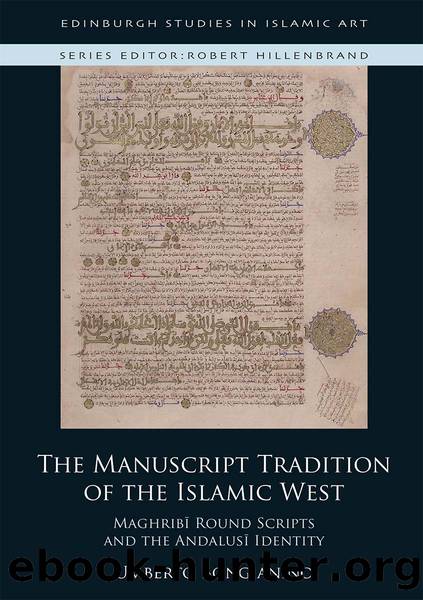
The Manuscript Tradition of the Islamic West by Umberto Bongianino;
Author:Umberto Bongianino;
Language: eng
Format: epub
ISBN: 9781474499613
Publisher: Edinburgh University Press
Final remarks
At the end of this chapter on the apogee of MaghribÄ« book culture in the sixth/twelfth century, it is important to stress that the palaeographic observations just presented should be ideally combined with a systematic study of the materials employed in these manuscripts, which has not been carried out for want of the necessary equipment and authorisations. In particular, significant data could emerge from the analysis of the type and quality of paper folios and of the methods followed by MaghribÄ« scribes for preparing the writing surfaces, since both aspects seem to depart noticeably from MashriqÄ« practices. The wide range of papers represented in the corpus, of varying thickness, colour and only featuring zigzag marks in a minority of cases, share nevertheless the same suppleness and porous texture, in contrast with the starchy and glossy aspect of coeval eastern papers. Especially during the second half of the century, the increased clarity, uniformity and perpendicularity in the arrangement of laid and chain lines seem to reveal the use of rigid moulds, possibly already fitted with metal wire. As recently pointed out by Jean-Louis Estève, however, this point still needs to be scientifically proven.396 Because the ribbed pattern imparted by the manufacturing process is much more visible in these less treated papers, it seems that MaghribÄ« copyists, instead of using ruling boards like their MashriqÄ« colleagues, simply continued to score the margins of the textbox in dry pen â a technique borrowed from parchment manuscripts â and then wrote following the laid lines imprinted in the folios, at regular intervals. In the manuscripts of smaller format, where folios are folded in octavo and laid lines are arranged vertically (e.g. items 109, 148, 158 and 196) the copyists may have followed the chain lines instead. In particularly fine manuscripts such as item 187 and 208, each line of text was scored individually before filling the text box with script (Figure 4.34). According to al-QalalÅ«sÄ«âs treatise, AndalusÄ« copyists determined the size of text boxes on the basis of semicircles, presumably traced with a compass, and fixed the measurements on the page with small dots (ânuqaá¹â).397 The beginning and end of each line were equally marked by small dots or needle pricks, a statement that seems supported by the traces left in some manuscripts, such as item 158.
Download
This site does not store any files on its server. We only index and link to content provided by other sites. Please contact the content providers to delete copyright contents if any and email us, we'll remove relevant links or contents immediately.
Aircraft Design of WWII: A Sketchbook by Lockheed Aircraft Corporation(32286)
The Great Music City by Andrea Baker(31917)
Call Me by Your Name by André Aciman(20499)
The Secret History by Donna Tartt(19053)
The Art of Boudoir Photography: How to Create Stunning Photographs of Women by Christa Meola(18614)
Shoot Sexy by Ryan Armbrust(17720)
Plagued by Fire by Paul Hendrickson(17405)
Portrait Mastery in Black & White: Learn the Signature Style of a Legendary Photographer by Tim Kelly(16996)
Adobe Camera Raw For Digital Photographers Only by Rob Sheppard(16969)
Photographically Speaking: A Deeper Look at Creating Stronger Images (Eva Spring's Library) by David duChemin(16683)
Ready Player One by Cline Ernest(14644)
Pimp by Iceberg Slim(14488)
Bombshells: Glamour Girls of a Lifetime by Sullivan Steve(14057)
The Goal (Off-Campus #4) by Elle Kennedy(13657)
Art Nude Photography Explained: How to Photograph and Understand Great Art Nude Images by Simon Walden(13031)
Kathy Andrews Collection by Kathy Andrews(11812)
The Priory of the Orange Tree by Samantha Shannon(9066)
The remains of the day by Kazuo Ishiguro(8977)
Thirteen Reasons Why by Jay Asher(8893)
