The India-Pakistan Nuclear Relationship: Theories of Deterrence and International Relations by E. Sridharan
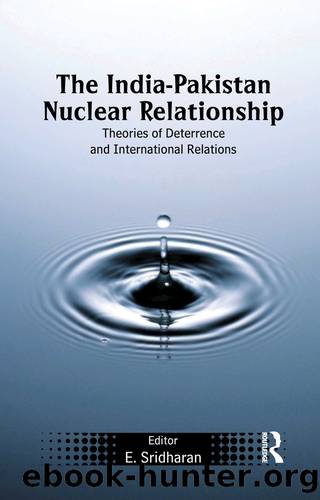
Author:E. Sridharan [Sridharan, E.]
Language: eng
Format: epub
Tags: Political Science, International Relations, Arms Control
ISBN: 9780415424080
Google: T_SOAAAAMAAJ
Goodreads: 13710239
Publisher: Routledge
Published: 2007-01-15T10:07:44+00:00
Risks of Inadvertent Use
Jessica Stern and Gregory Koblentz (2001: 83) have outlined different scenarios of unauthorized use of nuclear weapons by military units equipped with nuclear weapons. These range from the possibility of âthe legitimate custodians of nuclear weapons acting without prior orders, to commanders exercising their authority in an inappropriate manner or in reaction to false warning... âor rebellious military units wresting control of nuclear weapons and the launchers from their legitimate custodiansâ.
None of these apply to Pakistan for the simple reason that Pakistanâs nuclear weapons programme remains at a predeployment stage. As the programme matures and reaches a stage when warheads are mated to delivery systems and these systems get deployed, issues of unauthorized launch stemming from predelegation of authority would begin to surface.
Pre-delegation of authority to its local commanders to use nuclear weapons would be unavoidable for Pakistan, as its primary command post remains vulnerable to decapitating strikes by Indian missiles.
Just as American Presidents Eisenhower, Kennedy, and Johnson had âpre-delegated authorityâ to âsix or seven three-and-four star generalsâ for retaliatory use in the event of a massive Soviet attack (Bracken 1983: 202), Pakistan will have to do the same to deal with the scenario of a decapitating strike on its primary command post by India. In the absence of an India-Pakistan agreement committing them not to attack each otherâs nuclear command posts, the only way Islamabad can protect its centralized nuclear command authority from being attacked by India is to scatter its ânuclear triggersâ in secondary commands through pre-delegation.
The well-known tension between security and stability becomes acute as survival through dispersal emerges as the only realistic option for the evolving Pakistani nuclear force structure. âMobilityâ because of the lack of sound and reliable rail and road infrastructure in the country, and âsufficiencyâ due to financial constraints and limited fissile material, are not viable options for Pakistan, at least not in the immediate future. It is essentially by basing its small nuclear forces in hardened but geographically dispersed silos that Islamabad can have a high degree of confidence in the survivability of this force. Pre-delegation of launch authority to local commanders becomes inevitable if problems of connectivity associated with âdispersalâ are to be effectively tackled. The credibility of Islamabadâs nuclear deterrence would be seriously compromised if India were to entertain the belief that Pakistanâs dispersed nuclear assets could not be brought into play because of too much centralization of authority in a single command post.
A decentralized command and control system in Pakistan would entail setting up alternate and secondary nuclear commands, which would be lower in rank to those located in the Nuclear Command Authority. To guard against the danger of its âdistributed communication systemâ (linking the primary launch authority with secondary command sites) being rendered dysfunctional14 by a surprise enemy attack, Islamabad will have to accord a certain degree of autonomy of decision-making to those manning the secondary posts. As launch authority flows downward, the âhuman instabilityâ (Abrams 2001) factor in those responsible for pulling the nuclear trigger assumes paramount significance.
Download
This site does not store any files on its server. We only index and link to content provided by other sites. Please contact the content providers to delete copyright contents if any and email us, we'll remove relevant links or contents immediately.
Spell It Out by David Crystal(36120)
Life for Me Ain't Been No Crystal Stair by Susan Sheehan(35813)
Cecilia; Or, Memoirs of an Heiress — Volume 1 by Fanny Burney(32562)
The Great Music City by Andrea Baker(32023)
Cecilia; Or, Memoirs of an Heiress — Volume 2 by Fanny Burney(31959)
Cecilia; Or, Memoirs of an Heiress — Volume 3 by Fanny Burney(31945)
Professional Troublemaker by Luvvie Ajayi Jones(29671)
The Secret History by Donna Tartt(19103)
We're Going to Need More Wine by Gabrielle Union(19054)
Twilight of the Idols With the Antichrist and Ecce Homo by Friedrich Nietzsche(18642)
All the Missing Girls by Megan Miranda(16052)
Cat's cradle by Kurt Vonnegut(15365)
Pimp by Iceberg Slim(14522)
For the Love of Europe by Rick Steves(14174)
Bombshells: Glamour Girls of a Lifetime by Sullivan Steve(14081)
Norse Mythology by Gaiman Neil(13379)
Talking to Strangers by Malcolm Gladwell(13376)
Fifty Shades Freed by E L James(13247)
The Social Justice Warrior Handbook by Lisa De Pasquale(12197)
