The Essentials of the Language of Conscience: A Summarization and Guide to the Language of Conscience Series by Tieman H. Dippel Jr
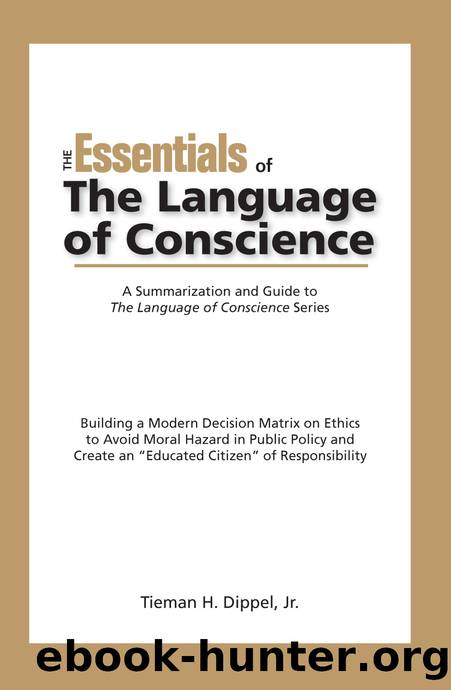
Author:Tieman H. Dippel Jr. [Dippel, Tieman H. Jr.]
Language: eng
Format: epub
ISBN: 9780982935460
Goodreads: 10521290
Publisher: Texas Peacemaker Publications LLC
Published: 2010-09-13T00:00:00+00:00
The Philosophy of Enlightened Conservatism
René Descartes, the French thinker who many consider the father of modern philosophy, used the equivalent of a scientific method as he thought through the use of reason. He conceptualized ideas and believed that there were two kinds of true ideas. These ideas are clear ideas that could be distinguished from others and distinct ideas that had parts that could be distinguished from each other. The purpose of a philosopher was to analyze these complex ideas and translate them into simpler ones. He distinguished between ideas of the mind and ideas that came from worldly experience, which he felt could not be as clearly defined. Enlightened Conservatism uses both of those concepts as it applies them to forces and strategic driving powers. It breaks complex ideas into simpler groupings, but most importantly it is not primarily based on academic theory. It is based on practical experience and an understanding of the nature of power, the various types of power, and the interactions that they have to enforce or diminish each other. It notes that the environment in which they operate, the peer pressure of the culture, is what implements the power of values or the lack thereof. It clearly understands the difference between direct power and influence. While power can be limited, influence can be much more pervasive. It is not a concept of detailed research of past theories but of applying many of the lessons of different ages in a synthesis to a more modern combination.
Enlightened Conservatism uses individual dignity as the balancing point of how people view their position in their environment and their desire for change. As a synthesis, it has taken thoughts from various parts of history in comparisons and linked them together. A typical example would be the concepts of power. Seldom have you had more diverse synthesis than combining thoughts such as Thomas Paineâs visionary concept on limited government in American society as compared to Frederick Engelsâ views. Both understood the power of culture. Paine believed that if you had a society of individual responsibility you needed less government, less courts, and less interference with life:
Political power means capacity to regulate national life through national representatives. If national life becomes so perfect as to become self-regulated, no representation becomes necessary. There is then a state of enlightened anarchy. In such a state every one is his own ruler. He rules himself in such a manner that he is never a hindrance to his neighbor. In the ideal state, therefore, there is not political power because there is no state.
Download
This site does not store any files on its server. We only index and link to content provided by other sites. Please contact the content providers to delete copyright contents if any and email us, we'll remove relevant links or contents immediately.
Spell It Out by David Crystal(36193)
Life for Me Ain't Been No Crystal Stair by Susan Sheehan(35881)
The Great Music City by Andrea Baker(32955)
Cecilia; Or, Memoirs of an Heiress — Volume 1 by Fanny Burney(32687)
Cecilia; Or, Memoirs of an Heiress — Volume 2 by Fanny Burney(32046)
Cecilia; Or, Memoirs of an Heiress — Volume 3 by Fanny Burney(32030)
Professional Troublemaker by Luvvie Ajayi Jones(29728)
The Secret History by Donna Tartt(19395)
We're Going to Need More Wine by Gabrielle Union(19137)
Twilight of the Idols With the Antichrist and Ecce Homo by Friedrich Nietzsche(18726)
All the Missing Girls by Megan Miranda(16490)
Cat's cradle by Kurt Vonnegut(15493)
For the Love of Europe by Rick Steves(14749)
Pimp by Iceberg Slim(14740)
Bombshells: Glamour Girls of a Lifetime by Sullivan Steve(14175)
Norse Mythology by Gaiman Neil(13506)
Talking to Strangers by Malcolm Gladwell(13494)
Fifty Shades Freed by E L James(13321)
The Social Justice Warrior Handbook by Lisa De Pasquale(12271)
