The Cool-Kawaii by Botz-Bornstein Thorsten;
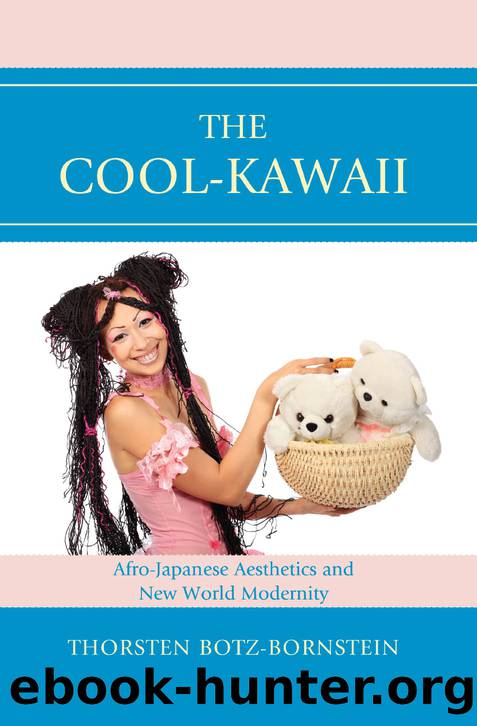
Author:Botz-Bornstein, Thorsten;
Language: eng
Format: epub
Publisher: Lexington Books/Fortress Academic
Published: 2011-08-15T00:00:00+00:00
Camp
âCamp,â as a mixture of the exaggerated, ostentatious, and affected, can be a good equivalent for kitsch but classical aesthetics limits it to the kitsch of the nineteenth century (Sternberg 1972: 9). Apart from that, camp is dependent on different psychological dispositions. It is true that kitsch and camp arise simultaneously as results of material enrichment of larger parts of the European population and some of Susan Sontagâs examples of camp taken from her famous essay âNotes on Campâ fully overlap with Gillo Dorflesâ typical kitsch items, (especially when it comes to pre-nineteenth century romanticism exemplified by Art Nouveau items, artificial ruins, Gothic novels, etc.) (cf. Sontag 1982: 280). Camp does also overlap with those stylistic tendencies that Clement Greenberg would most certainly have dismissed as kitsch like old movies, outmoded fashion styles, Tiffany lamps (cf. Doris 2007: 52). However, it is certainly no coincidence that camp developed later into an ironical and sophisticated aesthetization of kitsch operating through ambiguity and able to express social criticism. As for today, camp has adopted distinct features mainly because it can be linked to a sort of nostalgia that remains absent from kitsch. Interestingly, the same object can be perceived as kitsch and as camp, depending on the nostalgic input invested by the observer. Brian McVeigh holds that Hello Kitty, when consumed by more mature Japanese women, no longer appears as a kitsch item for the naïve and emotionally undeveloped but rather as a camp item âtied to a type of femininity that highlights cultural desirables such as sincerity, kindness, and sensitivity to the feelings of othersâ (McVeigh 2000b: 231). It seems that Sanryo premeditated the shift of its products towards camp when it began marketing Hello Kitty products to adult women as âretro objectsâ in the 1990s. Since then, not only are toothbrushes and school supplies featured in the catalogue, but also handbags and makeup compacts which give a nostalgic and ironical dimension to Japanese kawaii culture. Today, adult women share childhood memories of Hello Kitty on the Sanryo website that the company has created for the conservation of collective memories: âI remember taking this Kitty bag to the pool every summer . . .â (Yano 2004: 62-63).
However, internationally, camp is no longer primarily understood as being linked to nostalgic feelings but rather as an ironical, transparent, and self-conscious kitsch attitude which is particularly important to youth cultures that delve into liquefied structures, values, etc. Hopkins, for example, singles out camp as a must for Power Girl culture: âIn this postmodern culture, to be truly âcoolâ heroes have to be campâ (S. Hopkins 2002: 122) because what is important in an age of simulation, the essence of camp, which signifies âtaking pleasure in the unrealâ (124).
Download
This site does not store any files on its server. We only index and link to content provided by other sites. Please contact the content providers to delete copyright contents if any and email us, we'll remove relevant links or contents immediately.
Spell It Out by David Crystal(36113)
Life for Me Ain't Been No Crystal Stair by Susan Sheehan(35807)
Cecilia; Or, Memoirs of an Heiress — Volume 1 by Fanny Burney(32550)
Cecilia; Or, Memoirs of an Heiress — Volume 2 by Fanny Burney(31950)
Cecilia; Or, Memoirs of an Heiress — Volume 3 by Fanny Burney(31933)
The Great Music City by Andrea Baker(31919)
Professional Troublemaker by Luvvie Ajayi Jones(29652)
The Secret History by Donna Tartt(19062)
We're Going to Need More Wine by Gabrielle Union(19038)
Twilight of the Idols With the Antichrist and Ecce Homo by Friedrich Nietzsche(18627)
All the Missing Girls by Megan Miranda(15966)
Cat's cradle by Kurt Vonnegut(15340)
Pimp by Iceberg Slim(14490)
Bombshells: Glamour Girls of a Lifetime by Sullivan Steve(14062)
For the Love of Europe by Rick Steves(13954)
Talking to Strangers by Malcolm Gladwell(13353)
Norse Mythology by Gaiman Neil(13352)
Fifty Shades Freed by E L James(13236)
The Social Justice Warrior Handbook by Lisa De Pasquale(12188)
