The Collected Writings of Franz Liszt by Hall-Swadley Janita R.; Pekacz Jolanta T.; Pekacz Jolanta T
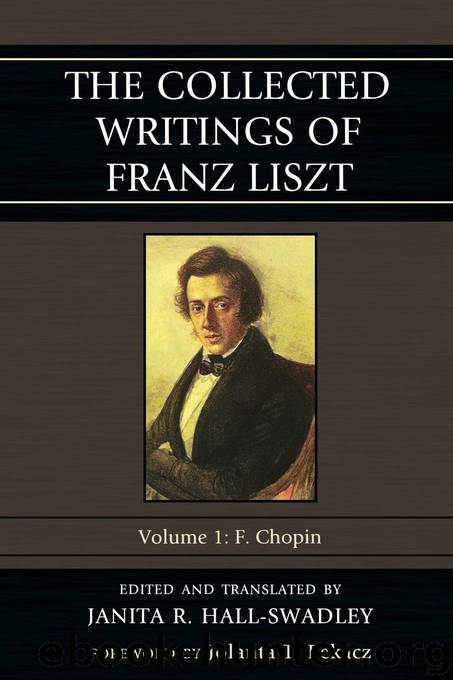
Author:Hall-Swadley, Janita R.; Pekacz, Jolanta T.; Pekacz, Jolanta T
Language: eng
Format: epub
Publisher: Scarecrow Press
Published: 2011-03-18T04:00:00+00:00
Notes
**Translator’s Note: For narration purposes, Liszt’s “voice” will be printed in italics, Carolyne von Sayn-Wittgenstein’s “voice” will be printed in boldface type, La Mara/Ramann’s “voice” will be printed in Courier New font, and my “voice” will be printed in standard Times Roman font. See pages 42-43 for more details.
494. In classical mythology nymphs were minor female deities, in that they were not immortal and would die. They were believed to protect various types of locations. Dryads, for example, were tree nymphs, oreads were the guardians of the mountains, and as their name implies, oceanids were associated with the ocean. See Gordon MacDonald Kirkwood, A Short Guide to Classical Mythology (Wauconda, IL: Bolchazy-Carducci Publishers, 1995), 66-67.
495. The 1852 edition does not mention Chopin by name.
496. This is a French title, which means “The Crumb Fairy.” The Fée aux miettes was popularized by Charles Nodier (1780-1844), a French writer of gothic lore. In this writing with the same name, the main protagonist is Michel, who marries the Crumb Fairy, an ugly old woman with two long front teeth. One night he sees his wife’s true identity in a dream, where she is revealed as the Queen of Sheba. In order to restore his wife to her youthful beauty, he goes through a series of adventures to find the mysterious singing Madragore flower. See Charles Nodier, La fée aux miettes, Oeuvres de Charles Nodier, vol. 4 (Brussels: J. P. Meline, 1832).
497. This is another title, known under the English heading Trilby, the Fairy of Argyle, written by the nineteenth-century French author Charles Nodier. The story is set in Scotland of the Middle Ages, where a sprite named Trilby offers a fisherman and his wife a tremendous fortune. Trilby and the fisherman’s wife eventually fall in love. Believing in the evil origins of the sprite, the local abbot exorcizes the troll, and the fisherman’s wife dies tragically. See Charles Nodier, Trilby, the Fairy of Argyle, trans. by Nathan Haskell Dole (Boston: Estes and Lauriat, 1895).
498. This last clause was not included in the 1852 edition.
499. The 1852 edition includes the following words after this opening clause: “of Chopin, as well as the pieces we just mentioned.”
500. The 1852 edition uses the word “peris” rather than “undines.”
501. The passage “the powerful and capricious Oberons” was not included in the 1852 edition.
502. In the 1852 edition, the word “disgust” is used rather than “agony.”
503. The passage beginning with the words “In the majority of his Waltzes” to the end of this paragraph was originally in Chapter 3 in the 1852 edition, but it was later revised and placed here in the 1879 edition. See page 123, note 488, of this translation for the earlier version of this passage.
504. Undines were water spirits, also known as Elementals, in that they were related to the four elements of nature (fire, water, air, and earth). See C. S. [Clive Staples] Lewis, The Discarded Image: An Introduction to Medieval and Renaissance Literature (Cambridge: Cambridge University Press, 1964), 135. Titanides were a fictional race of highly intelligent centaurs, which were half man and half horse.
Download
This site does not store any files on its server. We only index and link to content provided by other sites. Please contact the content providers to delete copyright contents if any and email us, we'll remove relevant links or contents immediately.
The Great Music City by Andrea Baker(32955)
Aircraft Design of WWII: A Sketchbook by Lockheed Aircraft Corporation(32364)
Call Me by Your Name by André Aciman(20660)
The Secret History by Donna Tartt(19397)
The Art of Boudoir Photography: How to Create Stunning Photographs of Women by Christa Meola(18728)
Shoot Sexy by Ryan Armbrust(17823)
Plagued by Fire by Paul Hendrickson(17499)
Portrait Mastery in Black & White: Learn the Signature Style of a Legendary Photographer by Tim Kelly(17082)
Adobe Camera Raw For Digital Photographers Only by Rob Sheppard(17056)
Photographically Speaking: A Deeper Look at Creating Stronger Images (Eva Spring's Library) by David duChemin(16764)
Ready Player One by Cline Ernest(14838)
Pimp by Iceberg Slim(14740)
Bombshells: Glamour Girls of a Lifetime by Sullivan Steve(14176)
The Goal (Off-Campus #4) by Elle Kennedy(13903)
Art Nude Photography Explained: How to Photograph and Understand Great Art Nude Images by Simon Walden(13123)
Kathy Andrews Collection by Kathy Andrews(12031)
The Priory of the Orange Tree by Samantha Shannon(9306)
The remains of the day by Kazuo Ishiguro(9151)
Thirteen Reasons Why by Jay Asher(9061)
