The Christians of Pakistan by Walbridge Linda;
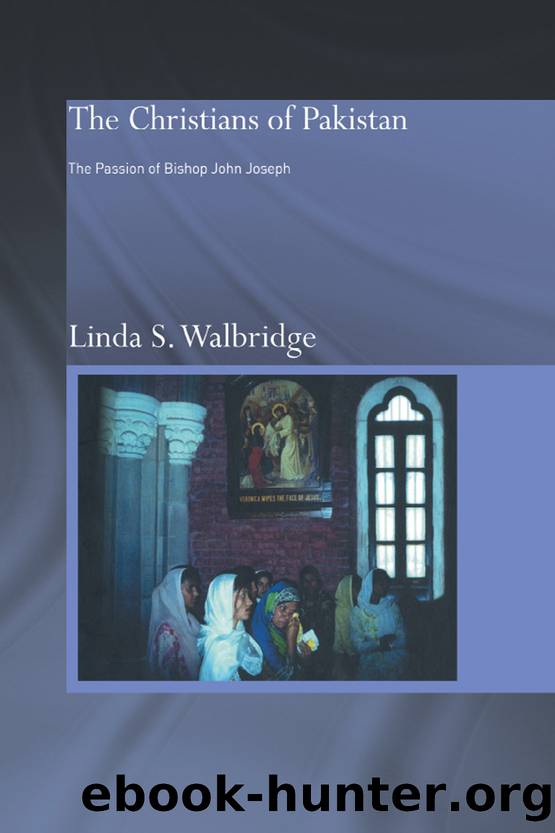
Author:Walbridge, Linda;
Language: eng
Format: epub
Publisher: Taylor & Francis Group
The Sisters of the Religious Orders
In view of all the problems women can face in Pakistan, the lives of the sisters2 in the religious orders in Pakistan are remarkable. Rather than being confined to a life of seclusion or to work considered demeaning, sisters are actively involved in addressing the problems of society: in education, health, and human rights issues. These were not elite women, but women who grew up in the villages and in the bastis and who have made service their livelihood through the religious life.
One does not normally think of women who live in convents as being free. In comparison with their lay sisters, however, they often have a far less restricted life. While I was in Karachi, I visited the Franciscan Missionaries of Mary (FMM) sisters. When they heard that I was to take a bus alone to Hyderabad, they would have none of it. Within minutes it was decided that one of them would accompany me. That is not to say they have an easy life â but the lives they have chosen make them actors in the world. They are not in hiding, and some of them â on a day-to-day basis â are answerable to no one.
These sisters were very much part of the world of Bishop John Joseph. Repeatedly people told me that he was a great advocate of womenâs rights and that he openly expressed his belief that sooner or later women would be ordained as priests. He told the priests of his parish to encourage families to allow their daughters to assist at mass as acolytes and readers. I can hardly recall a mass that did not have at least one woman or girl read from the scriptures from the altar area. For John Joseph women and religion would have been inseparable. Most of his sisters joined religious orders, as did his nieces Sabina and Camilla, who are both headmistresses of Catholic schools. He dealt with sisters every day in their capacity as school principals, teachers, hospital administrators, and nurses. They, like so many of the priests, were involved in âupliftingâ the people around them.
But women from the Subcontinent were not always permitted to join these religious orders on an equal footing with European women. An elderly Anglo-Indian nun, Sister Jemma, gave me an account of what it used to be like for âindigenousâ girls wishing to join a congregation. Actually, her mother was English, but her father was considered an Anglo- Indian, having an English father and an Indian mother. Thus, Sister Jemma was considered an Anglo-Indian or a Eurasian. In the early 1930s she wanted to enter the Oblates of the Sisters of Charity,
but my father wouldnât have it. He said no. Because at that time there was a great difference between indigenous and European types. They [the indigenous] were not counted as nuns. They were in service to the European nuns. I studied with them â they were my teachers. Bishop John Joseph was the one who fought this.
Download
This site does not store any files on its server. We only index and link to content provided by other sites. Please contact the content providers to delete copyright contents if any and email us, we'll remove relevant links or contents immediately.
Spell It Out by David Crystal(36113)
Life for Me Ain't Been No Crystal Stair by Susan Sheehan(35807)
Cecilia; Or, Memoirs of an Heiress — Volume 1 by Fanny Burney(32550)
Cecilia; Or, Memoirs of an Heiress — Volume 2 by Fanny Burney(31949)
Cecilia; Or, Memoirs of an Heiress — Volume 3 by Fanny Burney(31933)
The Great Music City by Andrea Baker(31919)
Professional Troublemaker by Luvvie Ajayi Jones(29651)
The Secret History by Donna Tartt(19061)
We're Going to Need More Wine by Gabrielle Union(19038)
Twilight of the Idols With the Antichrist and Ecce Homo by Friedrich Nietzsche(18627)
All the Missing Girls by Megan Miranda(15966)
Cat's cradle by Kurt Vonnegut(15340)
Pimp by Iceberg Slim(14490)
Bombshells: Glamour Girls of a Lifetime by Sullivan Steve(14062)
For the Love of Europe by Rick Steves(13952)
Talking to Strangers by Malcolm Gladwell(13353)
Norse Mythology by Gaiman Neil(13352)
Fifty Shades Freed by E L James(13236)
The Social Justice Warrior Handbook by Lisa De Pasquale(12188)
