The Adversary First Amendment by Redish Martin H.;
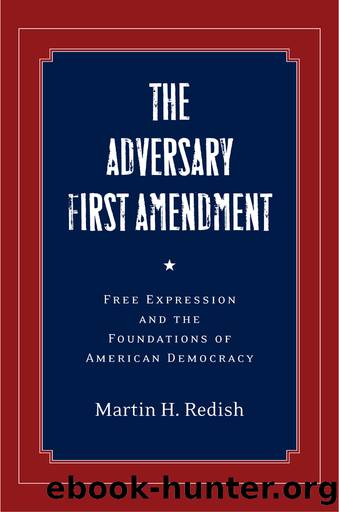
Author:Redish, Martin H.; [Redish, Martin H.]
Language: eng
Format: epub
Publisher: Stanford University Press
Published: 2013-08-15T00:00:00+00:00
CHAPTER FIVE
The Anticorruption Principle, Free Expression, and the Democratic Process
There are again two methods of removing the causes of faction: the one, by destroying the liberty which is essential to its existence; the other, by giving to every citizen the same opinions, the same passions, and the same interests. It could never be more truly said than of the first remedy, that it was worse than the disease.
James Madison, The Federalist No. 10
A number of scholars and jurists have long deplored what they see as the corruption of the American political process.1 In their view, too much money is having too large and unsavory an impact on American politics, simultaneously distorting political power toward the wealthy and seductively drawing politicians away from pursuit of the public interest.2 One of the leading scholars advocating such a view, Professor Zephyr Teachout, has gone so far as to suggest that there is actually an âanticorruption principleâ embedded in the Constitution, logically implying that political corruption rises to the level of a constitutional violation.3 This principle posits that, as a matter of American history and constitutional law, âofficeholdersâ are constitutionally obligated to act in the âpublic interestâ and in pursuit of the âcommon goodâ; anything less is deemed to amount to âcorruption.â4
The Supreme Courtâs decision in Citizens United v. Federal Election Commission only intensified scholarsâ and juristsâ concerns about the dangers of political corruption.5 In Citizens United, the Court held that the section of the Bipartisan Campaign Reform Act (BCRA) limiting direct corporate political expenditures for expression during a presidential campaign violated the First Amendment.6 In a strongly worded dissent, Justice Stevens relied on arguments grounded in the anticorruption principle as specifically fashioned by Professor Teachout to justify the BCRAâs suppression of corporate political speech.7 Justice Stevensâs dissent, like Professor Teachoutâs version of the anticorruption principle, relied on a broad definition of corruption, one extending far beyond the simple act of bribery.8 According to Justice Stevens, âThere are threats of corruption that are far more destructive to a democratic society than the odd bribe.â9
Justice Stevensâs opinion in Citizens United is not the first time that members of the Court have sought to uphold restrictions on political speech in the name of anticorruption. In Austin v. Michigan Chamber of Commerce, the Supreme Court upheld a state law that restricted corporate political expenditures in state elections.10 The Austin Court considered Michiganâs law to be âaim[ed] at a different type of corruption in the political arena: the corrosive and distorting effects of immense aggregations of wealth that are accumulated with the help of the corporate form.â11 The Courtâs decision in Austin, as Justice Scalia observed in his dissent, âendorse[d] the principle that too much speech is an evil that the democratic majority can proscribe.â12 The Austin decision, he said, allowed for âanything the Court deem[ed] politically undesirable [to be] turned into political corruptionâby simply describing it as politically âcorrosive.ââ13
The anticorruption principle, as developed by Professor Teachout, seeks to provide important constitutional grounding for the theories relied on by the Austin majority and Justice Stevensâs opinion in Citizens United.
Download
This site does not store any files on its server. We only index and link to content provided by other sites. Please contact the content providers to delete copyright contents if any and email us, we'll remove relevant links or contents immediately.
Spell It Out by David Crystal(36113)
Life for Me Ain't Been No Crystal Stair by Susan Sheehan(35807)
Cecilia; Or, Memoirs of an Heiress — Volume 1 by Fanny Burney(32550)
Cecilia; Or, Memoirs of an Heiress — Volume 2 by Fanny Burney(31949)
Cecilia; Or, Memoirs of an Heiress — Volume 3 by Fanny Burney(31933)
The Great Music City by Andrea Baker(31919)
Professional Troublemaker by Luvvie Ajayi Jones(29651)
The Secret History by Donna Tartt(19061)
We're Going to Need More Wine by Gabrielle Union(19038)
Twilight of the Idols With the Antichrist and Ecce Homo by Friedrich Nietzsche(18627)
All the Missing Girls by Megan Miranda(15966)
Cat's cradle by Kurt Vonnegut(15340)
Pimp by Iceberg Slim(14490)
Bombshells: Glamour Girls of a Lifetime by Sullivan Steve(14062)
For the Love of Europe by Rick Steves(13952)
Talking to Strangers by Malcolm Gladwell(13353)
Norse Mythology by Gaiman Neil(13352)
Fifty Shades Freed by E L James(13236)
The Social Justice Warrior Handbook by Lisa De Pasquale(12188)
