The 36-Hour Day by Nancy L. Mace MA & Peter V. Rabins MD MPH
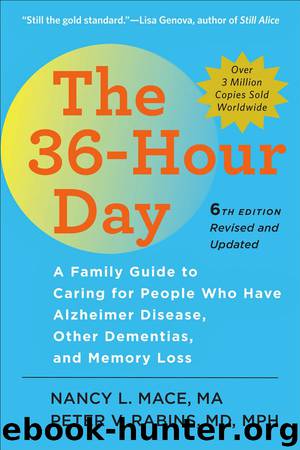
Author:Nancy L. Mace, MA & Peter V. Rabins, MD, MPH
Language: eng
Format: epub
Publisher: Johns Hopkins University Press
Published: 2017-03-13T04:00:00+00:00
HELP FROM FRIENDS AND NEIGHBORS
Usually, caregivers who feel that they have the support of others manage the burdens of care more successfully. It is important that you not feel alone with your burden. Most people first turn to family members, friends, or neighbors for support and help. Often people will offer to help; or you may have to ask them for help.
Family members sometimes disagree or don’t help out, or you may hesitate to ask others for the help you need. In Chapter 11 we discuss some ways to handle family disagreement and to ask for help.
Others are often willing to help. Sometimes a neighbor will look in on the person who has dementia; the pharmacist will keep track of prescriptions for you; the minister, priest, or rabbi will listen when you are discouraged; a friend will sit with the person in an emergency; and so forth. As you plan, you should consider these resources, because they are important to you.
How much help should you accept or ask for from friends and neighbors? Most people like to help, yet making too many demands on them may eventually cause them to pull away.
When you turn to friends and neighbors for help, there are several things you can do to help them feel comfortable helping you. Some people are uncomfortable around those who are visibly upset. You may not want to express all of your distress to such people. Close friends may be more willing to share some of the emotional burden with you than people who do not know you well.
Although most people have heard of Alzheimer disease, many need more information to understand why the person acts as she does. Explain that the behaviors are the result of the damage to the brain, that they are not deliberate or dangerous.
People may be reluctant to “sit with” or visit with the person because they feel uncomfortable and do not know what to do. You can help by suggesting specific things that the visitor might do with the person. For example, mention that going for a walk might be more fun than a conversation or that reminiscing about old times will be fun for both of them. Tell the visitor what you do when the person who has dementia becomes irritable or restless.
Some chapters of the Alzheimer’s Association have programs to train family members or friends to be special visitors. Such visitors bring pleasure to the person who has dementia, as well as giving you time away from caregiving.
When you ask people to help you, give them enough advance notice, if possible, so they can plan the time to help you. Remember to thank them, and avoid criticizing what they have done.
Look for things others can do that they will not consider inconvenient. For example, neighbors may not mind “looking in” because they live close by, while more distant friends might resent being asked to make a long drive.
Download
This site does not store any files on its server. We only index and link to content provided by other sites. Please contact the content providers to delete copyright contents if any and email us, we'll remove relevant links or contents immediately.
The Secret History by Donna Tartt(19365)
Goodbye, Things by Fumio Sasaki(8659)
Wonder by R. J. Palacio(8193)
Turbulence by E. J. Noyes(8152)
How to Be a Bawse: A Guide to Conquering Life by Lilly Singh(7571)
The Thirst by Nesbo Jo(7034)
The Testaments by Margaret Atwood(7025)
Kaplan MCAT General Chemistry Review by Kaplan(7014)
The Last Wish (The Witcher Book 1) by Andrzej Sapkowski(5544)
Spare by Prince Harry The Duke of Sussex(5291)
The Body: A Guide for Occupants by Bill Bryson(5213)
The Rules Do Not Apply by Ariel Levy(5052)
On Writing A Memoir of the Craft by Stephen King(5016)
Audition by Ryu Murakami(5007)
The Doodle Revolution by Sunni Brown(4848)
1578 Plant Pattern Recognition Receptors by Unknown(4802)
Gerald's Game by Stephen King(4735)
Adulting by Kelly Williams Brown(4647)
Millionaire: The Philanderer, Gambler, and Duelist Who Invented Modern Finance by Janet Gleeson(4554)
