Terrorism in Kenya and Uganda by Botha Anneli;
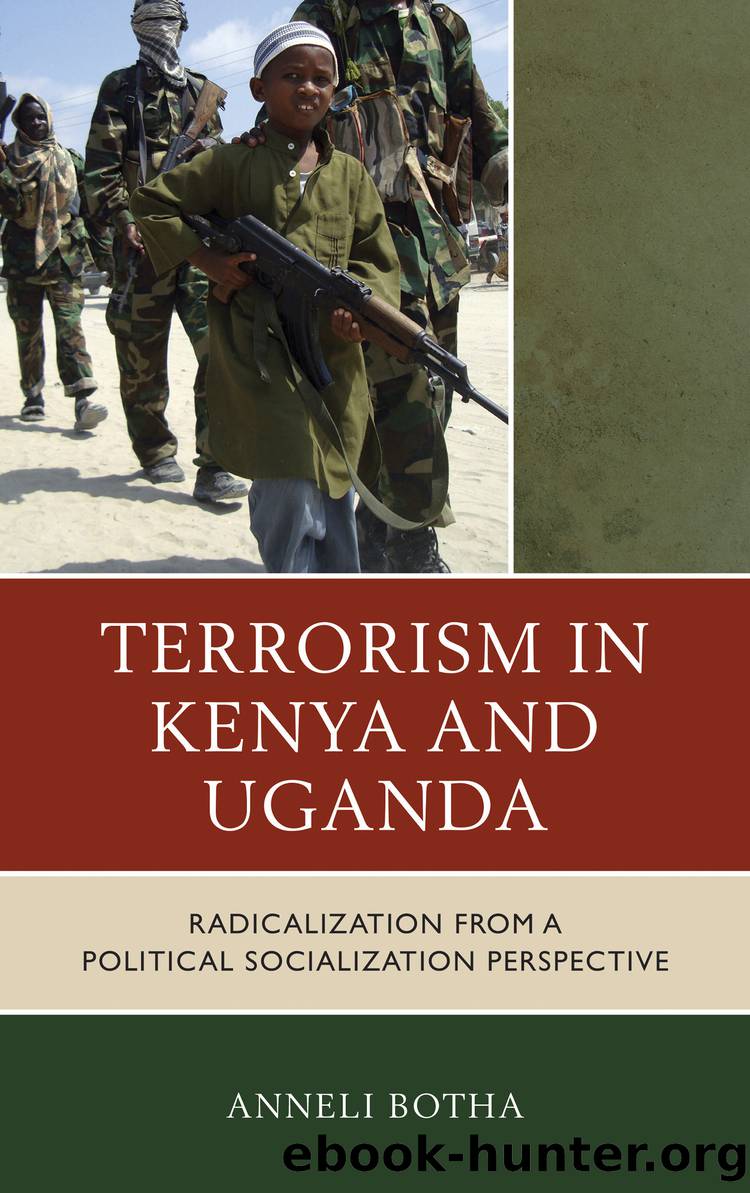
Author:Botha, Anneli; [Botha, Anneli]
Language: eng
Format: epub
Publisher: Lexington Books/Fortress Academic
Published: 2016-08-15T00:00:00+00:00
Chapter 6 Summarized
The frame of reference from the earliest point in a personâs development is provided by his or her parents. The relationship between parent and child plays an extremely important role in developing a personâs self-esteem and identity. However, lacking in a strong bond between parent and child in early life could cause the personâs inability to carry over values and lessons to his or her later life. Overall, the influence of parents as political socialization agents was more prominent in the MRC and LRA than the ADF and al-Shabaab. This assessment, however, should be interpreted from the perspective of the historical origins of the respective organizations and not only the relationship between parent and child. As explained, political antagonisms, loyalties and viewpoints are being transferred from one generation to another. The following in a parentâs footsteps fighting for the rights of especially an ethnic or geographic group, also explains the more prominent role parents played when analyzing the LRA and MRC.
Taking over from parents, the school and peers are two of the most prominent political socialization agents. Although parents still play a role, depending on the personâs relationship with his or her parents, going to school introduces a completely new environment. Through interaction with other groupsâmost notably other religious and ethnic or tribal groupsâthe individual will develop new or enforce existing perceptions of the âother.â Especially for this reason respondents were asked if they had contact with âothersâ (particular attention was paid to whether ethnicity or religion was the core of the group the person joined), and whether they had friends from the âotherâ while growing up. Both Kenya and Uganda are heterogeneous in the sense that the majority of respondents should have had contact with other ethnic and religious groups over the course of their lives. But having contact is, however, very different from closely associating and getting to know members of the out-group through establishing close friendships with individuals from other ethnic or religious groups. Furthermore, both countries have defined ethnic and religious areas, increasing the possibility of being âisolatedâ from other groups or, alternatively, being in the minority or majority in a particular area. Perceptions of being discriminated against or treated differently overall or within a specific geographic area will counter the possible positive implications of being in contact with others growing up or while attending school. Additionally, socialization also implies that we prefer to identify with others similar to âusââthat will manifest in people preferring to exclusively interact with members of their in-group. Segregation consequently occurs naturally, further enhancing established lessons learned during early socialization.
Download
This site does not store any files on its server. We only index and link to content provided by other sites. Please contact the content providers to delete copyright contents if any and email us, we'll remove relevant links or contents immediately.
Spell It Out by David Crystal(36105)
Life for Me Ain't Been No Crystal Stair by Susan Sheehan(35792)
Cecilia; Or, Memoirs of an Heiress — Volume 1 by Fanny Burney(32533)
Cecilia; Or, Memoirs of an Heiress — Volume 2 by Fanny Burney(31931)
Cecilia; Or, Memoirs of an Heiress — Volume 3 by Fanny Burney(31922)
The Great Music City by Andrea Baker(31906)
Professional Troublemaker by Luvvie Ajayi Jones(29644)
We're Going to Need More Wine by Gabrielle Union(19027)
The Secret History by Donna Tartt(19010)
Twilight of the Idols With the Antichrist and Ecce Homo by Friedrich Nietzsche(18611)
All the Missing Girls by Megan Miranda(15902)
Cat's cradle by Kurt Vonnegut(15315)
Pimp by Iceberg Slim(14471)
Bombshells: Glamour Girls of a Lifetime by Sullivan Steve(14042)
For the Love of Europe by Rick Steves(13837)
Talking to Strangers by Malcolm Gladwell(13336)
Norse Mythology by Gaiman Neil(13325)
Fifty Shades Freed by E L James(13222)
The Social Justice Warrior Handbook by Lisa De Pasquale(12179)
