Tales of an Ecotourist by Gunter Mike;
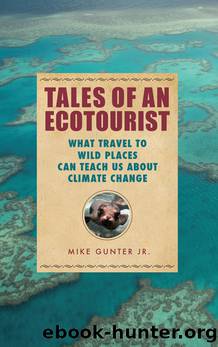
Author:Gunter, Mike;
Language: eng
Format: epub
Publisher: State University of New York Press
Published: 2017-09-15T00:00:00+00:00
chapter sixteen
AMID THE DEAFENING SILENCE
SILENCE IS NOT ALWAYS GOLDEN. Sometimes circumstances dictate the need to speak up, whether you are a social activist or not. In fact, choosing to remain quiet as others suffer, whether intended or not, implies tacit agreement. Still another powerful quotation from Martin Luther King, Jr., captures this sentiment. As he eloquently asserted during the civil rights movement in the United States, âHistory will have to record that the greatest tragedy of this period of social transition was not the strident clamor of the bad people, but the appalling silence of the good people.â
The examples donât stop there. During the Holocaust, for instance, a sad silence permeated not just Germany, but many parts of Europe, as six million Jews were led to nauseatingly systemic slaughter. While Hitler and his minions executed their Final Solution with maniacal precision, the Nazis received unspoken assists almost daily in the form of inaction among the wider, âinnocentâ civilian populace. Itâs not that the entire German public, or the European public for that matter, was innately evil. Many feared for their own lives. Total war encompassed the entire continent and a sense of helplessness discouraged resistance.
Helplessness is a familiar refrain, from continent to continent and time period to time period, when deconstructing the causes of inaction in the face of seminal societal struggles. For example, in the United States, fear and intimidation prevented countless individuals from standing up to racial violence, particularly in the South, as thousands of African-Americans were killed by the Ku Klux Klan during the Reconstruction era after the Civil War and again in episodes of the KKKâs rebirth, not to mention various spinoff hate groups during the twentieth century. Martin Luther King, Jr., himself perished at the hands of a white supremacist during the civil rights movement in the 1960s, as we well know.
In the midst of this tragedy, though, voices multiplied and a turning point in American society began, a move away from our racist past. We have considerably more work ahead of us, as headlines each month unfortunately bear out, but the social context today, more often than not, is an asset instead of a handicap, supporting those who speak out rather than suppressing them. The biggest threat to continued progress, one might argue, is becoming satisfied with partial progress to date. Our society must avoid the temptation to rest on our laurels. We need to stay hungry.
When it comes to the issue of climate change, though, weâre not even at that social stage. We havenât reached a tipping point. And hopefully, when we do, thatâs not dependent on violence. If it is, we probably will be too late. Indeed, while the violence from climate change is less direct and the fatalities not as obvious, at least to those of us in the developed world, the final tally of casualties from climate change will probably dwarf those from all previous conflicts. Indeed, as global environmental politics scholars such as American Universityâs Paul Wapner increasingly point out, considerable climate-related suffering has already begun.
Download
This site does not store any files on its server. We only index and link to content provided by other sites. Please contact the content providers to delete copyright contents if any and email us, we'll remove relevant links or contents immediately.
Spell It Out by David Crystal(36110)
Life for Me Ain't Been No Crystal Stair by Susan Sheehan(35802)
Cecilia; Or, Memoirs of an Heiress — Volume 1 by Fanny Burney(32546)
Cecilia; Or, Memoirs of an Heiress — Volume 2 by Fanny Burney(31944)
Cecilia; Or, Memoirs of an Heiress — Volume 3 by Fanny Burney(31929)
The Great Music City by Andrea Baker(31916)
Professional Troublemaker by Luvvie Ajayi Jones(29651)
The Secret History by Donna Tartt(19052)
We're Going to Need More Wine by Gabrielle Union(19034)
Twilight of the Idols With the Antichrist and Ecce Homo by Friedrich Nietzsche(18622)
All the Missing Girls by Megan Miranda(15954)
Cat's cradle by Kurt Vonnegut(15334)
Pimp by Iceberg Slim(14488)
Bombshells: Glamour Girls of a Lifetime by Sullivan Steve(14057)
For the Love of Europe by Rick Steves(13907)
Talking to Strangers by Malcolm Gladwell(13347)
Norse Mythology by Gaiman Neil(13345)
Fifty Shades Freed by E L James(13232)
The Social Justice Warrior Handbook by Lisa De Pasquale(12187)
