Suburban Crossroads by Vicino Thomas J.;
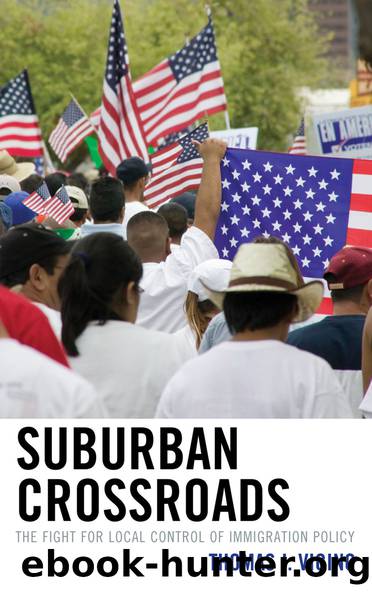
Author:Vicino, Thomas J.; [Vicino, Thomas J.]
Language: eng
Format: epub
Publisher: Lexington Books
Published: 2012-08-15T00:00:00+00:00
Chapter Five
The Politics of Relief
This country has a large Latino population and millions of Latinos live here without legal permission. However, the great majority live quietly, raise families, obey the law daily, and do work for our country. For all that they contribute to our welfare, they live in constant dread of being apprehended as [undocumented immigrants] and being evicted, perhaps having their families disrupted. As unsatisfactory as this situation is it is the immigration scheme we have today . . . This is a national problem, needing a national solution.1
âOpinion, US Court of Appeals for the Fifth Circuit, March 21, 2012
The case is definitely not over.2
âKris Kobach, Attorney, March 22, 2012
We need only look to the history of the progression of the legal battle to understand the fierce support and staunch opposition to IIROs. Responding to the latest ruling that IIROs usurp federal laws, Kris Kobach declared that the fight was not over. As lead counsel for the plaintiffs in the Hazleton case, Kobach emerged as a national spokesperson for relief ordinances for many other jurisdictions including Farmers Branch and Carpentersville. The majority of politicians and residents of Farmers Branch and Hazleton continued to utilize public resources for the fight to implement their ordinances. Despite numerous judicial setbacks, the supporters continue the political fight for policy adoption. This chapter examines how relief politics shaped these fights.
The fight for local control of immigration policy was about, at its core, the need of a native population to gain relief from a foreign-born population. The relief stemmed from the perceptions of the problems that illegal immigrants, and more broadly illegal immigration, brought into the community. It was further complicated as native residents perceived not only illegal immigrants as threats but also all immigrants, and especially native residents of Hispanic origin. Accordingly, this relief came in the form of a loosely joined set of public policies known as IIROs. Such ordinances allegedly diminished the threat to middle-class living and the threat of suburban decline that immigrants presented to the native population. The IIRO became a vehicle to provide relief from these threats.
Relief politics defined the struggle for power to gain local control of immigration policy. As Kingdon aptly notes, âThe political stream flows along according to its own dynamics and its own rules.â3 Relief emerged as the political dynamic in this debate. The political stream converged on the problem and solution streams as the process that ultimately would determine the outcome of the debate. The problem stream comprised a set of definitions that characterized the nature of the problems and the relationship to the public. The solution stream produced the IIRO policy design as a potential public law that could solve the problem. It was designed to be the âtacticâ or âmethodâ to carry out a set of desired values to regulate the presence of illegal immigrants. The problem and solution streams joined together to move toward policy adoption and an implementation process. Residents wanted to control their own political agenda, adoption, and implementation of immigration policies.
Download
This site does not store any files on its server. We only index and link to content provided by other sites. Please contact the content providers to delete copyright contents if any and email us, we'll remove relevant links or contents immediately.
Spell It Out by David Crystal(36113)
Life for Me Ain't Been No Crystal Stair by Susan Sheehan(35807)
Cecilia; Or, Memoirs of an Heiress — Volume 1 by Fanny Burney(32549)
Cecilia; Or, Memoirs of an Heiress — Volume 2 by Fanny Burney(31948)
Cecilia; Or, Memoirs of an Heiress — Volume 3 by Fanny Burney(31932)
The Great Music City by Andrea Baker(31919)
Professional Troublemaker by Luvvie Ajayi Jones(29651)
The Secret History by Donna Tartt(19061)
We're Going to Need More Wine by Gabrielle Union(19038)
Twilight of the Idols With the Antichrist and Ecce Homo by Friedrich Nietzsche(18627)
All the Missing Girls by Megan Miranda(15965)
Cat's cradle by Kurt Vonnegut(15339)
Pimp by Iceberg Slim(14489)
Bombshells: Glamour Girls of a Lifetime by Sullivan Steve(14061)
For the Love of Europe by Rick Steves(13951)
Talking to Strangers by Malcolm Gladwell(13353)
Norse Mythology by Gaiman Neil(13352)
Fifty Shades Freed by E L James(13235)
The Social Justice Warrior Handbook by Lisa De Pasquale(12188)
