Religious Radicalism after the Arab Uprisings by Alterman Jon B.;Barber Michael;Malka Haim;McCants William;Russakis Joshua;Sanderson Thomas M.;
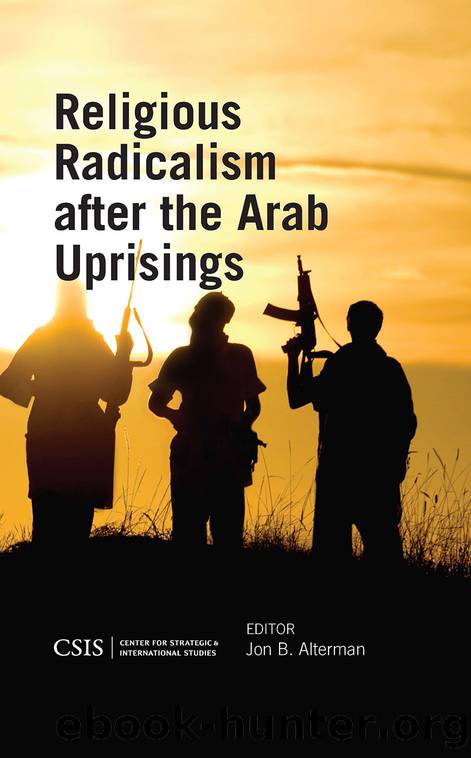
Author:Alterman, Jon B.;Barber, Michael;Malka, Haim;McCants, William;Russakis, Joshua;Sanderson, Thomas M.;
Language: eng
Format: epub
ISBN: 9781442240698
Publisher: ROWMAN & LITTLEFIELD
4. TUNISIA: CONFRONTING EXTREMISM
Haim Malka1
Jihadi-salafi groups thrived in Tunisia after the government of Zine El-Abidine Ben Ali fell in January 2011. They swiftly took advantage of political uncertainty, ideological freedom, and porous borders to expand both their capabilities and area of operations. By the end of 2012 two strains of jihadi-salafism had emerged in the country. The first, which grew directly out of the revolutionary fervor and political openings of the Arab uprisings, prioritized and promoted religious outreach to mainstream audiences, often through social activism.2 Ansar al Shariâa in Tunisia was the largest and most organized group taking this approach. The second strain followed al Qaedaâs traditional method, with organized bands of underground fighters who emerged periodically to launch violent attacks against security forces and the government. This strain was represented by Tunisian jihadi-salafists calling themselves the Okba ibn Nafaa Brigade who established a base in Tunisiaâs Chaambi Mountains on the Tunisian-Algerian border and launched numerous attacks against security forces.3 The first model was primarily a political threat, while the second represented a security threat. Both models overlapped in that they shared the common goal of replacing the existing political order with an Islamic state and were guided by jihadi-salafi ideology, though each pursued a different strategy.
Jihadi-salafi activism of both types poses particular challenges to Tunisia as the country transitions to a competitive political system after decades of authoritarian rule. Until the 2011 revolution, Tunisia had largely been shielded from the extremist violence that had plagued neighboring Algeria and the rest of the region over the last few decades. But as Tunisia wrote its new constitution and moved toward new parliamentary and presidential elections, extremist violence heightened tensions between secularists and political Islamists in the debate over the role of religion in society4 and deepened fissures between Tunisiaâs different Islamist streams.
The evolution of these two distinct yet overlapping models represented a debate over jihadi-salafi strategy in Tunisia after the fall of Ben Ali. Was Tunisia a land of daâwa (spiritual outreach and proselytization) or a land of jihadâin practical terms, should jihadi-salafists use direct violence against the state, or slowly build support through political and social activity in order to further their goals? The debate was complicated by the raging conflict in Syria against the Assad regime, which attracted hundreds and then thousands of young Tunisian men.5 The rural insurgency in Tunisia that pursued al Qaedaâs tradi-tional strategy was clearly violent. In the more politically active urban areas, developments were more ambiguous: jihadi-salafists took advantage of political freedom to organize, preach, and build constituencies. For them this was an important stage in creating a new social and political order based on Islamic law. Even as many urged jihad in Syria, local jihadi-salafi leaders counseled caution at home. Despite their predilection for vigilante violence and intimidation, they avoided confronting security forces or the state directly. For a time, Tunisia became a test case for jihadi-salafi experiments with political openings.
Tunisiaâs Ennahda-led government responded slowly at first to the growing jihadi-salafi threat. The Ennahda-led governmentâs ambivalence was shaped by a combination of politics and ideology.
Download
This site does not store any files on its server. We only index and link to content provided by other sites. Please contact the content providers to delete copyright contents if any and email us, we'll remove relevant links or contents immediately.
Spell It Out by David Crystal(36110)
Life for Me Ain't Been No Crystal Stair by Susan Sheehan(35803)
Cecilia; Or, Memoirs of an Heiress — Volume 1 by Fanny Burney(32546)
Cecilia; Or, Memoirs of an Heiress — Volume 2 by Fanny Burney(31945)
Cecilia; Or, Memoirs of an Heiress — Volume 3 by Fanny Burney(31929)
The Great Music City by Andrea Baker(31916)
Professional Troublemaker by Luvvie Ajayi Jones(29651)
The Secret History by Donna Tartt(19052)
We're Going to Need More Wine by Gabrielle Union(19034)
Twilight of the Idols With the Antichrist and Ecce Homo by Friedrich Nietzsche(18622)
All the Missing Girls by Megan Miranda(15957)
Cat's cradle by Kurt Vonnegut(15335)
Pimp by Iceberg Slim(14488)
Bombshells: Glamour Girls of a Lifetime by Sullivan Steve(14057)
For the Love of Europe by Rick Steves(13908)
Norse Mythology by Gaiman Neil(13348)
Talking to Strangers by Malcolm Gladwell(13347)
Fifty Shades Freed by E L James(13232)
The Social Justice Warrior Handbook by Lisa De Pasquale(12187)
