Political Exercise by Lawrence D. Brown
Author:Lawrence D. Brown
Language: eng
Format: epub
Publisher: Columbia University Press
PARKS AND RECREATION
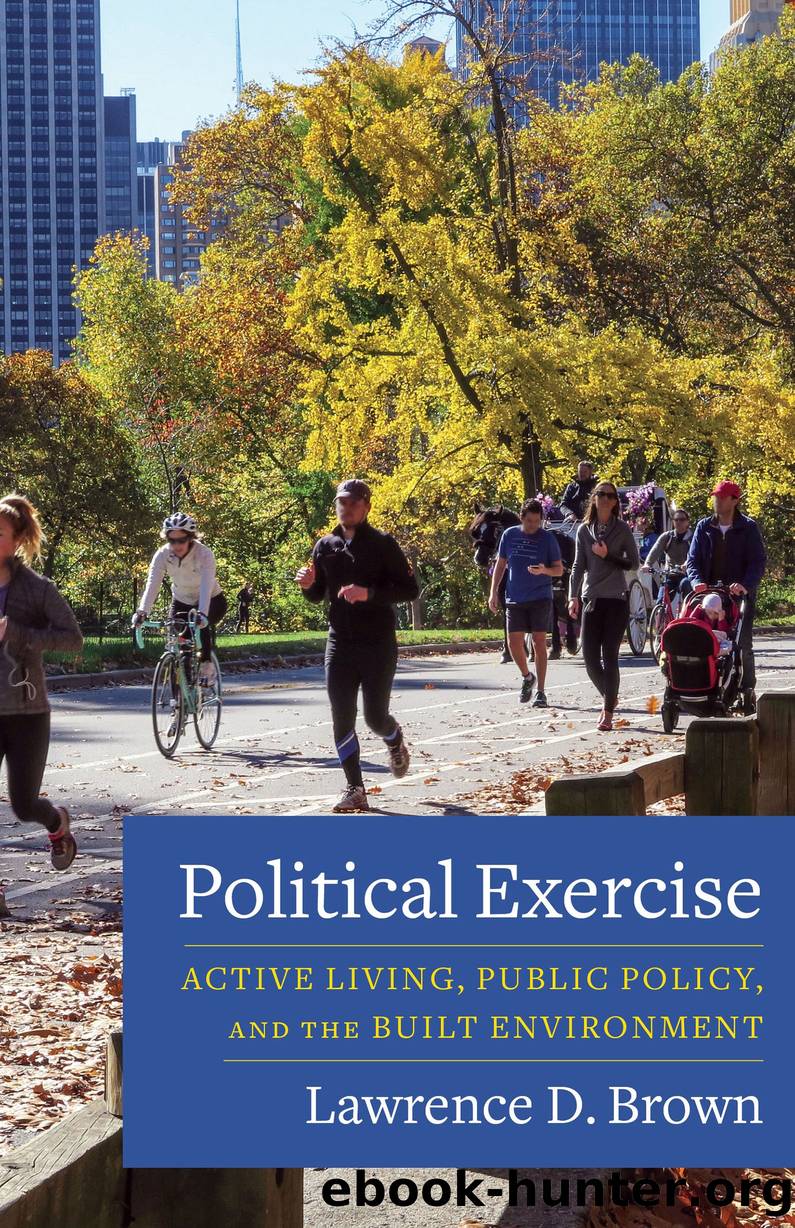
New Yorkâs concrete jungle is studded with parks and green spaces, large and small, that offer opportunities for walking, biking, sports, and after-school programs. Everyone loves parks (which occupy about 14 percent of the cityâs land area), and âlower crime, improving park conditions, and a growing cityâ have encouraged ever-heavier use of them.37 In the early 1980s Central Park welcomed about 12 million visitors but suffered roughly one thousand crimes per year. In 2017 visits had risen to 42 million and crimes had fallen to fewer than one hundred per year.38
The universal affection for parks, however, turns them into big green Rorschach tests that invite conflict over their character and contents. Where should they be located? Should policy emphasize the construction of new parks or the repair of older ones? What should be the relative priority and placement of, say, walkways, playgrounds, lawns, pools, pavilions, gardens, rest rooms, and benches (the latter a mixed blessing for active living aficionados given that, according to one survey, 61 percent of U.S. park-goers call themselves âsedentaryâ).39 And how much does size matter? Although very small parks need work âdesperately,â concentrating on them, said Tupper Thomas, executive director of New Yorkers for Parks, is ânot a good idea.â To make an impact on a community, the focus should be on âmidsized parks. Having a beautiful park nearby, a place where you can meet up with friends or go for a run, is essential.â40
The cityâs more prominent parks, moreover, are battlegrounds on which proponents of pedestrians and cyclists ally in the fight to limit cars. Although Transportation Alternatives has long argued for a complete ban on cars in the parks, its executive director praised as a âgreat leap forwardâ the announcement by Mayor de Blasio in 2015 that major portions of Central Park and Prospect Park would henceforth be off limits to cars on weekdays as well as weekends, thus creating âsafe zones for kids to play in, for bikers, for joggers,â and for others who want to âenjoy the park in peace.â41 Peace cannot be perpetual, however: parks are also sites of skirmishes between cyclists and pedestrians over how car-free space should be apportioned between them.
The complexities inherent in making policy for parks are aggravated by governance arrangements little less diffuse than are the expectations parks evoke. To make policyâand raise moneyâthe Department of Parks and Recreation (DPR) works with various nonprofit conservancies, advocacy groups, private donors, partnerships, funds, trusts, âFriends of,â and alliances; with local public officials (notably borough presidents and members of the city council, who can allot discretionary funds to parks in their jurisdictions); with community groups; and with consultants, architectural and design firms, and researchers.
Public agencies other than DPR also get into the act. Parks are important to the greenness that the Department of Environmental Protection seeks to promote, may figure in the design and maintenance of housing under the control of the New York City Housing Authority, are loci of instruction and recreation for school children the
Download
This site does not store any files on its server. We only index and link to content provided by other sites. Please contact the content providers to delete copyright contents if any and email us, we'll remove relevant links or contents immediately.
Spell It Out by David Crystal(36245)
Life for Me Ain't Been No Crystal Stair by Susan Sheehan(35908)
The Great Music City by Andrea Baker(33778)
Cecilia; Or, Memoirs of an Heiress — Volume 1 by Fanny Burney(32727)
Cecilia; Or, Memoirs of an Heiress — Volume 2 by Fanny Burney(32093)
Cecilia; Or, Memoirs of an Heiress — Volume 3 by Fanny Burney(32069)
Professional Troublemaker by Luvvie Ajayi Jones(29774)
The Secret History by Donna Tartt(19480)
We're Going to Need More Wine by Gabrielle Union(19193)
Twilight of the Idols With the Antichrist and Ecce Homo by Friedrich Nietzsche(18784)
All the Missing Girls by Megan Miranda(16756)
Cat's cradle by Kurt Vonnegut(15569)
For the Love of Europe by Rick Steves(14956)
Pimp by Iceberg Slim(14806)
Bombshells: Glamour Girls of a Lifetime by Sullivan Steve(14227)
Norse Mythology by Gaiman Neil(13584)
Talking to Strangers by Malcolm Gladwell(13563)
Fifty Shades Freed by E L James(13363)
The Social Justice Warrior Handbook by Lisa De Pasquale(12301)
