Paderewski by Adam Zamoyski
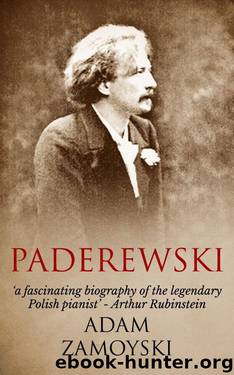
Author:Adam Zamoyski [Zamoyski, Adam]
Language: eng
Format: epub
Publisher: Endeavour Press
Published: 2014-12-03T08:00:00+00:00
Chapter Nine – The Politician
As soon as the little boy from Kurylowka had become “somebody” — which he had beyond his wildest expectations — he began to indulge his other childhood dream, of helping his country. The urge to become a great artist had never succeeded in distracting him from this ulterior goal. If anything, the dream had overshadowed and even, it could be argued, submerged his artistic development. The artistically harmful need for money was in large measure dictated by his desire to play a semi-political role. His patriotic outlook had cut him off from other composers and imposed not only nationalistic but even political functions on his own works, particularly in the case of Manru and the Symphony. Some of the resentment he felt towards the piano was the result of frustrated ambitions which were not those of a composer.
Paderewski had helped Poland indirectly in myriad ways. He had given money to individuals or groups of his countrymen and, by the example of his success, encouraged them. To the world at large he had played the part of cultural ambassador, taking every opportunity to acquaint foreigners with the plight and aspirations of his nation. In Poland he used every concert or banquet to make a statement which, however veiled, told his compatriots to take heart and look to the future. And he now embarked on his most ambitious project to date, which was to be a gesture to his country and a clarion call to Poles throughout the world.
When only a boy Paderewski had been much stirred by accounts of the Polish victory against the Teutonic Knights at Grunwald — which the Germans call the Battle of Tannenberg — in 1410. The pride he felt in this event, comparable to that felt by an English schoolboy when he reads of Agincourt or Waterloo, had remained with him, accentuated by the bleak reality of the present. The approaching quincentenary of the battle had fixed itself in his mind, and he had determined to commemorate it in some way. In 1908 he met in Paris a young Polish sculptor, Antoni Wiwulski, and commissioned him to make a project for a monument. The project met with his approval, and he decided to go ahead with the plan. For the site he chose Cracow, in Austrian-ruled Poland, which had been the capital at the time of Grunwald.
The monument was ready by January 1910 and the unveiling ceremony was set for July. The event was anticipated with excitement throughout Poland, and when the day came, hundreds of thousands gathered in the old city. There were the political leaders, the aristocracy, but there were also peasants from the depths of Lithuania and the Ukraine, as well as Poles from America. The day began with a mass followed by a procession; then came the unveiling, after which Paderewski made a speech to some 150,000 people gathered round the monument. It was a brilliant piece of oratory, perfectly judged; it could cause offence or irritation to
Download
This site does not store any files on its server. We only index and link to content provided by other sites. Please contact the content providers to delete copyright contents if any and email us, we'll remove relevant links or contents immediately.
The Great Music City by Andrea Baker(33664)
Aircraft Design of WWII: A Sketchbook by Lockheed Aircraft Corporation(32384)
Call Me by Your Name by André Aciman(20735)
The Secret History by Donna Tartt(19475)
The Art of Boudoir Photography: How to Create Stunning Photographs of Women by Christa Meola(18761)
Shoot Sexy by Ryan Armbrust(17854)
Plagued by Fire by Paul Hendrickson(17541)
Portrait Mastery in Black & White: Learn the Signature Style of a Legendary Photographer by Tim Kelly(17107)
Adobe Camera Raw For Digital Photographers Only by Rob Sheppard(17094)
Photographically Speaking: A Deeper Look at Creating Stronger Images (Eva Spring's Library) by David duChemin(16800)
Ready Player One by Cline Ernest(15148)
Pimp by Iceberg Slim(14804)
Bombshells: Glamour Girls of a Lifetime by Sullivan Steve(14220)
The Goal (Off-Campus #4) by Elle Kennedy(13968)
Art Nude Photography Explained: How to Photograph and Understand Great Art Nude Images by Simon Walden(13147)
Kathy Andrews Collection by Kathy Andrews(12096)
The Priory of the Orange Tree by Samantha Shannon(9364)
The remains of the day by Kazuo Ishiguro(9225)
Thirteen Reasons Why by Jay Asher(9126)
