Old Irish glass by Stannus Graydon Mrs
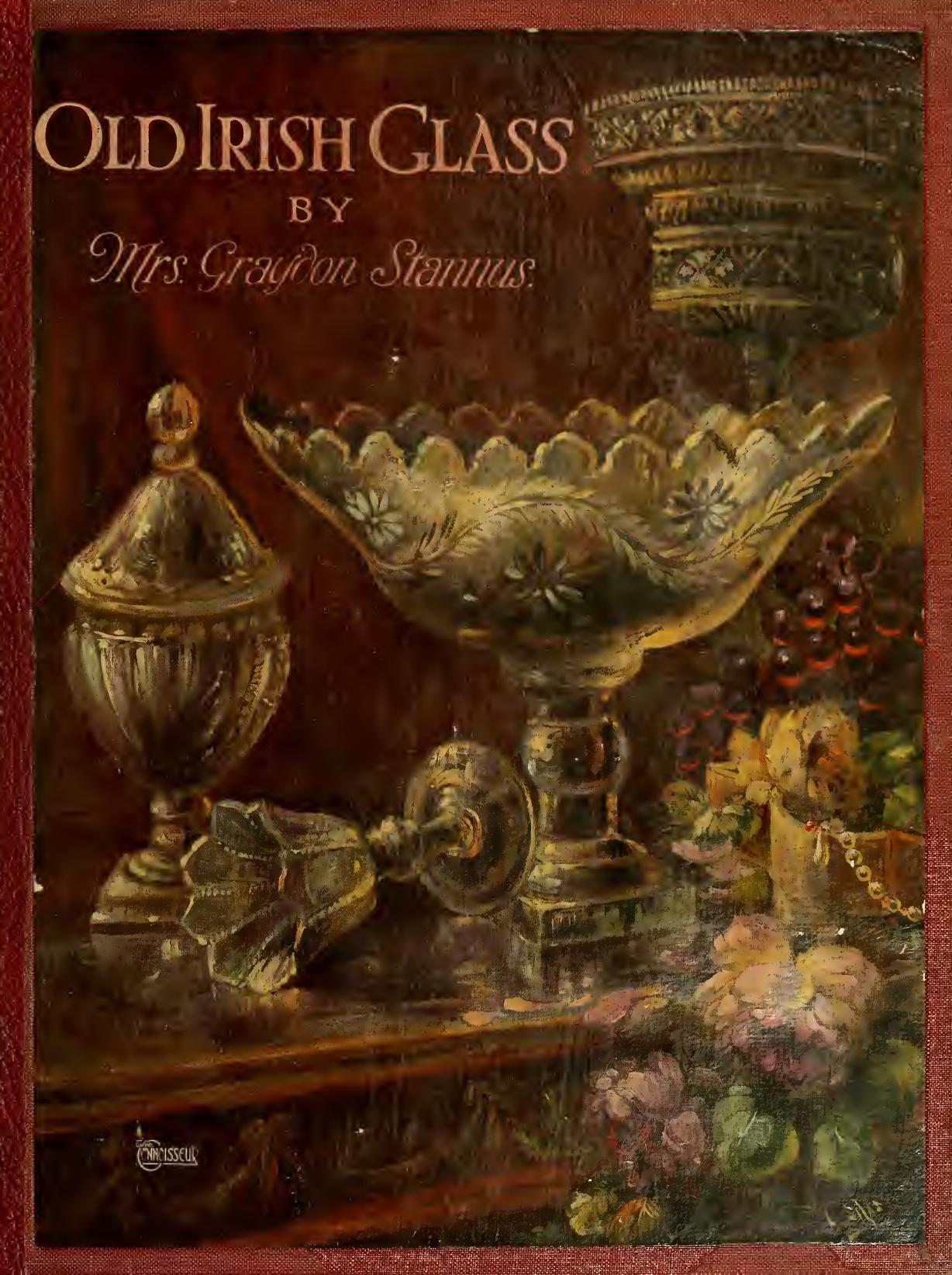
Author:Stannus, Graydon, Mrs
Language: eng
Format: epub, pdf
Tags: Glassware, Cut glass
Publisher: London : The Connoisseur
Published: 1921-03-25T05:00:00+00:00
they should be. Some time ago I parted with a magnificent Waterford bowl, beautifully toned in this manner, only to find a week later that it had been chemically polished clear and bright, leaving it with not a tithe of its pristine beauty.
These distinctions of tone and colour which f have ventured to point out are by no means universal, so that a piece which does not possess them must not be rejected as spurious merely on iliis account. Sometimes it is impossible to say from what county a piece came, and this has led experts to refer to the products supposed to emanate from the Cork or Waterford factories as " Munster glass." Even this term is not broad enough, however, for it fails to include the pieces turned out by the Dublin factories, and these are nearly as likely to be mistaken for Cork or Waterford wares, as the two latter are likely to be mistaken for each other. The blue-grey tinge popularly regarded as exclusively associated luith Waterford glass is quite an erroneous means of identification^ as most of the pieces I have come across, actually impressed with the mark " Cork Glass Co.," were of this tint. Dublin glass, before 1800, was very dark in colour, and the very early pieces are almost black.
It IS very frequently suggested that the chemical action of the air on old frish glass may have something to do with the mystery of its unique coloration; and, strange as it may seem, it is an undoubted fact that glass does change its tone with the slow lapse of _\'ears. I believe this to be specially so with Irish glass which has remained a long time 111 Ireland; and the existence of such phenomena is borne out by the effect that the atmosphere of Ireland has on old white marble. It ma)-be argued that, should this be the case, the coloration of Irish glass may be caused entirely by the atmospheric conditions under which it is kept, and owe nothing to its local peculiarities of manufacture. This theory, however, cannot be substantiated, as English glass does not appear to be affected b y Irish atmosphere to anything like the same degree as the native metal. I have frequently seen old Irish dessert services and chandeliers in which individual pieces which had been broken had been replaced by facsimiles made in England. These replaced pieces, however early their origin, do not appear to have changed colour in the least, and because of this can be readil}' singled out among their fellows of native manufacture.
RESILIENCE OF IRISH GLASS.
Irish glass is far tougher and stronger than any other, hence its wonderful survival even when m constant use. It takes a severe blow to break it, or even chip it, and I have seen solid pieces fall on a hard floor without being any the worse, beyond "singing" loudly. It has a wonderful elasticity, and actually bounces in a way that 1 have never found in any other glass.
Download
This site does not store any files on its server. We only index and link to content provided by other sites. Please contact the content providers to delete copyright contents if any and email us, we'll remove relevant links or contents immediately.
The Great Music City by Andrea Baker(33777)
Aircraft Design of WWII: A Sketchbook by Lockheed Aircraft Corporation(32385)
Call Me by Your Name by André Aciman(20740)
The Secret History by Donna Tartt(19480)
The Art of Boudoir Photography: How to Create Stunning Photographs of Women by Christa Meola(18772)
Shoot Sexy by Ryan Armbrust(17860)
Plagued by Fire by Paul Hendrickson(17545)
Portrait Mastery in Black & White: Learn the Signature Style of a Legendary Photographer by Tim Kelly(17108)
Adobe Camera Raw For Digital Photographers Only by Rob Sheppard(17098)
Photographically Speaking: A Deeper Look at Creating Stronger Images (Eva Spring's Library) by David duChemin(16802)
Ready Player One by Cline Ernest(15157)
Pimp by Iceberg Slim(14806)
Bombshells: Glamour Girls of a Lifetime by Sullivan Steve(14227)
The Goal (Off-Campus #4) by Elle Kennedy(13979)
Art Nude Photography Explained: How to Photograph and Understand Great Art Nude Images by Simon Walden(13152)
Kathy Andrews Collection by Kathy Andrews(12109)
The Priory of the Orange Tree by Samantha Shannon(9370)
The remains of the day by Kazuo Ishiguro(9229)
Thirteen Reasons Why by Jay Asher(9135)
