Nation-Building, State and the Genderframing of Women's Rights in the United Arab Emirates by Pinto Vania Carvalho;
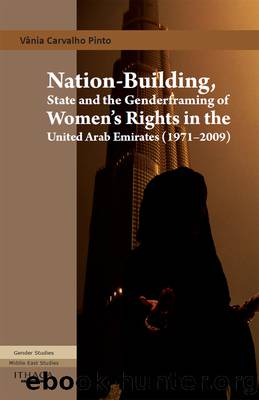
Author:Pinto, Vania Carvalho;
Language: eng
Format: epub
Publisher: Garnet Publishing (UK) Ltd
4.2. Cultural anxieties I: tradition and UAE womenâs roles
The above examination of the significance that cultural preservation acquired within the Emirati context elicits a deep, albeit gradual shift in terms of how the idea of modernity came to be popularly understood in the UAE. Modernity, believed in the 1970s to demand an overall change of mentality, underscored at the time the negation of traditional ways of life and social practices, which were then perceived as the hallmarks of backwardness (see Chapter 2). As explored in the previous section, in the period ranging from the late 1970s to the mid-1980s, these understandings came to be reshaped into a sharp critique punctuated by claims of loss of âcultural authenticityâ. Concomitantly, tradition has been recreated and reconfigured so as to adjust to conditions of modern life. The preservation of the indigenous character of society has been a paramount concern in this endeavour, and has given rise to attempted forgings of alternative paths of development that could simultaneously ensure economic growth and the preservation of the local character of society.24 Indeed, it can even be suggested that the ultimate expression of this assertion can be found in the recently launched âempowermentâ concept, already alluded to. Nonetheless, in the point where this societal discourse assumes an explicit gender focus, it is necessary, for the sake of analytical comparison, to briefly recall the role that UAE women were ascribed in the early days of the country.
As discussed in Chapter 2, upon the coming of independence in 1971, the modernization of societal values and family practices was depicted as crucial for the survival and legitimization of the new state. Within this context, the potential role of UAE women was ascribed significant weight, since it was expected that they, both as mothers and as managers of the household, could instil in the family habits associated with a âmodernâ lifestyle. In the late 1970s and throughout the 1980s, given the widespread feelings that modernization had perhaps gone too far, and that Emirati society risked being transformed beyond recognition, the continuous deployment of the genderframe under the banner of modernization (see section 2.4.) was no longer feasible for it was feared that it might elicit more opposition than support. Specifically, since the idea of modernization had acquired such negative emotional connotations, it can be suggested that decision-makers were apprehensive of its popular association with cultural obliteration, and feared that the female realizations hitherto accomplished could be undermined.
This was particularly true in relation to womenâs employment. Contrastingly, education for women had become increasingly acceptable, perhaps due to its perceived less family-threatening features. Womenâs employment, as a policy always difficult to promote due to deep-rooted convictions (see section 3.3.), was significantly challenged by the upsurge of anxieties connected to family well-being in the 1980s. With the appearance of new social problems such as teenager delinquency and drug abuse, the blame was routinely placed on womenâs employment, seemingly because this distracted them from family duties. Societal support for womenâs public activities was further
Download
This site does not store any files on its server. We only index and link to content provided by other sites. Please contact the content providers to delete copyright contents if any and email us, we'll remove relevant links or contents immediately.
Spell It Out by David Crystal(36110)
Life for Me Ain't Been No Crystal Stair by Susan Sheehan(35804)
Cecilia; Or, Memoirs of an Heiress — Volume 1 by Fanny Burney(32548)
Cecilia; Or, Memoirs of an Heiress — Volume 2 by Fanny Burney(31947)
Cecilia; Or, Memoirs of an Heiress — Volume 3 by Fanny Burney(31932)
The Great Music City by Andrea Baker(31917)
Professional Troublemaker by Luvvie Ajayi Jones(29651)
The Secret History by Donna Tartt(19058)
We're Going to Need More Wine by Gabrielle Union(19035)
Twilight of the Idols With the Antichrist and Ecce Homo by Friedrich Nietzsche(18625)
All the Missing Girls by Megan Miranda(15962)
Cat's cradle by Kurt Vonnegut(15339)
Pimp by Iceberg Slim(14489)
Bombshells: Glamour Girls of a Lifetime by Sullivan Steve(14058)
For the Love of Europe by Rick Steves(13933)
Talking to Strangers by Malcolm Gladwell(13350)
Norse Mythology by Gaiman Neil(13349)
Fifty Shades Freed by E L James(13233)
The Social Justice Warrior Handbook by Lisa De Pasquale(12187)
