Military, Monarchy and Repression: Assessing Thailand's Authoritarian Turn by Kevin Hewison & Veerayooth Kanchoochat
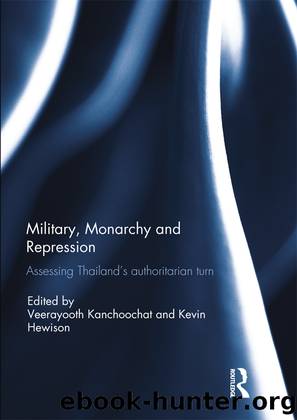
Author:Kevin Hewison & Veerayooth Kanchoochat [Hewison, Kevin & Kanchoochat, Veerayooth]
Language: eng
Format: epub
ISBN: 9781138215658
Goodreads: 30153443
Publisher: Routledge
Published: 2016-12-20T00:00:00+00:00
Phase 3: Rise and fall of judicialisation
The 2007 Constitution drafters, sympathetic to the idea of the âjudicialisation of politics,â and following the 2006 kingâs injunction and the ideas of royalist academic Thirayuth, intended to give the judiciary the means to act in ways that effectively took on the kingâs role as supreme arbitrator; they intended to give judges royal powers in times of crisis. In a document outlining the objectives of the Constitution distributed by the Constitution-Drafting Committee to Constitution-Drafting Assembly members, it was stated: âDo not let a government which was dismissed act as interim government.â Instead, it was provided that âthe Constitutional Court President, the President of the Supreme Court and the Supreme Administrative Court choose a special interim cabinet, which should be comprised of people with experience in administrationâ (Constitution Drafting Committee, Summary of CDC opinions regarding political institutions submitted to CDA, March 19, 2007, Parliament Secretariat, point 5.3: 21).
This proposal was translated into the fourth paragraph of Article 68 in the constitution, softening the draft version, from giving judges the authority to select a cabinet to giving judges the mandate to âmeetâ to âconsider ways to solve the problem.â The final version also added representatives from the political branch. In the draft version of the 2007 Constitution, Article 68 read:
If there is a national crisis or a political situation where it is necessary, there shall be a meeting of the following: the Prime Minister, President of House of Representatives, President of the Senate, Leader of the Opposition, President of the Constitution Court, President of the Supreme Court, President of the Supreme Administrative Court, and President(s) of Independent Agencies under the Constitution, to consider ways to solve the problem. (Draft of the 2007 Constitution, public hearings version submitted for public hearings in April 2007, Article 68 para. 4)
Download
This site does not store any files on its server. We only index and link to content provided by other sites. Please contact the content providers to delete copyright contents if any and email us, we'll remove relevant links or contents immediately.
Spell It Out by David Crystal(36183)
Life for Me Ain't Been No Crystal Stair by Susan Sheehan(35868)
The Great Music City by Andrea Baker(32738)
Cecilia; Or, Memoirs of an Heiress — Volume 1 by Fanny Burney(32663)
Cecilia; Or, Memoirs of an Heiress — Volume 2 by Fanny Burney(32028)
Cecilia; Or, Memoirs of an Heiress — Volume 3 by Fanny Burney(32011)
Professional Troublemaker by Luvvie Ajayi Jones(29719)
The Secret History by Donna Tartt(19364)
We're Going to Need More Wine by Gabrielle Union(19125)
Twilight of the Idols With the Antichrist and Ecce Homo by Friedrich Nietzsche(18712)
All the Missing Girls by Megan Miranda(16435)
Cat's cradle by Kurt Vonnegut(15475)
Pimp by Iceberg Slim(14719)
For the Love of Europe by Rick Steves(14682)
Bombshells: Glamour Girls of a Lifetime by Sullivan Steve(14153)
Norse Mythology by Gaiman Neil(13482)
Talking to Strangers by Malcolm Gladwell(13476)
Fifty Shades Freed by E L James(13310)
The Social Justice Warrior Handbook by Lisa De Pasquale(12259)
