Making Do in Damascus by Gallagher Sally K.;
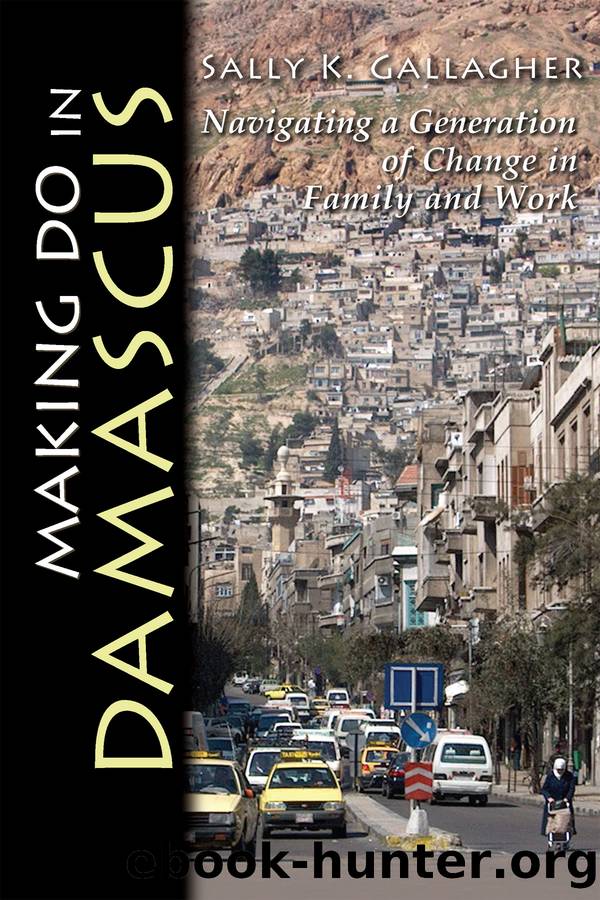
Author:Gallagher, Sally K.;
Language: eng
Format: epub
Publisher: Syracuse University Press
Published: 2021-02-02T00:00:00+00:00
Because practices around gender dependency and patronage are so deeply established, changes in womenâs status and rights under the law and educating women about those changes must take place before women have greater independent access to resources. The difficulty is that the notion of independent resources cuts across the grain of mutual interdependence that is foundational to sense of self as well as to social and economic security.
Elites: Privilege and Subordination
Damascus elites have access to all the best their culture has to offer: substantial financial resources; extensive political and social connections that are the foundation of a familyâs influence; extensive family in Syria and elsewhere; inexpensive basic goods; a car and, in many cases, a driver, which make traveling to Lebanon to shop or to the mountains for a holiday as easy as possible. Damascus elites also have a strong moral and religious framework that supports deeply held values around supporting family, generosity, respect, and care for the poor. The experiences of some elite women in Damascus, however, also reflect a profound loneliness, ennui, fear of loss of status and self through divorce, and ambivalence around relationships with kith and kin. The resources of social class alleviate the drudgery and tedium of household management, to be sure, yet resources themselves do little to assuage more personal questions around meaning, identity, and purpose.
For elite Damascene women, the ideal marriage is both hierarchical and complementary. Men and women are different, they argue, and so their responsibilities and ways of relating to each other and with their children are also different. In echoes of Western notions of essentialized gender differences, I was frequently told, âWomen are not rationalâthey are nurturing and emotional and need men to help them make decisions.â Stereotypes of women as the more natural parent, more emotional and empathetic, and of men as stronger and more rational and having better business sense were very strong. Each of these qualities is seen as having implications for family life. Consider, for example, an excerpt from a discussion with young adults (most of them married) in an advanced language class at the American Language Center.
LANA (married girl in her twenties): For a long, long time, maybe since the creation of the universe, jobs in life have been divided between male and female. The man is responsible for survival issues and hard labor. The woman is concerned about domestic lifeâcleaning, cooking, and raising children. This idea is deep inside us; it is in our very blood. The man is the breadwinner, and the woman is the housekeeper.
KHALID (single man in his thirties): Women are valued in Syria. Their value is in the home. Men and women are different, so we cannot think of them as being the same. Their value comes from doing their job well. A doctor is not more valuable than an engineer, but they are not the same. When I am sick, I want a doctor; when I want to build a house, I want an engineer.
Download
This site does not store any files on its server. We only index and link to content provided by other sites. Please contact the content providers to delete copyright contents if any and email us, we'll remove relevant links or contents immediately.
Spell It Out by David Crystal(36098)
Life for Me Ain't Been No Crystal Stair by Susan Sheehan(35783)
Cecilia; Or, Memoirs of an Heiress — Volume 1 by Fanny Burney(32523)
Cecilia; Or, Memoirs of an Heiress — Volume 2 by Fanny Burney(31928)
Cecilia; Or, Memoirs of an Heiress — Volume 3 by Fanny Burney(31912)
The Great Music City by Andrea Baker(31894)
Professional Troublemaker by Luvvie Ajayi Jones(29641)
We're Going to Need More Wine by Gabrielle Union(19019)
The Secret History by Donna Tartt(18994)
Twilight of the Idols With the Antichrist and Ecce Homo by Friedrich Nietzsche(18599)
All the Missing Girls by Megan Miranda(15882)
Cat's cradle by Kurt Vonnegut(15293)
Pimp by Iceberg Slim(14461)
Bombshells: Glamour Girls of a Lifetime by Sullivan Steve(14036)
For the Love of Europe by Rick Steves(13792)
Talking to Strangers by Malcolm Gladwell(13327)
Norse Mythology by Gaiman Neil(13312)
Fifty Shades Freed by E L James(13214)
The Social Justice Warrior Handbook by Lisa De Pasquale(12175)
