Learning from the Student's Perspective by Cook-Sather Alison;Clarke Brandon;Condon Daniel;Cushman Kathleen;Demetriou Helen;Easton Lois;
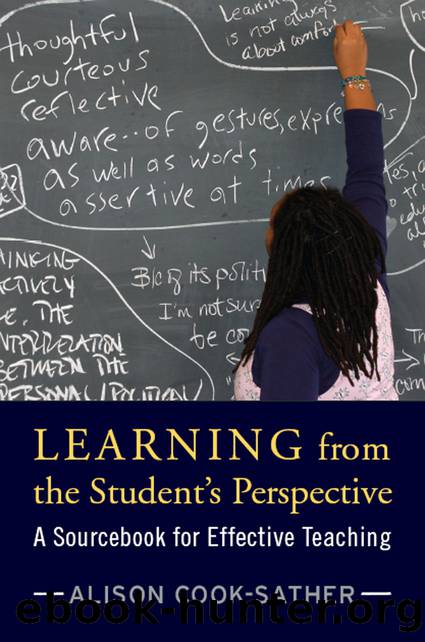
Author:Cook-Sather, Alison;Clarke, Brandon;Condon, Daniel;Cushman, Kathleen;Demetriou, Helen;Easton, Lois;
Language: eng
Format: epub
ISBN: 4186024
Publisher: Taylor & Francis Group
10
Beyond âWiggle Roomâ
Creating Spaces for Authentic Learning in a Twelfth-Grade English Class
Marsha Rosenzweig Pincus
Chapter Overview
Focus of this chapter: A case study of a challenging senior English class built around student interest and perspectives as an occasion for an urban teacher to reflect on her thirty-four-year career.
Discussed in this chapter:
⢠Prologue: The last act
⢠Inquiry across the lifespan: âI used to be an English teacherâ
⢠Creating âwiggle roomââdesigning the course
⢠Sample of student choice in text selection
⢠Moving beyond âwiggle roomâ: The intellectual autobiography
⢠A fitting final: Student-generated exam questions
⢠Conclusion: Student voice and teacher integrity
I would like to see a curriculum that is not so structured and restricting, with some wiggle room. Iâd like to have a variation of different teaching methods and materials: a class that isnât so predictable. Iâd like to read books that make sense and have actual meanings. Iâd also like to do different types of writing instead of just essays.
âBrent
It is possible that my previous English classes restricted me from my constitutional pursuit of happiness and that my subconscious saw this as a violation of my inalienable rights. As you have not prohibited enjoyment in the class, I think youâve already made English matter more than it has in the past.
âTiffany
The class would be more interesting to the students if we really had a say in the class. For example, most English teachers will force students to analyze every minor detail in a book because they feel that there are so many metaphors, symbols, and motifs behind the text. However, when this happens, students leave simply knowing those metaphors and motifs without really understanding the deeper concepts in the text. Thus, if we could really share our opinions on different books that we read in class without being confined to finding the symbols, the class would be much more meaningful.
âShanita
Prologue: The Last Act
As the summer of 2007 was winding down, I was preparing myself for what was to be my thirty-fourth and final year of teaching in the School District of Philadelphia and my tenth year at J. R. Masterman Laboratory and Demonstration School. I was all set to teach the same courses I had been teaching for the past five yearsâtwo sections of an Honors English 3 class with an emphasis on American literature and two sections of a popular senior elective entitled âDrama and Inquiry.â I was looking forward to a pleasant but uneventful school year to cap off an interesting and rewarding career when I was shaken from my complacency during the last week of August by an e-mail from my principal. In addition to my other courses, I was told, I would be teaching a section of English 4. This was not good news.
Masterman, a magnet high school for academically talented and mentally gifted students from every neighborhood in Philadelphia, is considered one of the most successful high schools in the country. By most accounts it is a desirable place to teach. That is, of course, unless you teach seniors, who are notoriously difficult to engage.
Download
This site does not store any files on its server. We only index and link to content provided by other sites. Please contact the content providers to delete copyright contents if any and email us, we'll remove relevant links or contents immediately.
Spell It Out by David Crystal(36110)
Life for Me Ain't Been No Crystal Stair by Susan Sheehan(35804)
Cecilia; Or, Memoirs of an Heiress — Volume 1 by Fanny Burney(32547)
Cecilia; Or, Memoirs of an Heiress — Volume 2 by Fanny Burney(31945)
Cecilia; Or, Memoirs of an Heiress — Volume 3 by Fanny Burney(31931)
The Great Music City by Andrea Baker(31917)
Professional Troublemaker by Luvvie Ajayi Jones(29651)
The Secret History by Donna Tartt(19053)
We're Going to Need More Wine by Gabrielle Union(19034)
Twilight of the Idols With the Antichrist and Ecce Homo by Friedrich Nietzsche(18622)
All the Missing Girls by Megan Miranda(15958)
Cat's cradle by Kurt Vonnegut(15335)
Pimp by Iceberg Slim(14488)
Bombshells: Glamour Girls of a Lifetime by Sullivan Steve(14057)
For the Love of Europe by Rick Steves(13911)
Talking to Strangers by Malcolm Gladwell(13349)
Norse Mythology by Gaiman Neil(13348)
Fifty Shades Freed by E L James(13232)
The Social Justice Warrior Handbook by Lisa De Pasquale(12187)
