Honduras in Dangerous Times by Phillips James J. ;
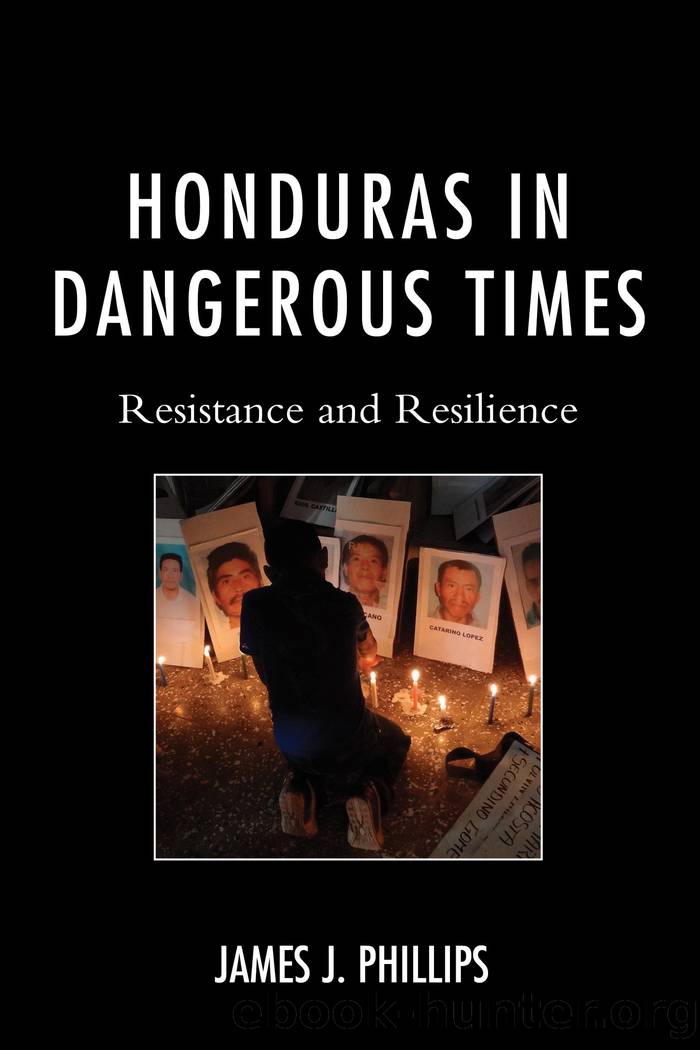
Author:Phillips, James J.,;
Language: eng
Format: epub
Tags: undefined
Publisher: Lexington Books
Published: 2012-08-15T00:00:00+00:00
Farming, Environment, and Sustainability
As the number of landless peasants and farmers continued to increase during the 1990s and into the new century, peasant organizations and cooperatives continued to engage in tomas de tierra (land taking) for growing crops, protests against the seizure of peasant community and cooperative land by large landowners and companies, and attempts to call attention to widespread hunger and food insecurity. The many examples of rural peasant and indigenous people and organizations engaged in forms of direct resistance to mining and logging operations near their communities were attempts to protect natural resources of land, air, and water as the physical bases of both farming and local community life. Peasant and indigenous communities found allies among middle-class Hondurans, environmental groups, and non-governmental organizations interested in rural community development, such as the Association of Non-Governmental Organizations (ASONOG). In 2001, some of these groups joined to launch an anti-mining campaign with the slogan, âHonduras is worth more than gold.â[15]
What seemed like defensive and short-term survival efforts often had another dimension. Peasant land takeovers reflected crucial short-term needs to ensure food for the present, but they also reflected a realization that peasants could not depend on government to make good on the old promises of the agrarian reform.[16] Forms of proactive resistance began to emerge that emphasized environmental and sustainable farming, appropriate agricultural technology, developing small farming and community regimes that cared for both present need and future resources, a shift in thinking about food and nutrition, and an emphasis on holistic or integral rural community development. All were elements in an emerging movement of resilience. Resistance meant building an alternative future, although it cannot be said with confidence that everyone engaged in these activities with that larger ârevolutionaryâ objective consciously in mind beyond an immediate and personal or local need to find more practical solutions to daily problems. For some, the idea that their activities might be a form of resistance was a gradual realization.
An important element in the development of farming as resilient resistance was recognition that traditional forms of peasant and small farming in Honduras were not always ecologically sound or sustainable.[17] Sustainability is a relative term whose meaning depends in part upon the external context in which one lives and functions. In Honduras in the 1990s and after, that external context included the many threats to rural communities and the natural environment that have already been mentioned, government policies that did not favor peasants and small farmers, and an apparently constricting access to land and good natural resources. For individuals these trends could be perceived as an increasing sense of insecurity, and a loss of independence and self-reliance tied to a loss of land, resources, and community.[18] Threats to sustaining a good way of life came in the form of loss of independence and increasing dependency.
The meaning of sustainability also depends upon differing personal or internal goals and measures such as the standard of living, level of food consumption, and length of existence a peasant family regards as acceptable or desirable.
Download
This site does not store any files on its server. We only index and link to content provided by other sites. Please contact the content providers to delete copyright contents if any and email us, we'll remove relevant links or contents immediately.
Spell It Out by David Crystal(36108)
Life for Me Ain't Been No Crystal Stair by Susan Sheehan(35796)
Cecilia; Or, Memoirs of an Heiress — Volume 1 by Fanny Burney(32538)
Cecilia; Or, Memoirs of an Heiress — Volume 2 by Fanny Burney(31935)
Cecilia; Or, Memoirs of an Heiress — Volume 3 by Fanny Burney(31925)
The Great Music City by Andrea Baker(31911)
Professional Troublemaker by Luvvie Ajayi Jones(29647)
We're Going to Need More Wine by Gabrielle Union(19032)
The Secret History by Donna Tartt(19032)
Twilight of the Idols With the Antichrist and Ecce Homo by Friedrich Nietzsche(18618)
All the Missing Girls by Megan Miranda(15927)
Cat's cradle by Kurt Vonnegut(15326)
Pimp by Iceberg Slim(14476)
Bombshells: Glamour Girls of a Lifetime by Sullivan Steve(14046)
For the Love of Europe by Rick Steves(13872)
Talking to Strangers by Malcolm Gladwell(13341)
Norse Mythology by Gaiman Neil(13333)
Fifty Shades Freed by E L James(13228)
The Social Justice Warrior Handbook by Lisa De Pasquale(12182)
