Home-Land: Romanian Roma, Domestic Spaces and the State by Humphris Rachel
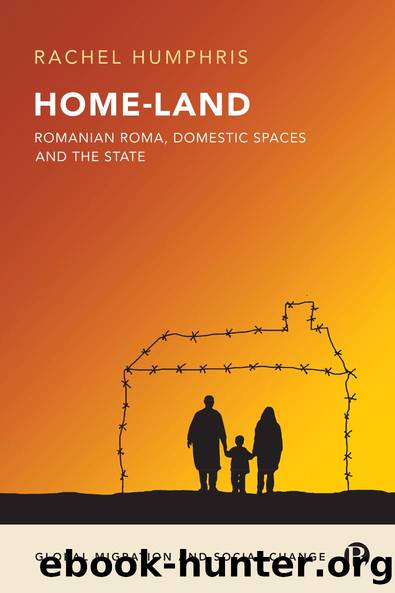
Author:Humphris, Rachel [Humphris, Rachel]
Language: eng
Format: epub
Tags: Social Science, Emigration & Immigration, Minority Studies, Discrimination & Race Relations
ISBN: 9781529201963
Google: uVgqygEACAAJ
Publisher: Bristol University Press
Published: 2019-01-15T05:13:57+00:00
The home: space, relationships and values
First, this section explores how spaces are imbued with meanings, with effects for the home encounter and the interactions that take place there. I build on previous scholarly attention to the dichotomy between public and private space. I draw on this literature to demonstrate how and why particular values and norms of behaviour have developed around the home with implications for citizenship. Second, this section shows how these values come to have specific meanings in particular situations. Third, it explores the contradictions within the public and private space that are revealed and exacerbated when frontline workers enter the home. Finally, it concludes to bring these three elements together to argue that the location of encounters in the home fundamentally affects how Romanian Roma form relationships with frontline workers and shapes the performances and negotiations that are able to take place.
The fact that interactions took place in the home brought many other aspects of migrantsâ lives into view. All of these aspects then became part of the encounter and affected how the label Romanian Roma developed for frontline workers and increased the number of different aspects that mothers had to negotiate to be seen as a âgood motherâ (see âStaging the homeâ later in this chapter). Moreover, meanings began to be formed before a frontline workers had set foot inside the house; for example, gardens were discussed to make meanings about Romanian Roma mothers (see âThresholds and gardensâ).
Relationships between support workers and mothers were shifting and contingent. The following encounters explore the fragility through which value judgements about mothering are constructed and negotiated within home spaces. In addition, the crucial importance of these relationships for navigating legal statuses in the UK are demonstrated, as well as the constrained positions that mothers are placed in because the encounters occur in âprivateâ space.
It is important to note the underpinning for the dichotomy between the âpublic and privateâ. The dichotomy has multiple uses and has been deemed one of the most âpowerful signifiers of how our social worlds are orderedâ (Davidoff 1999: 268). Nevertheless it must also be remembered that this division is a fiction, but a fiction that is mobilised in particular ways and has very real consequences. The private-public distinction is often used to describe the split between the state and the family. It has roots in how liberal democratic nation-states are organised. An underpinning logic of this organisation is how those living within the territory of a nation-state are turned into citizens with individual rights and responsibilities. The role of the citizen in this formulation is deeply permeated by gendered imaginations of family and personhood. Gendered expectations split the public space as a privileged space for men and the private and âdomesticâ as the sphere for women (see Pateman and Phillips 1987: 119; Chapman and Hockey 1999: 10â13; Massey 2007: 237â8).
The space of the home has come to be recognised as the quintessential physical and emotional setting for intimate lives in European welfare states and in
Download
This site does not store any files on its server. We only index and link to content provided by other sites. Please contact the content providers to delete copyright contents if any and email us, we'll remove relevant links or contents immediately.
Spell It Out by David Crystal(36118)
Life for Me Ain't Been No Crystal Stair by Susan Sheehan(35811)
Cecilia; Or, Memoirs of an Heiress — Volume 1 by Fanny Burney(32559)
The Great Music City by Andrea Baker(32020)
Cecilia; Or, Memoirs of an Heiress — Volume 2 by Fanny Burney(31957)
Cecilia; Or, Memoirs of an Heiress — Volume 3 by Fanny Burney(31943)
Professional Troublemaker by Luvvie Ajayi Jones(29668)
The Secret History by Donna Tartt(19096)
We're Going to Need More Wine by Gabrielle Union(19049)
Twilight of the Idols With the Antichrist and Ecce Homo by Friedrich Nietzsche(18638)
All the Missing Girls by Megan Miranda(16033)
Cat's cradle by Kurt Vonnegut(15361)
Pimp by Iceberg Slim(14513)
For the Love of Europe by Rick Steves(14135)
Bombshells: Glamour Girls of a Lifetime by Sullivan Steve(14077)
Talking to Strangers by Malcolm Gladwell(13374)
Norse Mythology by Gaiman Neil(13371)
Fifty Shades Freed by E L James(13244)
The Social Justice Warrior Handbook by Lisa De Pasquale(12191)
