Healing Hormones by Estren Mark;Potter Beverly;
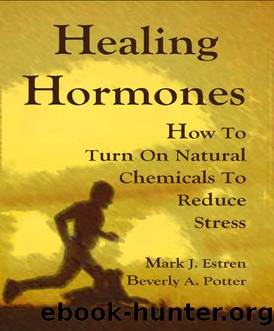
Author:Estren, Mark;Potter, Beverly; [Estren, Mark J. and Potter, Beverly A.]
Language: eng
Format: epub
Publisher: Ronin Publishing
Quite a few elements of everyday modern life are thought to pull down serotonin levels, although there is disagreement about the relative importance of these situations. The list of serotonin inhibitors is a long one, from deficiency of tryptophanâon which everyone agreesâto niacin and/or progesterone deficiency and/or deficiencies in other vitamins and minerals, lack of exposure to sunlight, overexposure to plastics and chemicals, insulin resistance, as well as genetic factors.
Serotonin deficiency results in a large number of symptoms that are all too common nowadays. Most of them are depressive in nature even if they do not advance to the level of full-scale clinical depression. Too-low amounts of serotonin can lead to anxiety, excessive worrying, pessimism, suicidal thoughts and tendencies, low self-esteem, and a strong negative reaction to dark weather. Free-floating fearânot directed at any specific situationâcan occur when serotonin levels are too low. So can panic, phobias and obsession.
Even people who do not have such strong reactions may experience irritation, impatience, repetitive thinking, anger and aggression. Since serotonin relaxes us and helps us sleep, too-low levels can produce too-light sleep or insomnia. Low serotonin production is also associated with sugar cravings, chronic pain, and other symptomsâthe list goes on and on. This healing hormone is particularly powerful.
Since it is a healing hormone, though, and one whose production it is particularly easy to increase through food consumption, it is tempting to âstock upâ on serotonin so that you have even more of it than you absolutely needâthe idea being to avoid the unpleasant symptoms of serotonin deficiency and feel even better, even more relaxed and at peace, than you otherwise would.
The Golden Mean
UNFORTUNATELY, trying to increase serotonin beyond a certain level does not work. As with so many bodily processes, there is a Golden Mean for keeping our bodies in balance. Overproduction of serotonin is a problem because it will make you feel sleepy at inappropriate times. It may be fine to collapse into inertia after a large Thanksgiving feast or a dinner built around generous servings of chickenâwhich, like turkey, is high in tryptophan.
However, this level of relaxation will not help you do your best at work if, for example, you overindulge at lunch in foods that boost serotonin production. In fact, most of us have experienced a kind of âafternoon sluggishnessâ of this sort from time to time. Serotonin is to blame, and the consequences of regular diminished afternoon productivity are certainly not pleasant ones in the workplace.
Worse, an overproduction of serotonin can be significantly more dangerous. A condition called serotonin syndrome can occur when your body has too much serotoninâand it is nothing to trifle with. At its most severe, it can be fatal. Even in less-serious form, serotonin syndrome produces a long list of unpleasant symptoms.
Serotonin Syndrome
⢠Shivering
⢠Heavy sweating
⢠Diarrhea
⢠Confusion
⢠Agitation
⢠Rapid heart rate
⢠Increased blood pressure
⢠Loss of muscle coordination
Things get even worse as serotonin syndrome progresses: more-serious symptoms can include high fever, muscle rigidity, irregular heartbeat, seizures, and unconsciousness.
Donât worry: you will not
Download
This site does not store any files on its server. We only index and link to content provided by other sites. Please contact the content providers to delete copyright contents if any and email us, we'll remove relevant links or contents immediately.
Spell It Out by David Crystal(36111)
Life for Me Ain't Been No Crystal Stair by Susan Sheehan(35806)
Cecilia; Or, Memoirs of an Heiress — Volume 1 by Fanny Burney(32549)
Cecilia; Or, Memoirs of an Heiress — Volume 2 by Fanny Burney(31948)
Cecilia; Or, Memoirs of an Heiress — Volume 3 by Fanny Burney(31932)
The Great Music City by Andrea Baker(31918)
Professional Troublemaker by Luvvie Ajayi Jones(29651)
The Secret History by Donna Tartt(19060)
We're Going to Need More Wine by Gabrielle Union(19037)
Twilight of the Idols With the Antichrist and Ecce Homo by Friedrich Nietzsche(18626)
All the Missing Girls by Megan Miranda(15965)
Cat's cradle by Kurt Vonnegut(15339)
Pimp by Iceberg Slim(14489)
Bombshells: Glamour Girls of a Lifetime by Sullivan Steve(14061)
For the Love of Europe by Rick Steves(13950)
Norse Mythology by Gaiman Neil(13351)
Talking to Strangers by Malcolm Gladwell(13351)
Fifty Shades Freed by E L James(13234)
The Social Justice Warrior Handbook by Lisa De Pasquale(12187)
