Garden and Landscape Practices in Pre-colonial India by Daud Ali Emma J. Flatt
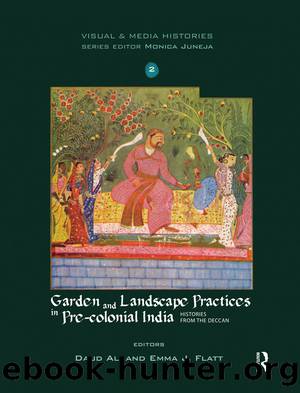
Author:Daud Ali, Emma J. Flatt [Daud Ali, Emma J. Flatt]
Language: eng
Format: epub
ISBN: 9781138659865
Google: 2RcjjwEACAAJ
Publisher: Routledge
Published: 2015-01-15T16:01:44+00:00
5
In AmÄ«n KhÄnâs Garden: Charitable Gardens in Qutb ShÄhi Andhra
PHILLIP B. WAGONER
Medieval Indian Islamic gardens are generally understood to have been privileged spaces, intended for use solely by the ruling elite. This holds true whether the garden is seen primarily as an enclave for the pursuit of pleasure, or alternately, as a highly charged political space where much of the business of state was transacted, as Mughal gardens have increasingly been understood in recent years.1 In either case, ordinary people are assumed to have had little chance of gaining entry into these garden sanctuaries which would have been perceived as having little relevance to their own lives. This may well hold true for most types of gardens in the medieval Deccan, but there is at least one type of garden which stands as an exception to this pattern. The purpose of this article is to call attention to this type of garden, here referred to as the âcharitable gardenâ. Not only do charitable gardens appear to have been open and accessible to anyone, but more importantly, the evidence suggests that their fundamental purpose was to produce fruits and medicinal substances for distribution to any and all who needed them, regardless of their social class.
1 Much recent scholarship on Mughal gardens (and their Timurid prototypes) has usefully stressed the political functions of these artificially constructed ânaturalâ environments. Mughal gardens are no longer understood simply as images of paradise, nor merely as âpleasure gardensâ, where rulers might escape, however briefly, from the worries and cares of political life. To the contrary, they are now recognised as intensely political spaces, the design of which contributed significantly to the definition of sovereignty and authority. See, for example, Catherine B. Asher, âBabur and the Timurid Char Bagh: Use and Meaningâ, Environmental Design: Journal of the Islamic Environmental Design Research Centre, vol. 1, no. 2, 1991, pp. 46â55; James L. Wescoat, Jr., âGardens versus Citadels: The Territorial Context of Early Mughal Gardensâ, in John Dixon Hunt (ed.), Garden History: Issues, Approaches, Methods, Washington DC: Dumbarton Oaks Research Library and Collection, 1992, pp. 331â58; Lisa Golombek, âTimurâs Gardens: The Feminine Perspectiveâ, in Mahmood Hussain, Abdul Rehman and James L. Wescoat, Jr. (eds), The Mughal Garden: Interpretation, Conservation, and Implications, Rawalpindi: Ferozsons (Pvt) Ltd., 1996, pp. 29â36; Ebba Koch, âMughal Palace Gardens from Babur to Shah Jahan, 1526â1648â, Muqarnas, vol. 14, 1997, pp. 143â65; D. Fairchild Ruggles, âHumayunâs Tomb and Garden: Typologies and Visual Orderâ, in Attilio Petruccioli (ed.), Gardens in the Time of the Great Muslim Empires: Theory and Design, Leiden: E. J. Brill, 1997, pp. 173â86.
The existence of such charitable gardens, and even the occasional use of elite gardens for charitable purposes, is hinted at in many sources that are well-known to historians of Indian Islamic gardens, yet these sources are rarely explicit and detailed enough to provide a clear picture of the characteristics and functioning of the âcharitable gardenâ as a type. A welcome exception to this general rule is provided by the historical preface
Download
This site does not store any files on its server. We only index and link to content provided by other sites. Please contact the content providers to delete copyright contents if any and email us, we'll remove relevant links or contents immediately.
Aircraft Design of WWII: A Sketchbook by Lockheed Aircraft Corporation(32298)
The Great Music City by Andrea Baker(32026)
Call Me by Your Name by André Aciman(20531)
The Secret History by Donna Tartt(19117)
The Art of Boudoir Photography: How to Create Stunning Photographs of Women by Christa Meola(18639)
Shoot Sexy by Ryan Armbrust(17739)
Plagued by Fire by Paul Hendrickson(17420)
Portrait Mastery in Black & White: Learn the Signature Style of a Legendary Photographer by Tim Kelly(17018)
Adobe Camera Raw For Digital Photographers Only by Rob Sheppard(16988)
Photographically Speaking: A Deeper Look at Creating Stronger Images (Eva Spring's Library) by David duChemin(16695)
Ready Player One by Cline Ernest(14689)
Pimp by Iceberg Slim(14534)
Bombshells: Glamour Girls of a Lifetime by Sullivan Steve(14086)
The Goal (Off-Campus #4) by Elle Kennedy(13688)
Art Nude Photography Explained: How to Photograph and Understand Great Art Nude Images by Simon Walden(13057)
Kathy Andrews Collection by Kathy Andrews(11851)
The Priory of the Orange Tree by Samantha Shannon(9121)
The remains of the day by Kazuo Ishiguro(9009)
Thirteen Reasons Why by Jay Asher(8925)
