From Realism to 'Realicism' by Rosa Mari Perez-teran mayorga
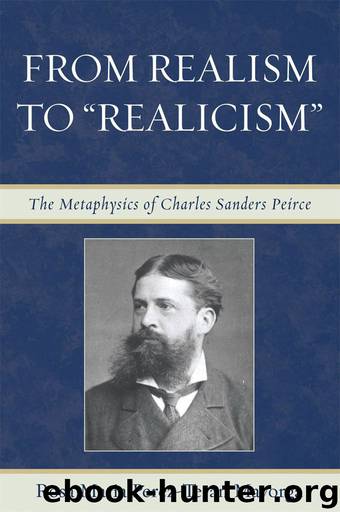
Author:Rosa Mari Perez-teran mayorga [Perez-teran mayorga, Rosa Mari]
Language: eng
Format: azw3
ISBN: 9780739132579
Publisher: Lexington Books
Published: 2007-02-09T05:00:00+00:00
Nominalists and realists then agreed on the following points:
Singulars are real, and
Only singulars exist, therefore
Universals are concepts, or thoughts, and therefore mind-dependent.
In determining whether Peirce really was an extreme scholastic realist, as he said he was, these two aspects, that is, the status of universals and the status of singulars, have to be considered. As will be apparent, this approach provides valuable insight into Peirce’s position.
Like the scholastic or moderate realists, and unlike the nominalists, Peirce, I will show, believed that universals were real. However, as I will point out,290 his notion of “real” was not quite the same as the scholastics’. In fact, as will be seen, it is not even the same as the common notion of “real.” Actually, Peirce himself seems aware that he is using the word in an uncommon way: phrases such as “in what sense I always use the word,” “according to my use of it,” “as I employ that term,” “that is what I mean by,” all serve to indicate this awareness.291
Peirce claims that the clue to settling the issue between nominalists and realists revolves around the notion of the “real.”292 And it is precisely Peirce’s definition of the “real,” adapted from what he claims is originally Scotus’s definition that gives Peirce’s realism its distinctive flavor and which provides a base for Peirce to eventually add all the other ingredients of his own theory:
Are universals real? . . . Objects are divided into figments, dreams, etc., on the one hand, and realities on the other. The former are those which exist only inasmuch as you or I or some man imagines them; the latter are those which have an existence independent of your mind or mine or that of any number of persons. The real is that which is not whatever we happen to think it, but is unaffected by what we may think of it. (CP 8.12, 1871)
Peirce says the real is unaffected by, or independent of, what I (or any number of persons) think about it. It is the opposite of the fictitious, of the figment, which is affected by or dependent on what others or I think about it. Examples of the latter would be a character in fiction, an optical illusion, a hallucination, etc. Peirce describes the difference between the real and a figment elsewhere:
The question whether Hamlet was insane is the question whether Shakespeare conceived him to be insane. Consequently, Hamlet is a figment and not a reality. But as to the inkstand being on my table, though I should succeed in persuading myself and all who have seen it that it is a mere optical illusion, yet there will be a limit to this . . . it will, at last. . . force its recognition upon the world . . . it has the characteristic which we call reality. (CP 8.153, 1900)
A character in a literary work is fictitious, or a figment, if its characteristics and circumstances are completely up to the author’s decision. In other
Download
This site does not store any files on its server. We only index and link to content provided by other sites. Please contact the content providers to delete copyright contents if any and email us, we'll remove relevant links or contents immediately.
Spell It Out by David Crystal(36185)
Life for Me Ain't Been No Crystal Stair by Susan Sheehan(35869)
The Great Music City by Andrea Baker(32739)
Cecilia; Or, Memoirs of an Heiress — Volume 1 by Fanny Burney(32665)
Cecilia; Or, Memoirs of an Heiress — Volume 2 by Fanny Burney(32029)
Cecilia; Or, Memoirs of an Heiress — Volume 3 by Fanny Burney(32012)
Professional Troublemaker by Luvvie Ajayi Jones(29719)
The Secret History by Donna Tartt(19365)
We're Going to Need More Wine by Gabrielle Union(19128)
Twilight of the Idols With the Antichrist and Ecce Homo by Friedrich Nietzsche(18712)
All the Missing Girls by Megan Miranda(16440)
Cat's cradle by Kurt Vonnegut(15477)
Pimp by Iceberg Slim(14720)
For the Love of Europe by Rick Steves(14686)
Bombshells: Glamour Girls of a Lifetime by Sullivan Steve(14154)
Norse Mythology by Gaiman Neil(13483)
Talking to Strangers by Malcolm Gladwell(13477)
Fifty Shades Freed by E L James(13313)
The Social Justice Warrior Handbook by Lisa De Pasquale(12262)
