Fear and the Muse Kept Watch by Andy McSmith
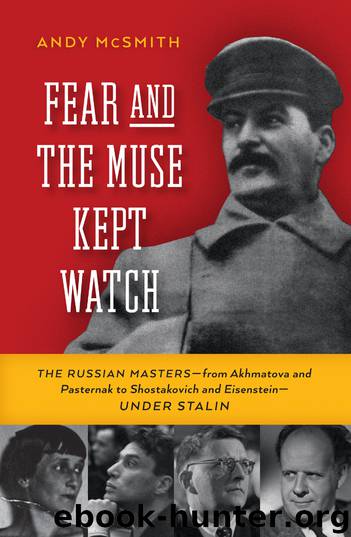
Author:Andy McSmith [McSmith, Andy]
Language: eng
Format: epub
ISBN: 9781620970799
Publisher: The New Press
9
Stalin’s Nights at the Opera
Even if they cut off both my hands and I have to hold my pen in my teeth, I shall go on writing music.
—DMITRI SHOSTAKOVICH
Even as Russia’s cultural community enjoyed an Indian summer of relative freedom in the year 1935—and the likes of Maxim Gorky and Nikolai Bukharin were trying to draw the intelligentsia into more active involvement in the regime in the hope of creating a loyal opposition that could rein in the dictatorship—others who were driven by ambition, fear, or stupidity were priming Stalin with flattery and lies that encouraged him to believe that he was infallible and that any real or imagined challenge to his authority was malicious. Before Mikhail Kalinin, nominal president of the USSR, set off for his annual vacation on the Black Sea, he consulted two fellow Politburo members, Lazar Kaganovich and Anastas Mikoyan, about what to say to Stalin when they met down south. “We told him to say that ‘the country and party are so well charged up with energy that although the chief marksman is resting, the army is still firing.’ For example, what has happened with the grain procurements this year is our completely unprecedented stupefying victory—the victory of Stalinism,” Kaganovich boasted to a colleague.1
One of those who joined Stalin on holiday was his fellow countryman Lavrenti Beria, the sinister new ruler of Georgia, Armenia, and Azerbaijan who in 1935 commissioned a history of the early years of Bolshevism in that region to glorify the young Stalin. Old Bolsheviks whose memories differed from what was now the official record were vilified, humiliated, and in some cases arrested. Stalin’s daughter, Svetlana, recalled how Beria “flattered my father with a shamelessness that was nothing if not Oriental . . . in a way that caused old friends, accustomed to looking on my father as an equal, to wince with embarrassment.”2
Trotsky’s former hanger-on Karl Radek, a talented, treacherous journalist anxious to work his way back into favor, wrote a conceit titled “The Architect of a Socialist Society.” While Kaganovich praised Stalin’s current achievements and Beria focused on reinventing his past, Radek cast flattery into the future by imagining a lecture delivered at an interplanetary symposium on the fiftieth anniversary of the revolution in which the speaker marveled at the grandeur of Stalin’s achievements: “Notwithstanding the great strides made by science in communist society, it cannot yet answer the problem of personality. It can only reveal the local conditions which nurtured the leader, who, like a pillar of fire, marched in front of mankind and lit up the way.”3
But the gold standard for slobbering sycophancy seems to belong to a forgotten poet named Aleksander Avdienko who reportedly said in a speech to the Seventh Congress of Soviets in January 1935:
Thank you, Stalin. Thank you because I am joyful. Thank you because I am well. No matter how old I become, I shall never forget. . . . Centuries will pass, and the generations still to come will regard us as
Download
This site does not store any files on its server. We only index and link to content provided by other sites. Please contact the content providers to delete copyright contents if any and email us, we'll remove relevant links or contents immediately.
The Great Music City by Andrea Baker(33662)
Aircraft Design of WWII: A Sketchbook by Lockheed Aircraft Corporation(32384)
Call Me by Your Name by André Aciman(20733)
The Secret History by Donna Tartt(19472)
The Art of Boudoir Photography: How to Create Stunning Photographs of Women by Christa Meola(18760)
Shoot Sexy by Ryan Armbrust(17853)
Plagued by Fire by Paul Hendrickson(17541)
Portrait Mastery in Black & White: Learn the Signature Style of a Legendary Photographer by Tim Kelly(17107)
Adobe Camera Raw For Digital Photographers Only by Rob Sheppard(17094)
Photographically Speaking: A Deeper Look at Creating Stronger Images (Eva Spring's Library) by David duChemin(16800)
Ready Player One by Cline Ernest(15146)
Pimp by Iceberg Slim(14800)
Bombshells: Glamour Girls of a Lifetime by Sullivan Steve(14220)
The Goal (Off-Campus #4) by Elle Kennedy(13966)
Art Nude Photography Explained: How to Photograph and Understand Great Art Nude Images by Simon Walden(13147)
Kathy Andrews Collection by Kathy Andrews(12093)
The Priory of the Orange Tree by Samantha Shannon(9363)
The remains of the day by Kazuo Ishiguro(9225)
Thirteen Reasons Why by Jay Asher(9122)
