Digging for History at Old Washington by Kwas Mary L.;Miller Jay S.;
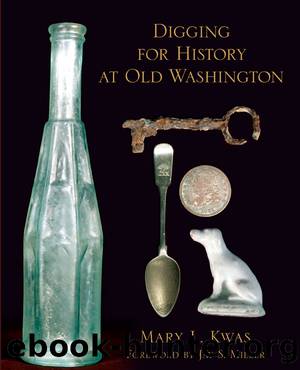
Author:Kwas, Mary L.;Miller, Jay S.; [Kwas, Mary L.]
Language: eng
Format: epub
Publisher: University of Arkansas Press
Other Artifacts from Feature 14
Although I have concentrated on the ceramics and food remains from Feature 14 because they provide the best clues to the Blocksâ lifestyle, other artifacts found in the trash pit deserve mention. Although these objects may not tell us as much about the Block family as do the ceramics, they do provide details that flesh out the story.
Fig. 4.10: The bold, hand-painted designs on these bowls (top) are folkloric in style and would have brightened up a kitchen or dining room. The bottom row shows a small bowl (left) painted with a maroon-colored mum, and sherds from slipware pieces. Photo by Leslie Walker, Arkansas Archeological Survey.
A variety of mostly broken glass was discarded in the trash pit, the pieces consisting of fragments representing bottles and jars. These were used during the early 1800s to hold beverages, preserved foods and condiments, liquid medicine and pills, ink, dyes, and cleaning products. Several remnants of wine bottles and mustard bottles could be identified. There was also a very small free-blown bottle, about 1½ inches high by ¾ inch in diameter, that probably held pills. In addition to containers, fragments of table glass were also recovered, which included tumblers, drinking glasses, and stemware. Other objects involved in foodways included a two-tine fork with a bone handle, a separate bone handle from an eating utensil, and a large bone handle with a cross-hatched grip that was probably part of a carving knife or fork (Fig. 4.11).
Items for personal use that were found in the trash pit included a bone handle and a bone head from a toothbrush and a fine-toothed bone comb used to remove head lice. Limestone marbles and a bone or ivory domino show how the Block children amused themselves (Fig. 4.12). Two child-sized thimbles, one from Feature 14 and one found elsewhere, remind us that young girls, including the Block daughters, were taught needlework skills. A needle and part of a scissors were also found. Fragments of clay pipes indicate that Abraham or his sons enjoyed tobacco. The two pipe bowls from the trash pit included one of white clay with a reeded design and a brown clay elbow pipe decorated with a dot-and-ring pattern.
Buttons were found all over the lot as well as in the trash pit and mostly consist of utilitarian styles. Similar in size and shape to our plain white or colored plastic shirt buttons, these nineteenth-century buttons were cut from bone or the mother-of-pearl shells of river mussels, or manufactured of finely ground porcelain or other clays and pressed in molds (called Prosser buttons). They were easily lost in the wear and tear of daily activities. Noteworthy from the trash pit were two large bone buttons, about 1â inches in diameter, probably used on a coat, and three tiny pearl buttons, only ¼ inch in diameter, that would have been used on clothes for a baby.
Other noteworthy artifacts from Feature 14 include a large iron key, about 4¾ inches long, that might have been used to lock a barn or an outbuilding, as well as an iron strike plate for a door (Fig.
Download
This site does not store any files on its server. We only index and link to content provided by other sites. Please contact the content providers to delete copyright contents if any and email us, we'll remove relevant links or contents immediately.
Spell It Out by David Crystal(36109)
Life for Me Ain't Been No Crystal Stair by Susan Sheehan(35800)
Cecilia; Or, Memoirs of an Heiress — Volume 1 by Fanny Burney(32543)
Cecilia; Or, Memoirs of an Heiress — Volume 2 by Fanny Burney(31939)
Cecilia; Or, Memoirs of an Heiress — Volume 3 by Fanny Burney(31928)
The Great Music City by Andrea Baker(31915)
Professional Troublemaker by Luvvie Ajayi Jones(29648)
The Secret History by Donna Tartt(19037)
We're Going to Need More Wine by Gabrielle Union(19032)
Twilight of the Idols With the Antichrist and Ecce Homo by Friedrich Nietzsche(18618)
All the Missing Girls by Megan Miranda(15936)
Cat's cradle by Kurt Vonnegut(15328)
Pimp by Iceberg Slim(14481)
Bombshells: Glamour Girls of a Lifetime by Sullivan Steve(14046)
For the Love of Europe by Rick Steves(13885)
Talking to Strangers by Malcolm Gladwell(13344)
Norse Mythology by Gaiman Neil(13343)
Fifty Shades Freed by E L James(13230)
The Social Justice Warrior Handbook by Lisa De Pasquale(12183)
