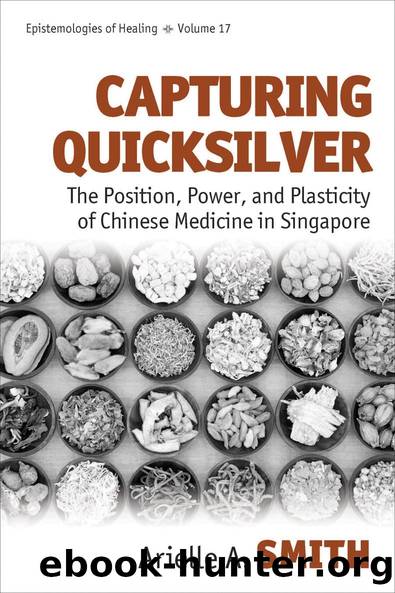
Capturing Quicksilver by Arielle A. Smith
Author:Arielle A. Smith [Smith, Arielle A.]
Language: eng
Format: epub
Tags: Social Science, Anthropology, General, Medical
ISBN: 9781785337956
Google: 70QtDwAAQBAJ
Publisher: Berghahn Books
Published: 2018-05-24T05:22:03+00:00
Anna
Through participant observation and a series of interviews at Chung Hwa (and in Batam, Indonesia), I became acquainted with a regular patient ofâand occasional volunteer forâDr Wang, named Anna.12 Born in 1941 (the first year of the Japanese occupation), Anna was a middle-class, free thinker (secular) Singaporean Chinese who lived with her son and Fujianese daughter-in-law, with whom she shared a common dialect. Although both her parents were born in Singapore, she traced her paternal lineage to Fujian, China, and therefore grew up speaking Hokkien at home and Mandarin in school (she was educated in the Chinese stream). Later in life she also learned Teochew, Cantonese, Hainanese, Malay, English, and Japanese for business or personal reasons, as well as Hakka from her husbandâs family. With a wry smile, she described her proficiency in these languages, however, as âhalf-past six.â In the course of her life she worked in a wide range of professionsâfrom owning a provision shop, to real estate, to clothing alterationsâwith her most prolonged work as a psychiatric nurse at Woodbridge Hospital (also known as the Institute of Mental Health), presently at Buangkok Green Medical Park.
In the course of this career, as well as a lifetime of observations and experiences with various medical practices, Anna developed a very clear opinion of both biomedicine and Chinese medicine. In fact, at the onset of our first interview she presented me with an unsolicited, two-page handwritten list of the pros and cons of eachâone page headed zhongyi and the other xiyi (âWesternâ medicine). This presentation not only echoed Singaporeâs regulatory division of the two practices, but also her own assessment of their relationship: although individually beneficial, âthe two kind[s] of medicine cannot go together,â she informed me. In Annaâs comparison, biomedicine operated quickly on âthe sickness, the germ,â providing immediate relief from symptoms but often with undesired side effects that weakened the body. Chinese medicine, on the other hand, operated slowly on âthe whole system,â providing treatments that could âcure the root lah, bingyin [illness factors],â strengthen the body, and protect against the side effects of âWestern medicine.â She primarily saw biomedical doctors for check-ups, prescription medications, or when she needed medical leave from work. For the majority of other health-related matters she relied on a range of Chinese healing modalities, including regular and incidental home-based herbal remedies. She was particularly fond of decoctions like liangcha for heatiness or ganmao cha [tea for the flu]), tuina, dietary regulation, acupuncture, cupping, and/or herbal prescriptions.13
Anna explained that biomedicine and Chinese medicine each had its own utility and, in general, could be used jointly to manage both individual and public health. However, like most other patients with whom I spoke, she avoided simultaneous use of the two, consuming biomedical and Chinese medical prescriptions at least three to four hours apart. While she claimed that either practice could be used for the majority of medical conditions, she felt that certain conditions were best treated by biomedicineâsuch as infections, cancer, or internal conditions requiring surgeryâwhile others were best treated with Chinese medicineâsuch as rheumatism, bone fractures, or the flu.
Download
This site does not store any files on its server. We only index and link to content provided by other sites. Please contact the content providers to delete copyright contents if any and email us, we'll remove relevant links or contents immediately.
Spell It Out by David Crystal(36243)
Life for Me Ain't Been No Crystal Stair by Susan Sheehan(35906)
The Great Music City by Andrea Baker(33722)
Cecilia; Or, Memoirs of an Heiress — Volume 1 by Fanny Burney(32726)
Cecilia; Or, Memoirs of an Heiress — Volume 2 by Fanny Burney(32090)
Cecilia; Or, Memoirs of an Heiress — Volume 3 by Fanny Burney(32068)
Professional Troublemaker by Luvvie Ajayi Jones(29763)
The Secret History by Donna Tartt(19477)
We're Going to Need More Wine by Gabrielle Union(19178)
Twilight of the Idols With the Antichrist and Ecce Homo by Friedrich Nietzsche(18784)
All the Missing Girls by Megan Miranda(16738)
Cat's cradle by Kurt Vonnegut(15560)
For the Love of Europe by Rick Steves(14937)
Pimp by Iceberg Slim(14805)
Bombshells: Glamour Girls of a Lifetime by Sullivan Steve(14223)
Norse Mythology by Gaiman Neil(13576)
Talking to Strangers by Malcolm Gladwell(13559)
Fifty Shades Freed by E L James(13353)
The Social Justice Warrior Handbook by Lisa De Pasquale(12297)
