Britain's Hidden Role in the Rwandan Genocide by Cameron Hazel;
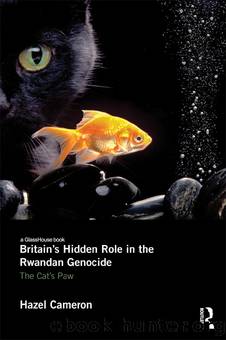
Author:Cameron, Hazel;
Language: eng
Format: epub
ISBN: 1125219
Publisher: Taylor & Francis Group
Chapter 6
Britain, Uganda and the RPF
Throughout the 17 years since the genocide in Rwanda, the British Government of 1994 has repeatedly excused its decisions and actions in respect of its policy towards Rwanda, claiming to have had no prior interest in the country and no access to intelligence or information. Members of John Majorâs 1994 Government claim to have been âuninformedâ, âunsightedâ and lacking in any semblance of reliable or relevant information about events in the country. However, as this chapter will evidence, this was not in fact the case. Critical to our understanding of the role of the British Government in the Rwandan genocide are the complex events of several years immediately before the genocide, namely from 1990 until early 1994. An exploration of the data available to the British Government during this period of time indicates that its members were in possession of a wealth of detailed, reliable and relevant intelligence, both before and during the Rwandan genocide, which would have allowed them a clear perspective on the unfolding situation in the country. The data explored includes information and intelligence from both official and unofficial sources; official communications and directions between the FCO, the British Embassies of Kinshasa, Kampala and Dar Es Salaam, UKMIS NY, Washington and Cabinet ministers; and interviews undertaken with elite informants from various nations.1
Before the genocide in Rwanda in 1994, the United Kingdom did not have a permanent diplomatic mission in either Rwanda or Burundi, although a British Honorary Consul, Tony Wood, was resident in Rwanda throughout the early 1990s.2 Britainâs lack of diplomatic capacity in Rwanda reflects the fact that the United Kingdom had no direct political or financial interests in the country. However, the same is not true of the two countries sharing borders with Rwanda, namely Uganda and the DRC (then Zaire), both of which, unlike Rwanda, were rich in raw materials and had governments that were sympathetic to foreign investment. Britain maintained a strong relationship with President Yoweri Museveni of Uganda, nurtured since his rise to power in 1986. Britain also maintained substantial business interests in Uganda and the DRC. Before 1993, the British Government handled diplomatic issues and maintained foreign relations with Rwanda and Burundi in a variety of ad hoc ways. Historically, the British diplomatic offices in Kinshasa and Dar Es Salaam had administered Rwanda and Burundi respectively, but both countries subsequently fell under the administration of Kinshasa. This arrangement changed once again in 1993, when the British High Commissioner of Uganda assumed roving responsibility for diplomacy as a non-resident ambassador in Rwanda. No explanation is available for this policy change, but one can assume that the Uganda-based RPFâs influential role on Rwandan politics since 1990 would have been a pivotal factor.
By 1988, it was an open secret in Uganda and Rwanda that Tutsi members of the Ugandan army were planning an invasion of Rwanda (Waugh 2004). Britain supported both the formation of the RPF and its objectives, and from early 1990 onwards, British intelligence services developed a
Download
This site does not store any files on its server. We only index and link to content provided by other sites. Please contact the content providers to delete copyright contents if any and email us, we'll remove relevant links or contents immediately.
Spell It Out by David Crystal(36113)
Life for Me Ain't Been No Crystal Stair by Susan Sheehan(35807)
Cecilia; Or, Memoirs of an Heiress — Volume 1 by Fanny Burney(32549)
Cecilia; Or, Memoirs of an Heiress — Volume 2 by Fanny Burney(31948)
Cecilia; Or, Memoirs of an Heiress — Volume 3 by Fanny Burney(31932)
The Great Music City by Andrea Baker(31919)
Professional Troublemaker by Luvvie Ajayi Jones(29651)
The Secret History by Donna Tartt(19061)
We're Going to Need More Wine by Gabrielle Union(19038)
Twilight of the Idols With the Antichrist and Ecce Homo by Friedrich Nietzsche(18627)
All the Missing Girls by Megan Miranda(15965)
Cat's cradle by Kurt Vonnegut(15339)
Pimp by Iceberg Slim(14489)
Bombshells: Glamour Girls of a Lifetime by Sullivan Steve(14061)
For the Love of Europe by Rick Steves(13951)
Talking to Strangers by Malcolm Gladwell(13353)
Norse Mythology by Gaiman Neil(13352)
Fifty Shades Freed by E L James(13235)
The Social Justice Warrior Handbook by Lisa De Pasquale(12188)
