Azerbaijan in a Reconnecting Eurasia by Kuchins Andrew C.;Mankoff Jeffrey;Backes Oliver; & Jeffrey Mankoff & Oliver Backes
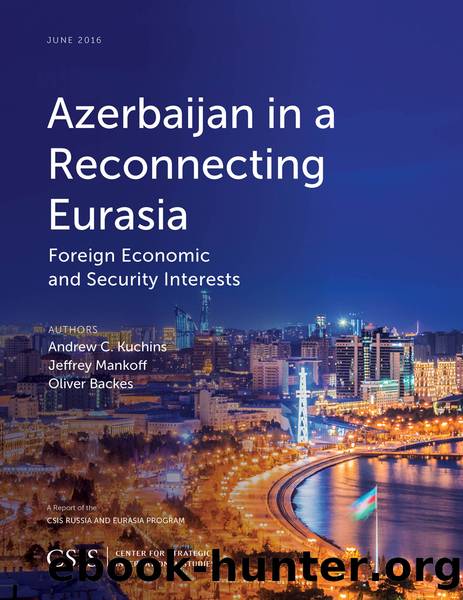
Author:Kuchins, Andrew C.;Mankoff, Jeffrey;Backes, Oliver; & Jeffrey Mankoff & Oliver Backes
Language: eng
Format: epub
ISBN: 9781442259560
Publisher: Center for Strategic & International Studies
03
Azerbaijan in a Reconnecting Eurasia
Energy and geography dictate the contours of Azerbaijanâs foreign economic policy. Located astride critical east-west and north-south transit corridors, and blessed with substantial oil and gas reserves, Azerbaijan seeks to establish itself as a regional transit hub. Its ability to export energy from the Caspian littoral to Turkey and Europe has boosted Azerbaijanâs prosperity as well as its strategic independence. Yet these assets also pose vulnerabilities that Azerbaijanâs larger neighbors have at times sought to exploit, and have left Azerbaijan vulnerable in the face of oil prices that have fallen from over $110 per barrel in the summer of 2014 to around $30 per barrel at the start of 2016.
Given this complex regional environment, few of our interlocutors showed enthusiasm at the prospect of either European or Russian-backed integration. The general consensus among our interlocutors was that Baku views integration as a zero-sum game, which might benefit Azerbaijanâs economy, but would inevitably undermine its sovereignty. Baku has thus pursued a policy of selective participation in regional trade and transit development projects, favoring engagement with neutral third parties such as the United Nations Development Program (UNDP) in order to avoid possible entanglement in what one of our academic contacts termed any âcompeting political-military blocs.â
Between 2005 and 2013, Azerbaijanâs total trade turnover increased from $8.55 billion to $34 billion, for an annualized growth rate of roughly 16.58 percent. Trade, however, dropped to $30.9 billion in 2014 on the back of lower oil prices.1 Throughout this same period, Baku experienced annualized trade growth in excess of 10 percent with its most important trading partners. Azerbaijan meanwhile conducts little intraregional trade due to the closure of its border with Armenia; it has meanwhile seen only minute gains (less than 1 percent) in its commercial ties with Georgia.
While hydrocarbon production and export have facilitated rapid economic growth, they have left Azerbaijan vulnerable to fluctuations in energy prices and demand. Nonetheless, most of our interlocutors in Azerbaijan favored increasing oil and gas production. A few did note the importance of diversifying the economy by attracting additional foreign direct investment (FDI) in non-energy sectors, but seemed to have limited understanding of the obstacles Azerbaijan faces.
Download
This site does not store any files on its server. We only index and link to content provided by other sites. Please contact the content providers to delete copyright contents if any and email us, we'll remove relevant links or contents immediately.
Spell It Out by David Crystal(36110)
Life for Me Ain't Been No Crystal Stair by Susan Sheehan(35804)
Cecilia; Or, Memoirs of an Heiress — Volume 1 by Fanny Burney(32548)
Cecilia; Or, Memoirs of an Heiress — Volume 2 by Fanny Burney(31947)
Cecilia; Or, Memoirs of an Heiress — Volume 3 by Fanny Burney(31932)
The Great Music City by Andrea Baker(31917)
Professional Troublemaker by Luvvie Ajayi Jones(29651)
The Secret History by Donna Tartt(19053)
We're Going to Need More Wine by Gabrielle Union(19034)
Twilight of the Idols With the Antichrist and Ecce Homo by Friedrich Nietzsche(18624)
All the Missing Girls by Megan Miranda(15958)
Cat's cradle by Kurt Vonnegut(15338)
Pimp by Iceberg Slim(14488)
Bombshells: Glamour Girls of a Lifetime by Sullivan Steve(14057)
For the Love of Europe by Rick Steves(13915)
Norse Mythology by Gaiman Neil(13349)
Talking to Strangers by Malcolm Gladwell(13349)
Fifty Shades Freed by E L James(13233)
The Social Justice Warrior Handbook by Lisa De Pasquale(12187)
