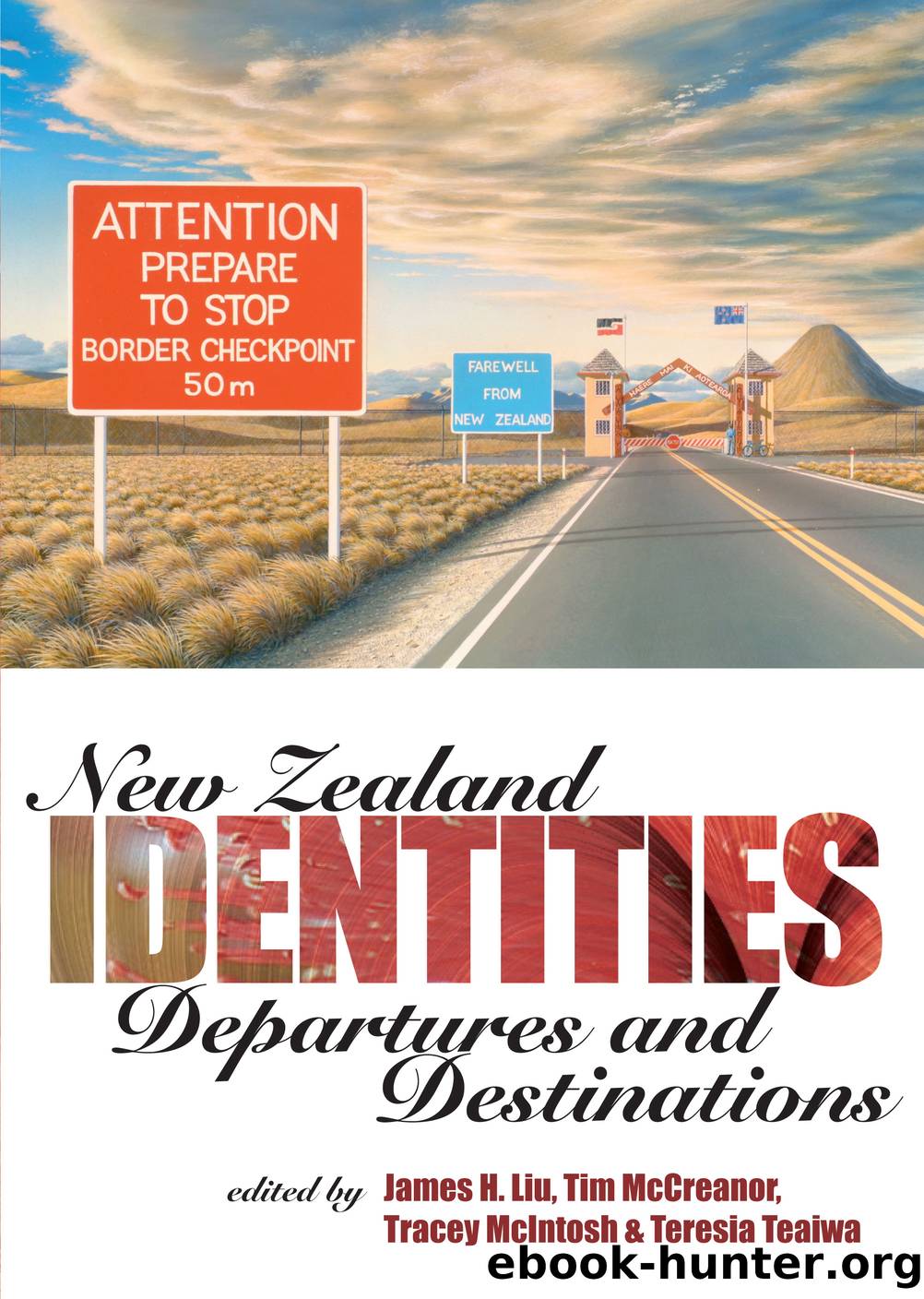
New Zealand Identities by James H. Liu
Author:James H. Liu
Language: eng
Format: epub
Publisher: Victoria University Press
⦠Immigrants will be encouraged to participate fully in New Zealandâs multicultural society while being able to maintain valued elements in their own heritage. (Burke, 1986, p. 11)
⦠the old notion of assimilation is no longer seen as the desirable outcome of immigration ⦠our society clearly now sees a positive value in diversity and the retention by the ethnic minorities of their cultural heritage. (Burke, 1986, p. 48)
Trlin (1992, p. 4) argues that while these principles can be observed in the rules of entry, they fall short of permitting immigrant groups to engage effectively in maintaining their presence, ethnic heritage and hence their effective contribution to âthe multi-cultural social fabric of New Zealand societyâ. However, this has changed slightly in recent years through some symbolic accommodation of ethnic diversity in municipal and national celebrations of âcultural daysâ.
The past âmelting potâ policy aiming at the ultimate absorption of these different ethnic groups in a common, undifferentiated New Zealand is no more desirable under the changing dynamics of the New Zealand population. The increasing ethnic diversity of the New Zealand population warrants the advocacy of a policy of diversity â in unity. Such a policy would make it possible for each group to preserve its distinctive personality, to add its own quota to enrich the New Zealand way of life. We must somehow in our planning create a social environment in which each of these communities can maintain and develop its own values and way of life. All human beings need a sense of who and what they are and where they belong in order to function socially. To assert an identity is to distinguish oneself or oneâs group from others. In my opinion, social assimilation should require not that immigrants forget their own culture, but that they are fully at home in that of their adopted land (Zodgekar, 1980).
This has fundamental implications for the maintenance of immigrant minority culture and New Zealandâs long-term cultural and national identity. The changing immigration system, which is increasingly stimulated by globalisation, has brought a changing face to what it is to be a New Zealander and what it is like to live here. Diversity is the new national identity, so to speak. New Zealand is moving away from a sort of monocultural domination by Europeans, the colonists, to the wrenching process of coming to grips with the bicultural focus on many of its policies now. I imagine a multicultural focus will be increasingly reflected in every one of us one day. This has raised a number of issues related to adaptation and assimilation for New Zealanders and immigrants equally.
The increasing diversity and the growth of various minorities have raised the issues concerning how to legitimise their presence in the society. The debate about citizenship and national and cultural identity has become an important issue in New Zealand in recent times.
The definitional complexity of these concepts will always provide an endless supply of fuel for debate. These conceptual issues are discussed in the other parts of this book (see Pearson, this volume).
Download
This site does not store any files on its server. We only index and link to content provided by other sites. Please contact the content providers to delete copyright contents if any and email us, we'll remove relevant links or contents immediately.
Spell It Out by David Crystal(36191)
Life for Me Ain't Been No Crystal Stair by Susan Sheehan(35879)
The Great Music City by Andrea Baker(32902)
Cecilia; Or, Memoirs of an Heiress — Volume 1 by Fanny Burney(32685)
Cecilia; Or, Memoirs of an Heiress — Volume 2 by Fanny Burney(32043)
Cecilia; Or, Memoirs of an Heiress — Volume 3 by Fanny Burney(32028)
Professional Troublemaker by Luvvie Ajayi Jones(29727)
The Secret History by Donna Tartt(19391)
We're Going to Need More Wine by Gabrielle Union(19135)
Twilight of the Idols With the Antichrist and Ecce Homo by Friedrich Nietzsche(18725)
All the Missing Girls by Megan Miranda(16484)
Cat's cradle by Kurt Vonnegut(15491)
For the Love of Europe by Rick Steves(14737)
Pimp by Iceberg Slim(14735)
Bombshells: Glamour Girls of a Lifetime by Sullivan Steve(14174)
Norse Mythology by Gaiman Neil(13503)
Talking to Strangers by Malcolm Gladwell(13492)
Fifty Shades Freed by E L James(13320)
The Social Justice Warrior Handbook by Lisa De Pasquale(12270)
