Justice, Property and the Environment by Tim Hayward John O'Neill
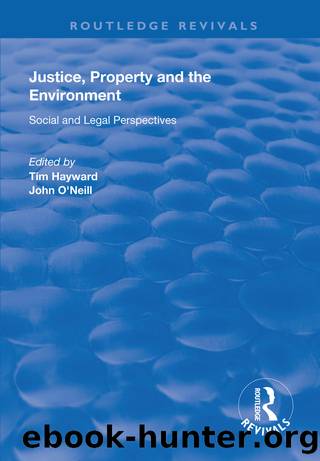
Author:Tim Hayward, John O'Neill [Tim Hayward, John O'Neill]
Language: eng
Format: epub
ISBN: 9781138322769
Barnesnoble:
Publisher: Taylor & Francis
Published: 2018-08-01T00:00:00+00:00
Compensatin others
The compensation argument justifies acts of appropriation in the context of prevailing scarcity. It answers the question of why we may appropriate and use the commons by referring to beneficial consequences ensuing from this conduct: to appropriate (through labour) is to advance development and to make steps to reach a higher level in the evolution of civilisation, Locke's opinion of enclosures is that they are good for the rest of humanity and those who do the hard work of appropriating are benefactors of humanity.
[H]e who appropriates land to himself by his labour, does not lessen but increases the common stock of mankind ... And therefore he, that incloses Land and has a greater plenty of the conveniencys of life from ten acres, than he could have from an hundred left to Nature, may truly be said, to give ninety acres to Mankind. For (he provisions serving to the support of humane life, produced by one acre of inclosed and cultivated land, are (to speak much within compasse) ten times more, than those, which are yielded by an acre of Land, of an equal richnesse, lyeing waste in common (§37).
So, by means of efficiently exploiting raw materials under a regime of private property, we should not diminish the quality of life of the propertyless but quite the opposite; the invention of money made it possible to invest in technological development, in the creation of infrastructure and in the production of goods (cf. Kavka, 1981, p. 120). This kind of development would be the best way to benefit present and future property less. Although the amount, availability and quality of natural resources in common and the general conditions of living would not remain alike and unchanged through the course of time, this advancement could compensate the propertyless for the fact that some family-lines have less left them to appropriate: appropriation is based on labour and labour increases the value in nature, which adjusts the declining chances of appropriation. In addition, when the unowned resources are being used, the situation of others is improved, since it is made possible for them to have new kinds of things. As Ellen Frankel Paul (1987, p. 204) highlights, appropriation is not theft â a violation of others' rights â but it 'constitutes a benefaction upon the rest of mankind'. But does it justify negligence toward the sufficiency limitation?
Seeking an answer to this question calls our attention to the nature of the substituted interest of the propertyless. Let us consider this issue in terms of future generations. What is peculiar in the compensation argument is that it puts forward, explicitly or implicitly, a substantive suggestion about the quality of the interests of future people and alleges that they would prefer a technologically advanced, completely privatised world to one which was less privatised and less technologically advanced. In this respect it resembles the preservationist argument based on certain assumptions about the content of the interests of the future people and about the conditions necessary to satisfy their interests.
Download
This site does not store any files on its server. We only index and link to content provided by other sites. Please contact the content providers to delete copyright contents if any and email us, we'll remove relevant links or contents immediately.
Spell It Out by David Crystal(36120)
Life for Me Ain't Been No Crystal Stair by Susan Sheehan(35813)
Cecilia; Or, Memoirs of an Heiress — Volume 1 by Fanny Burney(32562)
The Great Music City by Andrea Baker(32023)
Cecilia; Or, Memoirs of an Heiress — Volume 2 by Fanny Burney(31959)
Cecilia; Or, Memoirs of an Heiress — Volume 3 by Fanny Burney(31945)
Professional Troublemaker by Luvvie Ajayi Jones(29671)
The Secret History by Donna Tartt(19103)
We're Going to Need More Wine by Gabrielle Union(19053)
Twilight of the Idols With the Antichrist and Ecce Homo by Friedrich Nietzsche(18642)
All the Missing Girls by Megan Miranda(16050)
Cat's cradle by Kurt Vonnegut(15365)
Pimp by Iceberg Slim(14522)
For the Love of Europe by Rick Steves(14174)
Bombshells: Glamour Girls of a Lifetime by Sullivan Steve(14081)
Norse Mythology by Gaiman Neil(13376)
Talking to Strangers by Malcolm Gladwell(13376)
Fifty Shades Freed by E L James(13247)
The Social Justice Warrior Handbook by Lisa De Pasquale(12197)
