The Elite by Ranulph Fiennes
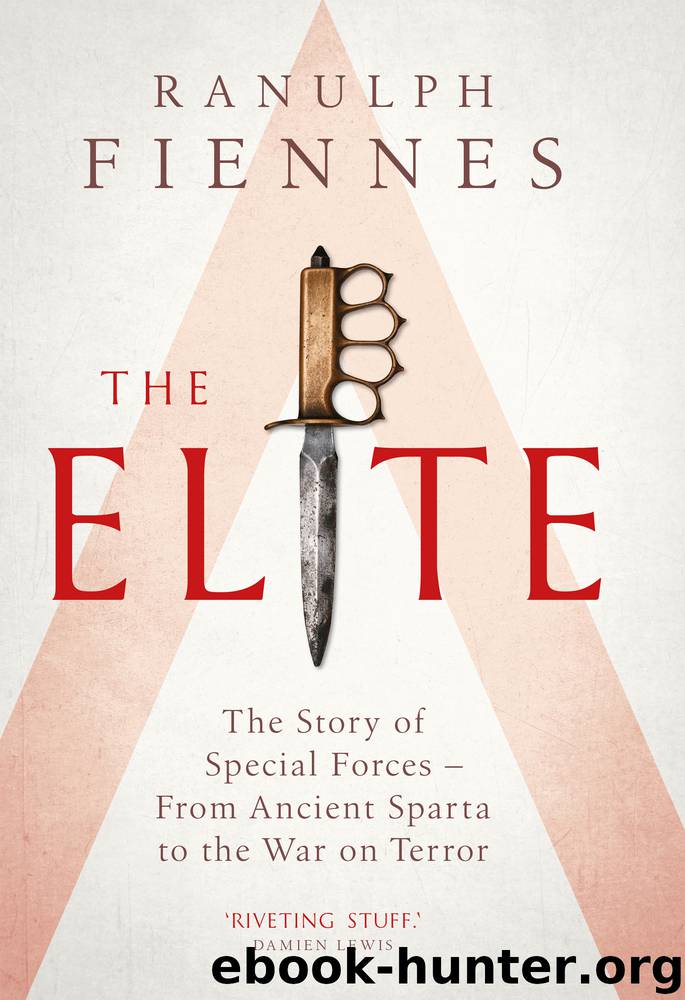
Author:Ranulph Fiennes [Fiennes, Ranulph]
Language: eng
Format: epub
Publisher: Simon & Schuster UK
16
THE BRITISH LIGHT INFANTRY
AD 1809
Like a scene from the Old Testament, thousands of bedraggled, emaciated figures emerged from the snow-covered mountains and staggered towards the Spanish port of Corunna. With their matted beards, bloodied bare feet and stale stench, these men could easily have been mistaken for a horde of beggars, if not for one thing – their filthy, torn, red uniforms. For this was the might of the British Army and, if they didn’t get home soon, they might all be wiped out.
For weeks, they had fled from Napoleon’s forces, retreating for over 250 miles, in perilous conditions, in order to reach the ocean. Here, their leader, Sir John Moore, expected a convoy of ships to be waiting. However, as they reached the port, they found it was empty. There appeared to be no way to get home, while Napoleon’s men were advancing hard on the rear. If they were still going to be alive by the time the ships did finally arrive, then they would have to fight. And while England’s armed forces looked to have nothing left, Moore had one card left to play: the British Light Infantry. To prevent total obliteration, they were the British Army’s only hope. Yet, without the inspiration of the French, and the genius of Sir John Moore, it was unlikely that they would have even been formed.
The French were experts at utilising their light infantries, with their so-called chasseurs, helping Napoleon to a number of victories ever since he had seized power in 1799. The British, meanwhile, had been left behind. Despite these units offering greater mobility on the battlefield, British attempts to embrace the concept had been half-hearted at best. Unbelievably, some British commanders were resistant because they believed that fighting from cover was in some respect dishonourable. Yet, if Britain was to prevail against Napoleon and his chasseurs, it had to take building a light infantry force seriously. The man it looked to achieve this was Sir John Moore.
The son of a Scottish doctor, Moore was born in 1761 and, after joining the army in 1776, had risen to the rank of lieutenant general of the 52nd Regiment. His knowledge of military tactics, and his good relations with his troops, were said to be second to none. However, it was his experience with light infantry that made him particularly ideal for the role, having utilised such a corps when serving as military governor of St Lucia.
As such, in 1803, following the outbreak of war between Britain and France, Moore was appointed commander of a new brigade based at Shorncliffe Army Camp in Kent. This brigade was designed to serve as the basis of the permanent light infantry force, with Moore offering his own regiment of line infantry, the 52nd Oxfordshire, for training. Moore subsequently chose fellow Scot, Colonel Kenneth Mackenzie, to take command.
At Shorncliffe, the teaching of musketry was considered of the first importance. From taking immaculate care of their arms to efficiently loading them, the troops incessantly practised shooting at targets from a range of distances, at rest and on the move.
Download
This site does not store any files on its server. We only index and link to content provided by other sites. Please contact the content providers to delete copyright contents if any and email us, we'll remove relevant links or contents immediately.
| Assassinations | Conspiracies |
| Espionage | Political |
| Terrorism |
The Wolf Sea (The Oathsworn Series, Book 2) by Low Robert(35255)
Crowbone (The Oathsworn Series, Book 5) by Low Robert(33633)
The Daughters of Foxcote Manor by Eve Chase(23636)
The Silent Patient by Alex Michaelides(19776)
The Secret History by Donna Tartt(19105)
Shot Through The Heart (Supernature Book 1) by Edwin James(18933)
All the Missing Girls by Megan Miranda(16052)
Ready Player One by Cline Ernest(14681)
The Betrayed by Graham Heather(12843)
The Betrayed by David Hosp(12800)
Red by Erica Spindler(12579)
Bull's Eye Sniper Chronicles Collection (The Second Cycle of the Betrayed Series) by McCray Carolyn(12391)
Kathy Andrews Collection by Kathy Andrews(11846)
Warriors (9781101621189) by Young Tom(10857)
Invisible Girl by Lisa Jewell(10523)
The Last by Hanna Jameson(10265)
Year One by Nora Roberts(9804)
Mindhunter: Inside the FBI's Elite Serial Crime Unit by John E. Douglas & Mark Olshaker(9350)
Tell Tale: Stories by Jeffrey Archer(9043)
