Newman, Jay - Undermoney by Newman Jay
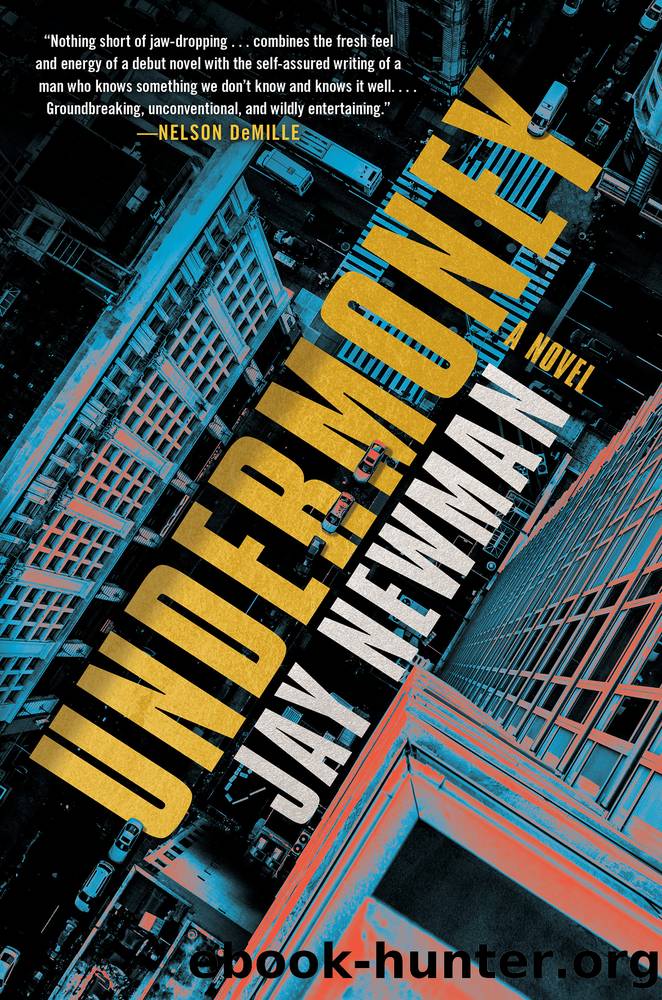
Author:Newman, Jay [Newman, Jay]
Language: eng
Format: epub
Publisher: Scribner
Published: 2022-01-25T05:00:00+00:00
29 Limassol, Cyprus
After the ballet, Volk whisked them back to the Better Place. Vicker and Gonzaga watched as the Butler ladled his own variation of bouillabaisse into warm bowls. Ivanov poured ice-cold vodka.
âMr. Vicker, I am interested to know your reaction to what we discussed at lunch. How can we work together?â Volk asked.
âLorenzo and I have been talking about nothing else. You got me thinking about how Perrow includes âtightly coupledâ systems in his definition of ânormal accidents.â So I spent the afternoon reading up on some related ideas. One is ânetwork effectâ and the other is âdisaster creep.â The ânormal accidentâ idea is neat, but we may as well work on accidents that ripple, causing potentially catastrophic effects. Letâs call them normal, networked catastrophes.â
Volk nodded: his pupil was catching on. Network effect and disaster creep were the logical extrapolations of Perrowâs insights. In the decades since 1984, when he first published his research, every man-made system on earth had become infinitely more complex and ever more tightly coupled to other systems. Back then, for instance, local electric utilities were still controlled by human beings who looked at dials and gauges, turned knobs and flipped breakers and switches. Thirty-five years later, human operators were pretty much along for the ride. In the name of efficiency, utilities relied more and more on âsmartââtightly coupledâcomputer programs that talked to one another and taught themselves by employing artificial intelligence algorithms. But that was just the system effect. The network effect arose from the fact that each utilityâs âsmartâ software talkedâor tried to talkâdirectly to the software of other utilities, educating and learning from one another. American utilities might be legally separate, but, as a practical matter, they operate as one huge network. Every country had organized the same way, and, in Europe, transnationally. Those interconnections mean that, when accidents happen and disasters occur, they tend to be bigger. In academic lingo: disaster creep.
âFor the sake of conversation, in the U.S., most electric and gas utilities are public companies,â said Vicker, fairly vibrating with excitement, his left eye twitching involuntarily, cracking his knuckles unconsciously. âPeople can buy and sell their stocks and bonds. What if itâs a hot summer and a transformer explodes? Maybe it is no big deal. Happens all the time. What if three explode? Or five? What if major transmission lines are damaged? What if, at the same time, one of the power lines overheats and fuses and an LNG tanker on âshoreâ power loses the juice it needs to keep the gas cool? What if it explodes and takes out a nearby generating station? What if all that prevents the utility from supplying power to major industrial companiesâso that factories have to shut down?â
Vicker, on a roll, stopped for a breath. In thirty seconds, he had drawn a roadmap for the guys who could make all those things happen. A series of improbable, fat-tail events occurring in quick successionâall ânormal accidentsââequipment failures, human errors, one thing building on the next, rippling through the electrical grid and the economy.
Download
This site does not store any files on its server. We only index and link to content provided by other sites. Please contact the content providers to delete copyright contents if any and email us, we'll remove relevant links or contents immediately.
| Assassinations | Conspiracies |
| Espionage | Political |
| Terrorism |
The Wolf Sea (The Oathsworn Series, Book 2) by Low Robert(35242)
Crowbone (The Oathsworn Series, Book 5) by Low Robert(33609)
The Daughters of Foxcote Manor by Eve Chase(23616)
The Silent Patient by Alex Michaelides(19736)
The Secret History by Donna Tartt(19066)
Shot Through The Heart (Supernature Book 1) by Edwin James(18918)
All the Missing Girls by Megan Miranda(15972)
Ready Player One by Cline Ernest(14652)
The Betrayed by Graham Heather(12824)
The Betrayed by David Hosp(12779)
Red by Erica Spindler(12566)
Bull's Eye Sniper Chronicles Collection (The Second Cycle of the Betrayed Series) by McCray Carolyn(12373)
Kathy Andrews Collection by Kathy Andrews(11819)
Warriors (9781101621189) by Young Tom(10844)
Invisible Girl by Lisa Jewell(10508)
The Last by Hanna Jameson(10252)
Year One by Nora Roberts(9788)
Mindhunter: Inside the FBI's Elite Serial Crime Unit by John E. Douglas & Mark Olshaker(9329)
Tell Tale: Stories by Jeffrey Archer(9032)
