Defining Citizenship in Archaic Greece by Duplouy Alain; Brock Roger W.; & Roger W. Brock
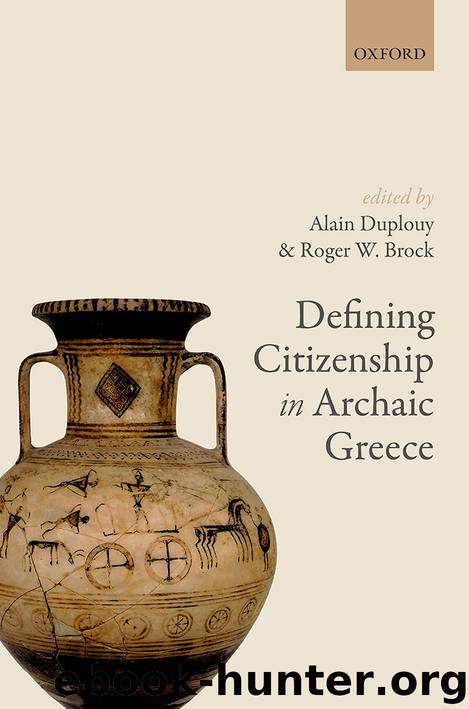
Author:Duplouy, Alain; Brock, Roger W.; & Roger W. Brock
Language: eng
Format: epub
Publisher: Oxford University Press
Published: 2018-02-26T00:00:00+00:00
2. Ancient Citizenship
They managed these things very differently in the ancient Graeco-Roman world—or rather, since in this case ‘Greece’ and ‘Rome’ are very different from each other, in the Greek and Roman worlds. This point was succinctly and elegantly made by the distinguished French ancient historian Philippe Gauthier, who entitled an article comparing and contrasting ancient Greek and Roman attitudes to and practices of citizenship ‘Roman “generosity” and Greek “avarice”’.13 As an ideal type, or at least as a stereotype, that binary opposition will work very well. But it’s not just the fact of the difference, but the reasons behind that fact of difference, that are of historical interest and concern. Most of our English political descriptive vocabulary comes from Greek, not Latin, but ‘citizen’ comes to us from Latin (civitas, civis), not Greek, and civitas is cognate with civilitas, civilization: both literally, that is etymologically, and metaphorically, that is symbolically, to be a citizen in ancient Rome was to be civilized. By implication, Roman citizenship was deemed to be one of the hallmarks, or high watermarks, of Roman culture. It was not just an institution, nor even merely a practice, but a culture, and a culture above all.14 So too was ancient Greek citizenship, for which the word was politeia, derived from the original state-form that they called polis. The traditional English translation of polis is ‘city-state’, and for many purposes that will still do. But the realization has dawned, properly and correctly, that a much more apt translation would be ‘citizen-state’, since that captures both the central, defining importance of citizenship in the ancient Greek world and emphasizes the ancient Greeks’ concrete rather than abstract understanding of the political community as a living corporate entity.15
To show just how closely citizenship as an institution was related to citizenship as a practice in Greece, we might observe, first, that the very same word, politeia, was used for ‘citizenship’ as for what we, again borrowing from Latin rather than Greek, call a ‘constitution’. Moreover, in illustration of how deeply and how intimately citizenship as both institution and practice was connected with citizenship as culture in ancient Greece, I observe that a polis’s politeia (in the sense of constitution) might be called, enthusiastically but unforcedly, its ‘soul’ (Isocrates), or (more measuredly, by Aristotle) its ‘sort of life’.16 So much for citizenship in Greece in general; now for Sparta.
Download
This site does not store any files on its server. We only index and link to content provided by other sites. Please contact the content providers to delete copyright contents if any and email us, we'll remove relevant links or contents immediately.
| Africa | Americas |
| Arctic & Antarctica | Asia |
| Australia & Oceania | Europe |
| Middle East | Russia |
| United States | World |
| Ancient Civilizations | Military |
| Historical Study & Educational Resources |
The Daily Stoic by Holiday Ryan & Hanselman Stephen(3301)
The Fate of Rome: Climate, Disease, and the End of an Empire (The Princeton History of the Ancient World) by Kyle Harper(3055)
People of the Earth: An Introduction to World Prehistory by Dr. Brian Fagan & Nadia Durrani(2729)
Ancient Worlds by Michael Scott(2682)
Babylon's Ark by Lawrence Anthony(2673)
The Daily Stoic by Ryan Holiday & Stephen Hanselman(2569)
Foreign Devils on the Silk Road: The Search for the Lost Treasures of Central Asia by Peter Hopkirk(2456)
India's Ancient Past by R.S. Sharma(2450)
MOSES THE EGYPTIAN by Jan Assmann(2412)
The Complete Dead Sea Scrolls in English (7th Edition) (Penguin Classics) by Geza Vermes(2277)
The Earth Chronicles Handbook by Zecharia Sitchin(2226)
Lost Technologies of Ancient Egypt by Christopher Dunn(2223)
24 Hours in Ancient Rome by Philip Matyszak(2078)
Alexander the Great by Philip Freeman(2064)
Aztec by Gary Jennings(2022)
The Nine Waves of Creation by Carl Johan Calleman(1915)
Curse Tablets and Binding Spells from the Ancient World by Gager John G.;(1860)
Before Atlantis by Frank Joseph(1849)
Earthmare: The Lost Book of Wars by Cergat(1823)
