Why Gallipoli Matters: Interpreting Different Lessons From History by Lieutenant Colonel John M. Sullivan Jr USMC
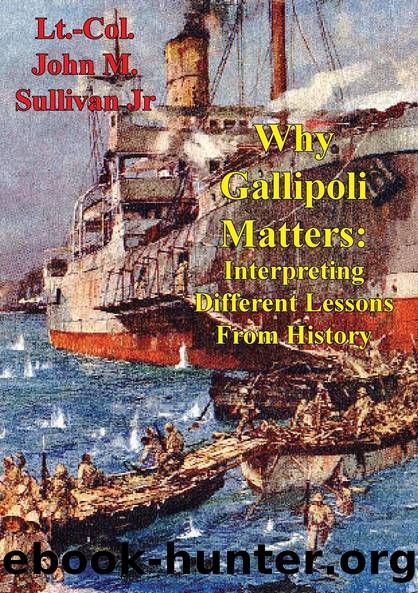
Author:Lieutenant Colonel John M. Sullivan Jr USMC [USMC, Lieutenant Colonel John M. Sullivan Jr]
Language: eng
Format: epub
Tags: History, Military, World War I, Europe, Great Britain, General, Germany, France
ISBN: 9781782897033
Google: NB1vCwAAQBAJ
Publisher: Pickle Partners Publishing
Published: 2014-08-15T05:04:18+00:00
Operational Experiences
The American approach was taken from the operational combat experiences of the British at Gallipoli and honed by U.S. exercises as American forces tested their theories. Where the British saw the weaknesses of amphibious operations, the Americans, untainted by emotions, saw opportunities and promise. For the Americans, different principles of war mattered more; where the British placed more emphasis on security, surprise, and simplicity, the Americans focused more on the principles of mass, offensive, and unity of command. The operational factors of time, space, and force weighed heavily in the selection of these particular principles of war.
The operational area the Americans expected to fight in, the Pacific, brought with it challenges quite different from those that Britain faced on the European continent. The small islands, possibly reinforced for defense, provided only limited beaches capable of supporting an amphibious operation or maneuver. As a result, the Americans understood the extreme likelihood that landings would be opposed. The requirement to move over great distances with the entire force meant the operations would be large-scale affairs. Overwhelming superiority on the sea and in the air were required to isolate the objective, while a significant force would be necessary to both seize a lodgment area and secure the entire island. The importance of proper combat loading of men and equipment was reinforced by the British experience at Gallipoli and became an essential ingredient to success.{23}
Offensive. The Americans noted the British success in gaining a foothold on the beaches, in both the April and August landings on the Gallipoli peninsula. However, they thought the British tended to focus too much on the ship to shore phase at the expense of expanding the lodgment area. The Americans trained to quickly organize on the beach and move rapidly inland to secure the island. The lack of offensive spirit at Sulva in August 1915, when the British landed with overwhelming superiority and then halted after securing a lodgment, was a clear demonstration. Offensive action there might have proven decisive. The quicker the objective was secured the sooner the vulnerable fleet offshore could disperse; German submarine attacks off Gallipoli a month after the initial landings highlighted this point.{24}
Mass. Mass of forces and effects were essential in seizing a lodgment and securing an island. Sea and air control were necessary too, as Ellis had seen the need to isolate the objective area and prevent the enemy from interfering in the landing or introducing strategic reserves. At Gallipoli, the British landed a smaller covering force to secure a toehold before landing the main force after the element of surprise was lost. The Americans instead saw the need for a powerful force in the first echelon since they fully expected an opposed landing.{25}
The Marines too stressed the requirement for the massed effects of fires, primarily naval gunfire. They preferred to listen to German General Liman von Sanders who, while at Gallipoli with the Turks, credited the effectiveness of British fires with keeping the defenders from approaching the beach and denying them respite too.
Download
This site does not store any files on its server. We only index and link to content provided by other sites. Please contact the content providers to delete copyright contents if any and email us, we'll remove relevant links or contents immediately.
The Vikings: Conquering England, France, and Ireland by Wernick Robert(84450)
Ali Pasha, Lion of Ioannina by Eugenia Russell & Eugenia Russell(40340)
The Conquerors (The Winning of America Series Book 3) by Eckert Allan W(38184)
The Vikings: Discoverers of a New World by Wernick Robert(37028)
Cecilia; Or, Memoirs of an Heiress — Volume 1 by Fanny Burney(32666)
Cecilia; Or, Memoirs of an Heiress — Volume 2 by Fanny Burney(32030)
Cecilia; Or, Memoirs of an Heiress — Volume 3 by Fanny Burney(32013)
Empire of the Sikhs by Patwant Singh(23160)
The Secret History by Donna Tartt(19376)
Hans Sturm: A Soldier's Odyssey on the Eastern Front by Gordon Williamson(18681)
Cat's cradle by Kurt Vonnegut(15480)
Pimp by Iceberg Slim(14722)
Sapiens: A Brief History of Humankind by Yuval Noah Harari(14493)
Norse Mythology by Gaiman Neil(13492)
Talking to Strangers by Malcolm Gladwell(13481)
Leonardo da Vinci by Walter Isaacson(13435)
4 3 2 1: A Novel by Paul Auster(12554)
Underground: A Human History of the Worlds Beneath Our Feet by Will Hunt(12180)
The Radium Girls by Kate Moore(12125)
